
Having sequestered myself in the spare room (AKA my office) on two of the hottest days of the year, along with a fan and a supply of cherry Tango, I’ve reviewed the 2025 statutory guidance and compared them with the newly published version of the guidance.
Whilst at first glance there seems to be few concrete changes as in effect the legal duties are unchanged; the philosophy underpinning careers provision has shifted significantly. This of course will have an impact on when and how we deliver CEIAG (Careers education, information, advice and guidance) and once again force SLT to reevaluate the role of the Careers Leader. Hopefully, meaning a shift towards viewing the CL role as more far reaching and complex than it has previously been seen.
Executive Summary
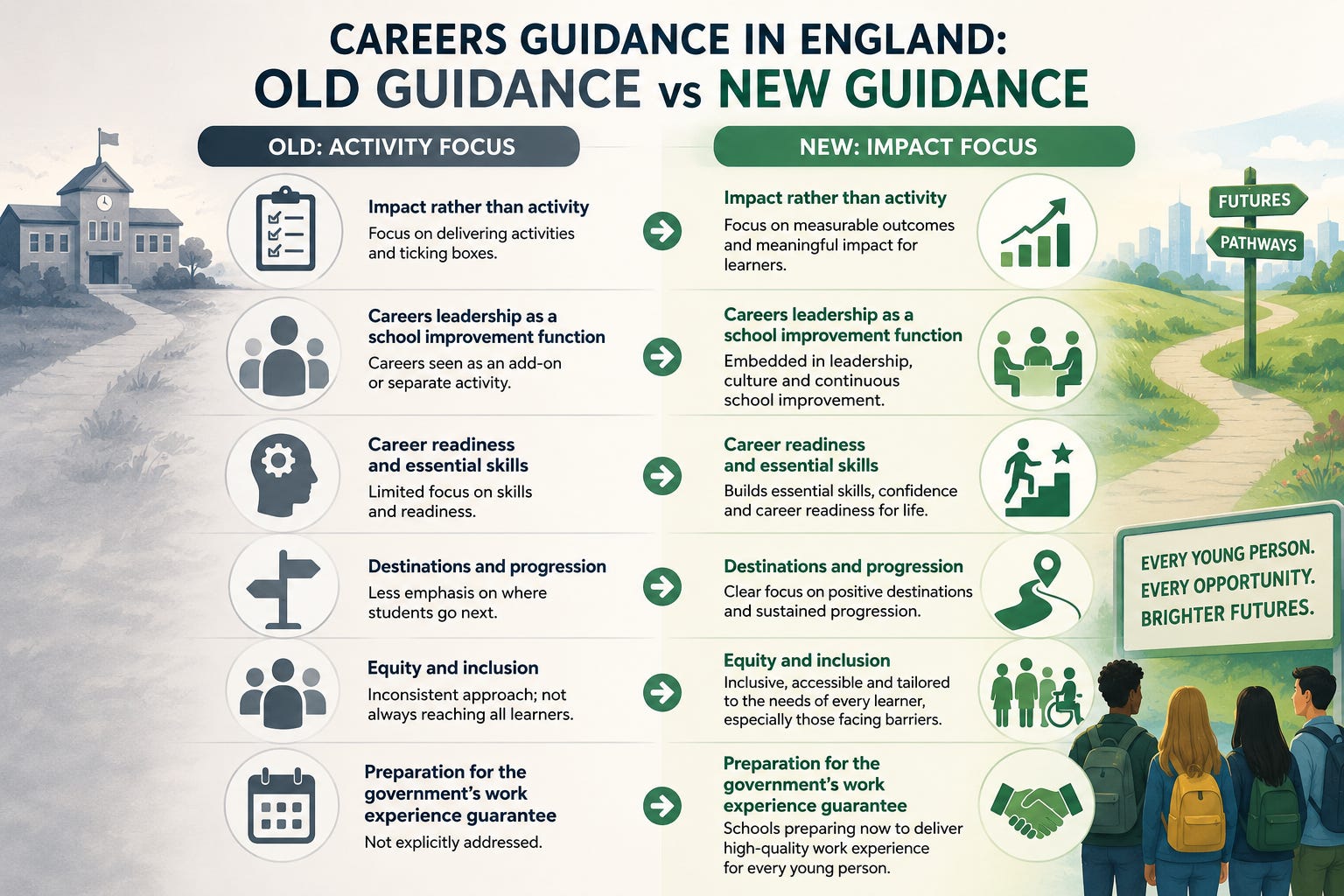
The previous version was primarily focused on:
Compliance
Gatsby Benchmark achievement
Provider Access Legislation
Careers activities and encounters
The new version places much greater emphasis on:
Impact rather than activity
Careers leadership as a school improvement function
Career readiness and essential skills
Destinations and progression
Equity and inclusion
Strategic governance
Preparation for the government’s work experience guarantee
Hooray! At long last, what I’ve been saying for years has been put into place. Careers education is being repositioned from a standalone programme to a mechanism for improving wider educational outcomes.
Major Changes
Careers Leaders are now Strategic Leaders
Under the 2025 Guidance the Careers Leader was expected to coordinate and manage the careers programme. Albeit the previous guidance said that :-
The careers leader should have the skills, commitment and support from their senior leadership team. They should be given protected time and sufficient budget to carry out the role effectively.
This was often ignored and I can’t tell you how many conversations I’ve had over the years about how much time away from teaching should be given to a teacher/CL.
You’re now a strategic leader
The new guidance sets out that the CL is responsible for input and outcomes that include:
institutional improvement
progression outcomes
inclusion
attendance
employer engagement
career readiness
How will this change affect me as a CL?
Firstly, it gives you the opportunity to build greater influence with SLT.
Secondly it presents a stronger case for dedicated time and resources.
However there is a possibility that CLs may be expected to influence whole-school priorities without additional capacity. This may well be the topic of an upcoming blog.
There are Stronger Governance Expectations
Under the 2025 version governors were expected to provide strategic oversight and appoint a link governor.
New Guidance
There is significantly more emphasis on the buck stopping with Governors and their role in:-
accountability
oversight of impact
challenge and scrutiny
strategic planning
What Should the Governors be Asking?
Careers Leaders should expect governors to ask:
What difference is the programme making?
What does destination data tell us?
Which groups are underperforming?
How are we evaluating impact?
This is a notable shift away from reporting activity counts. This places the onus on you as CL to ensure that your Governors and SLT understand this.
Outcomes Have Replaced Activities as the Primary Focus
The 2025 guidance introduced learning outcomes and programme evaluation, though many of us had one or both of those activities in place previously. Especially if your school held the Quality in Careers Award, about which the DfE says :-
We strongly recommend that all schools and colleges work towards the national Quality in Careers Standard to support the development of their careers programme. This external assessment allows independent judgement of the quality of careers provision, including its impact upon learners’ career-related learning. Schools and colleges can gain formal accreditation of their careers programme through the Quality in Careers Standard – the national quality award for all aspects of careers education and guidance.
I strongly recommend that if you’ve not already started to work towards an Award, you seriously consider doing so now as it will support you meeting the new guidance.
So What Do We Focus On Now?
The language around progression; career readiness; sustained destinations and learner development is considerably stronger. Thus we need to consider how we will measure and demonstrate the main benefits of CEIAG :-
improved decision-making
increased confidence
broader aspirations
successful transitions
I’ve seen enough social media posts about how to meet the expectations of the previous guidance’s requirement for encounters to know this is still an ongoing worry. However, we’re now going to have to consider not just how many encounters our young people have but also how we demonstrate their effect on our students.
It’s No Longer Just About Gatsby Benchmark Data
Whilst Gatsby is still central to the statutory guidance there are strengthened expectations around destination tracking; aspiration data; alumni engagement and learner records.
The updated guidance builds further on this, Thus meaning many schools will need better systems for recording destination analysis; alumni networks and learner career portfolios. I’ve no idea of what the CEC might be doing with Compass+ so I’d keep an eye out for changes in the coming weeks or months.
You may recall my post on record keeping from a short while ago
You’d do well to keep at the back of your mind that:-
The days of careers programmes being judged solely by benchmark scores are gradually disappearing.
Careers and Inclusion Are More Closely Connected
Previously there was already substantial content on: SEND; looked-after children; vulnerable learners and NEET prevention.
The DfE are gradually coming around to my way of thinking! The narrative increasingly positions careers as a tool for:
social mobility
reducing disadvantage
supporting attendance
improving engagement
This creates opportunities for careers leaders to work more closely with: SENDCOs; Attendance Leads; Designated Teachers and Inclusion Leads. This also adds to the message that the CL is a vital and respected member of the schools’ middle or senior leadership.
Work Experience Has Moved Up the Agenda
We all knew this was coming due to the Skills White Paper and various other announcements. So it’s no surprise that the updated version places much greater emphasis on preparing for delivery.
The Most Challenging Aspect
As I’ve been saying for a long time, (see my previous post on WEX) CLs need to be ahead of the curve on this and hopefully, if you’re a long term reader of my blogs you’ve had a chance to plan for:-
increased employer capacity
more workplace visits
virtual experiences
project-based employer activity, especially within subjects. See my previous post on this topic here
extended encounters
Parent Engagement Is No Longer Optional Good Practice
The 2025 guidance strengthened expectations around parental engagement.
The updated guidance goes further by embedding parent engagement throughout careers provision.
Implications
Schools may need to provide:
regular labour market updates
progression briefings
apprenticeship information
parent workshops
rather than relying on a single annual event.
The Most Significant Change
The biggest change is not a new legal duty.
It is the move from asking:
“Have we delivered careers activities?”
to asking:
“Can we demonstrate that our careers programme improves learner outcomes, progression and life chances?”
For Careers Leaders, this is potentially positive. It elevates careers education from a compliance exercise to a recognised contributor to school improvement. The challenge will be developing the evidence, systems and leadership capacity needed to demonstrate that impact.
Paid subscribers have access to further content suggesting immediate actions to be taken to keep ahead of the changes in a time efficient manner. They will also be receiving resources such as a Governor briefing paper as well as acces to previous resources which also link to the updated guidance.
The careers education substack is a reader-supported publication. To get access to the downloadable time saving resources, please consider becoming a paid subscriber either by using the button below and paying £10 pcm or £80 pa Alternatively by emailing to subscribe directly via invoice at £60 pa

The CEC have also published a synopsis of the new statutory guidance you will find it here
Comments
Nothing yet. Say the first thing.
Sign in to join the conversation.