
It is a truth universally acknowledged, (No not that a single man in possession of a good fortune, must be in want of a wife) but that one of the biggest challenges for Careers Leaders is moving Gatsby Benchmark 4 beyond a small number of enthusiastic staff and embedding it consistently across all curriculum areas.
It is, indeed a huge job. But to trot out one of my favourite analogies… When asked, how would you eat an elephant, the answer is…

As set out in my previous posts, teachers understand that linking learning to the working world matters. The difficulty is usually not willingness. It is confidence, time, competing priorities and uncertainty about what meaningful careers learning actually looks like within their subject.
This is where a simple diamond 9 activity can become a powerful tool. Used well, it can help Careers Leaders open productive conversations with departments, identify genuine barriers and create practical next steps that staff actually buy into.
The Careers & Enterprise Company defines Gatsby Benchmark 4 as linking curriculum learning to careers. In practice, this means helping students understand how subject knowledge connects to future pathways, employment sectors and real-world applications.
The challenge is that many teachers are already balancing:
Heavy curriculum demands
Assessment pressures
Behaviour and attendance concerns
Limited curriculum time
Rapid changes in industry and labour market information
As a result, careers learning can sometimes feel like “something extra” rather than part of excellent teaching.
A diamond 9 activity allows Careers Leaders to uncover these issues without staff feeling judged, pressured or criticised.
The strength of a Diamond 9 activity is that it encourages discussion rather than compliance.
Instead of telling departments what they should be doing, it asks them to prioritise the barriers they genuinely experience.
This changes the tone of the conversation completely.
Teachers are far more likely to engage when they feel:
listened to
involved in decision-making
trusted as subject specialists
able to discuss challenges honestly
It also helps Careers Leaders avoid making assumptions about why Benchmark 4 is inconsistent across subjects.
For example:
A maths department may feel uncertain about meaningful employer engagement.
A humanities department may struggle with curriculum time.
A science department may already make strong careers links but lack resources to make them visible.
The Diamond 9 helps uncover the real picture. Simply put a diamond 9 is a collaborative thinking and ranking technique where participants arrange nine items such as ideas, images, or statements in a diamond shape based on importance, priority, or agreement. It promotes critical thinking and structured debate, typically placing the most important item at the top, followed by two, three, two, and finally the least important at the bottom.
Well first of all read the rest of the blog to find out what you need to do!!!. Once you’ve done that and downloaded or prepared the resources you need to run the session, start by asking a department for some time in their departmental meeting. Even if it’s only 15-30 minutes, you can make huge inroads into moving GB4 forward. Below you’ll find support to help you to plan the sessions.
Paid subscribers will have access to resources to use when working with departments, including pre filled diamond 9 activity and a fully customisable PowerPoint which you can use during the meeting.

Start with one single department. Take time to speak to the department head and ask for just 15-30 minutes in their departmental meeting. The main thing to remember is to avoid framing the session as a “careers compliance check”. Instead, position it as:
curriculum development
improving student motivation
supporting destination outcomes
helping students understand relevance and progression
Staff are more receptive when Benchmark 4 is linked to teaching and learning rather than accountability alone.
The session can be run without the resources which paid subscribers can download, but obviously will take more time to set up.
Introduce the why, using the points above or slide 2 in the PowerPoint. Explain the activity is to identify the issues that the department faces linking the curriculum to the working world.
Provide them with 9 sentences (Slide 3) explaining the barriers that prevent them from linking their subject to careers. (Alternatively, give them 8 sentences and allow them to include one of their own barriers) You may have your own ideas of what barriers exist, common issues often include: lack of confidence discussing careers; uncertainty about labour market information; limited awareness of pathways linked to subjects; pressure from examinations or concerns about tokenistic careers links.
Ask them to rank the concerns in a diamond pattern (Slide 4) with the most challenging at the top, the next 2 on the 2nd row, 3 on the middle row and 2 and 1 in the rows below, see below. You can download a blank template from my Dropbox here Yes even free subscribers can have access to that.
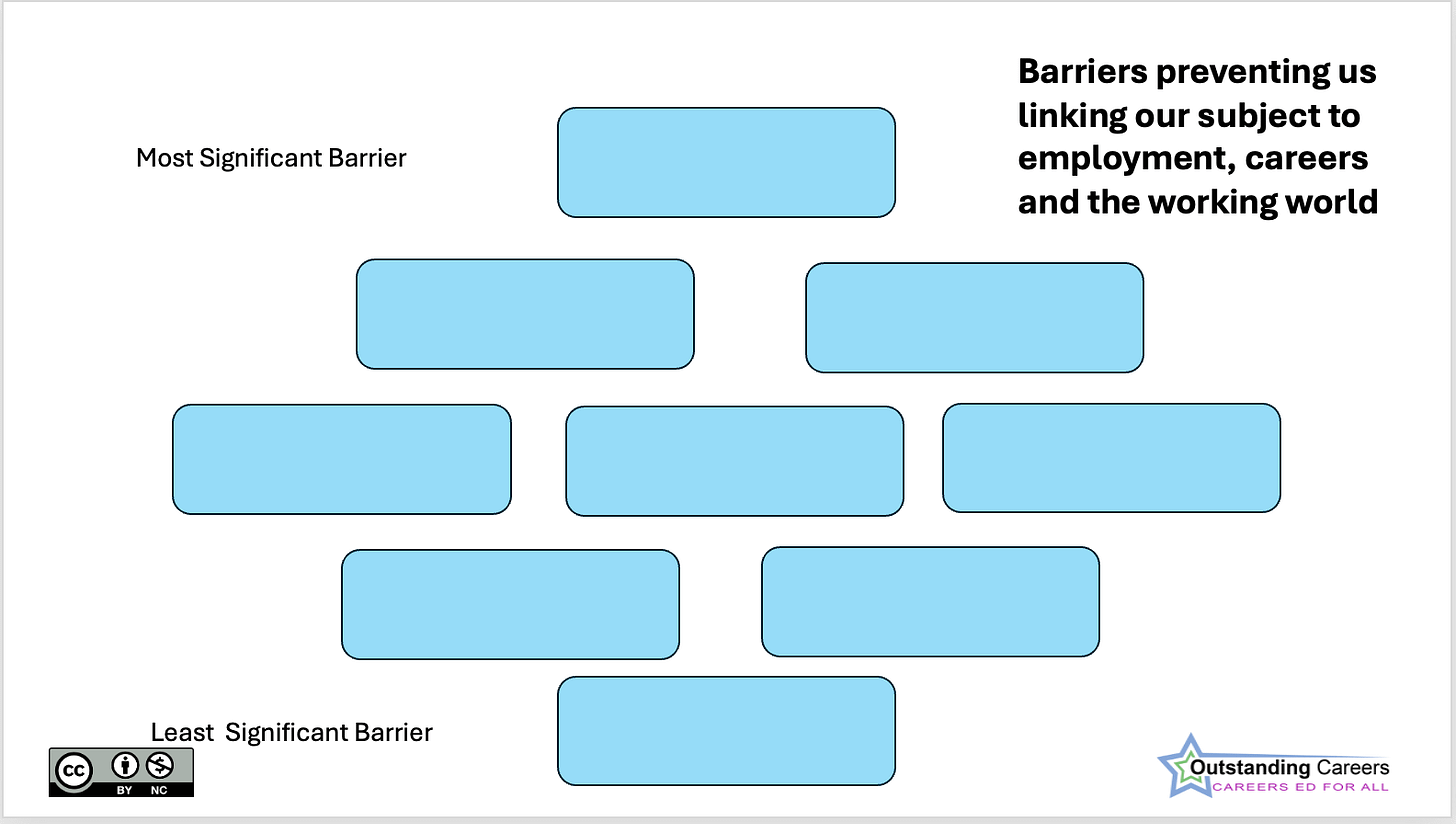
Allow time to discuss the options. (Slide 5) The richest conversations happen when staff can debate the barriers openly. Let them voice their own worries, try not to assume too much but give them a few suggestions to start them off.
Follow up with a synopsis of what you witnessed in the session. Ask them if that’s a fair summary. Explain that you’re going to take the information away and debrief with the subject head and plan support to help make it easier for them. (Slide6)
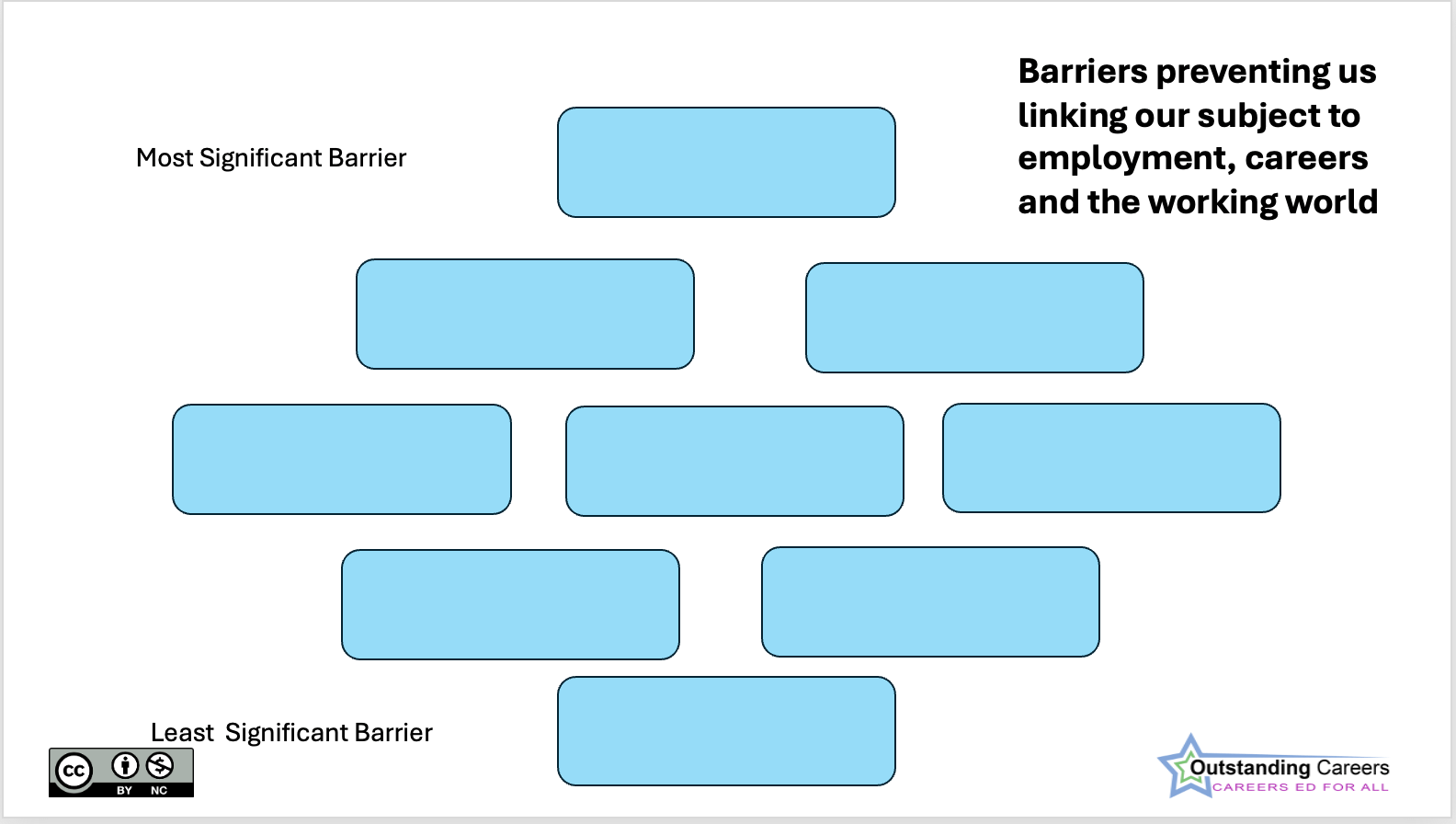
These discussions are extremely valuable because they reveal where support is actually needed.
Perhaps the greatest strength of this activity is that it helps Careers Leaders build stronger relationships with curriculum staff.
Too often, careers education can become something done to departments rather than with them.
The Diamond 9 encourages collaboration instead.
It shows departments that:
their expertise matters
their challenges are understood
support can be tailored
careers learning is a shared responsibility
That cultural shift is often the key to improving Benchmark 4 sustainably across a school.
Again, don’t leave it as something that has been done to the department. Get together, subject leader to subject leader and discuss how it went and what should happen next. I’ll be following up on how to do this in the coming weeks but in the meantime, book in some time for a 10-15 minute chat to agree a way forward.
Once several departments have completed the activity, Careers Leaders can identify recurring themes. I’ll be working on a follow up article on what to do with the findings in the next week or two.
Benchmark 4 is often strongest when it grows through collaboration rather than accountability.
A simple Diamond 9 activity creates space for honest discussion, helps Careers Leaders understand departmental needs and encourages staff ownership of careers learning.
Most importantly, it shifts the conversation away from “doing careers” and towards helping students understand why their learning matters beyond the classroom.
That is where meaningful Benchmark 4 practice really begins.

Comments
Nothing yet. Say the first thing.
Sign in to join the conversation.