
You clear a final round for a role you’ve been chasing for months. The offer comes through on Monday, and there’s a line near the bottom you weren’t expecting.
“We recently moved to five days a week in the office.”
Your partner works two hours away. Your commute would be ninety minutes each way. You haven’t been in an office five days a week in three years.
So when you read that line, you read it the way almost everyone does, as a rule you’d either have to accept or walk away from.
I don’t think it’s that simple. That one sentence can mean three very different things, and if you read it as the wrong one, it can cost you the job, or a chunk of money you never had to leave on the table.
Careerflow runs mostly remote. Most of our team is distributed, and the roles we’re hiring for right now go out in seven languages across three continents.
So the office question isn’t one I sit with much from where I’m standing, which is probably why I’ve been watching how it plays out on the other side of the table so closely.
The numbers moved a lot this year.
In its Q2 2025 report, JLL found that 54% of Fortune 100 employees are now under a five-day office requirement.

A year earlier that figure was 11%, and two years before that it was 5%.
Amazon, JPMorgan, Goldman Sachs, Dell, Home Depot, Instagram, Boeing, UPS, the federal workforce, with more names added every quarter.
That’s the headline everyone reacts to, but the number sitting underneath it is the one actually worth thinking about.
CBRE checked how many companies enforce the policies they announce.
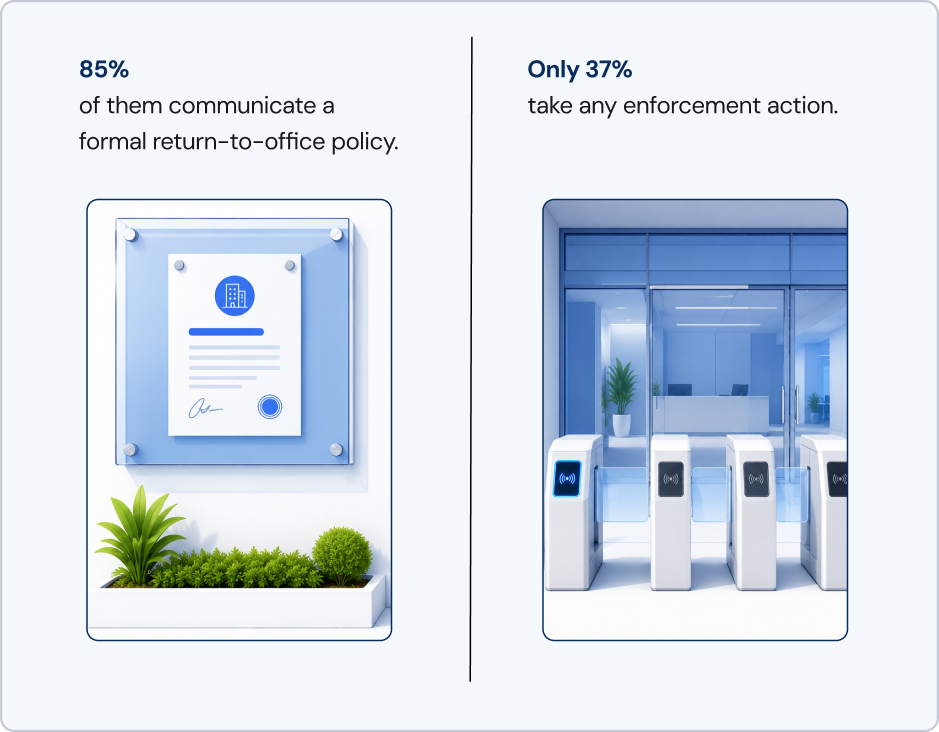
So for well over half the companies that put a five-day rule in writing, nobody is really acting on it.
Which is where Nick Bloom comes in.
Bloom is the Stanford economist who’s probably done more research on where we work than anyone, and in February he told CNBC something that reframes the whole thing:
“One way to lose about 5% to 10% of staff is to make them all come in five days a week. For every person that quits because of the RTO, that is one less person that needs a redundancy package.”
Read plainly, that means the five-day rule is quietly doing the work of a layoff at a real number of companies.
Nobody has to be told they’re being let go.
The rule just makes staying uncomfortable enough that some people leave on their own.
So the sentence at the bottom of your offer could be one of three things, and the offer letter itself won’t tell you which.
The first version is the one you’re afraid of, where the rule is exactly what it says. At Amazon, coffee badging is over.
Amazon employees have posted on Blind that managers now have a dashboard logging not just whether you showed up but how long you stayed, on a rolling eight-week view, and it flags anyone averaging under four hours a day in the building.
Promotions, from those same posts, are effectively off the table if you don’t comply. If your offer is this version, five days is the deal you’re signing.
The second version looks identical on paper and works nothing like it.
The CEO wanted the headline, so the policy exists. But team leads quietly told their people the fifth day is flexible for anyone who needs it, and half the team has been ignoring it for months without a word from anyone.
A lot of large companies are living here right now, especially outside finance.
The third version is the hardest to spot, because the rule is the point. Leadership looked at the attrition they wanted, picked a policy that would produce it, and hit send.
You can usually tell this one by who leaves. When Walmart pushed its people to relocate to Bentonville, Cheryl Ainoa, the CTO of Sam’s Club, walked away rather than move.
When senior leaders start leaving over the mandate itself, you’re probably looking at version three.
The trouble is that all three read the same in an offer letter. You can’t tell them apart from the outside.

Find one current employee, ideally on the team you would be joining. The alumni filter on LinkedIn is the fastest way in.

Before you send the first message, look at your own profile.
The current employee is going to click through and skim it in about 15 seconds before deciding whether to reply. If your headline still reads “Senior Product Manager at [Last Company]” and your About section is three years old, you look like every other cold DM they got this week.
Careerflow's LinkedIn Optimizer rewrites your headline and About against the shape of ask you're making, so what they see when they click through gives them a reason to say yes to the fifteen minutes.
Save that person into Careerflow’s Networking Tracker the second you find them. Tag them by company. Add the notes from the call.
Set a follow-up for six weeks after you start, or after you turn the offer down.
Someone who took 15 minutes to help you read an offer is exactly who you want warm the next time you are on the market.
Once you have them on the call, ask three questions.
“How strict is the RTO policy, really?” This is the exact question people ask their friends on Blind before they sign an Amazon offer. “Coffee badging works fine, nobody has said anything” is version two. “Badge in, sit at your desk, 6-hour minimum, tracked bi-weekly” is version one. “They’re using it to thin the team” is version three.
“Are they tracking badges? Is it actually enforced?” The single sharpest signal. Amazon publishes an 8-week individual dashboard for every employee. Snap tracks badge-in-and-out and reports to your manager every two weeks. If your current employee cannot answer this question, that is your answer.
“What was the mood on your team when the policy came in?” People will not volunteer “my company is running a stealth layoff.” They will tell you “a couple of people got pretty upset and two of them left within a month.” Read the version off the answer.
15 minutes with one current employee, and you will know more about the offer than every recruiter you talk to about it.
Even at version-one companies, the rule bends more for some people than others. I have watched this play out at Careerflow's own hiring loop more than once.

Mark Ma at the University of Pittsburgh ran the numbers on 54 S&P 500 companies with RTO mandates, using 3 million LinkedIn profiles. His finding:
“The probability of more skilled employees departing after RTO mandates is 77% higher than that of less skilled workers, and the probability of senior employees departing after RTO mandates is 36% higher than that of junior workers.”
Bloom said the quiet part out loud in a Hoover Institution podcast:
“You may actually be able to get some selectivity in retention even with an RTO policy.”
Meaning the same firm publicly saying “everyone, five days” is quietly agreeing to four days for the senior hire they need.
If you have real leverage, seniority, in-demand skills, a competing offer, you are almost certainly negotiating against a fake floor.
We covered the mechanics of this in negotiate 18% extra? Two things apply directly.
Salary is only 70% of the offer. Location and flex are the other 30. Almost nobody negotiates the location line, which means when you do, you are one of the very few candidates asking for something everyone wants but nobody requests.
Do not negotiate on the spot. Buy 24 to 48 hours. Talk to your current employee source. Then come back with the ask.
The ask itself is simpler than people think. “I am really excited about the role. Would there be flexibility on the office days, either three days from the start, or four days with one flex day a month for personal appointments? Happy to review after ninety days.”
If you have a live offer or a late-stage loop right now, do this before you invest another hour.
Step 1: Find one current employee. Ideally on the team you would be joining. LinkedIn alumni filter, a mutual connection, or a warm intro through someone in your network. 20 minutes of searching, one message out. Save the contact to Networking Tracker before you get on the call, not after.
Step 2: Ask the three questions above. How strict is the RTO really? Are they tracking badges? What was the mood on your team when the policy came in?
Their answers tell you version one, two, or three. Log what you hear against the role card in Careerflow’s Job Tracker the same day, while it’s fresh. If you have three loops running right now, the difference between one company being version one and another being version two is the entire difference between the two roles a month from now.
Step 3: Act on what you learned. Version two, take the offer and enjoy the flex quietly. Version one, run the negotiation with data. Version three, walk. A better company is hiring you next month, and it will not have told you in the offer letter what they think of you.
“Time is the coin of your life,” Carl Sandburg wrote in 1939. “It is the only coin you have, and only you can determine how it will be spent.”
The fifth day in the office is not free. It is time your friends will not get back, hours with your family you cannot rebook, a commute the company is not paying you for. Bloom’s own research shows hybrid schedules cut attrition by 33% with no drop in performance reviews or promotion rates. The senior people at the company already know this, which is why they took a version of the deal you were not offered.
Do not sign an offer without knowing which version of the mandate is on it. Do not accept the version they wrote for the junior candidate when your leverage says you should be reading the senior version instead.
The mandate on your offer letter is not a rule. It is a negotiation you were invited into without being told you were invited.
See you next week.
Puneet
P.S. Forward this to someone sitting on an offer this week who is about to say yes or no over the RTO line. There is a middle move they have not tried yet.
No posts
Comments
Nothing yet. Say the first thing.
Sign in to join the conversation.