
Every big hiring platform started with someone doubting it. Monster was the weird new thing in 1994.
Indeed was the weird new thing in 2004. LinkedIn spent years as a niche resume site before it became the place every recruiter I know runs their entire day from.
Then Google Jobs launched in 2017 and Facebook Jobs the same year, both backed by more money and more engineers than most startups will ever touch, and neither became the next LinkedIn.

So when a headline says “the next LinkedIn,” I’ve learned to be skeptical first and curious second.
My first reaction to OpenAI’s announcement was to file it under Google Jobs and move on.
But I’ve been wrong dismissing things too quickly before, so I read it properly instead.
Here’s what it actually is, and what’s still just a plan.
Every hiring platform running today, LinkedIn included, is built on Boolean search underneath.
A recruiter types senior + python + fintech, and the system hands back everyone whose profile contains those three strings, whether or not the person behind them is actually good at any of it.
That’s why keyword-stuffing your headline has worked for a decade.
The system is scanning for words, not thinking about whether you can do the work.
OpenAI says its platform will do something different. Match on what a candidate can actually do, read from the substance of their work rather than the words on their profile.
If that holds up once it ships, the profile that wins isn’t the one with the right keywords in the right boxes.
It’s the one with something real behind it, something a model can actually parse. What the model reads, how it weighs each signal, and whether it beats what LinkedIn’s own AI search already does are all open questions until the thing is live.
But the shift in what gets rewarded, from phrasing to proof, is the whole bet OpenAI is making.
And unlike Google Jobs or Facebook Jobs, which launched with no named employers behind them, this one has real companies on record before it’s even shipped.
Big names backing it:
Walmart’s US CEO John Furner put his name on it:
"The future of retail won't be defined by technology alone. It will be defined by people who know how to use it."
Not all of this has shipped yet. The Jobs Platform itself isn’t live, original target was mid-2026, and there’s no confirmed launch or delay as of July.
The free courses are live, three of them through OpenAI Academy, open to anyone with a ChatGPT account.
The proctored certification is still locked inside employer pilots at Walmart, BCG, Accenture, and a few others, built with ETS and Pearson’s Credly.
None of this is guaranteed to land the way OpenAI says it will.
Launches slip, partnerships fade, and LinkedIn isn’t sitting still either.
Microsoft’s behind them and Hiring Assistant has been shipping since October 2024, with global rollout last September.
But there’s a set of moves cheap enough to make regardless of which future actually shows up.
Here’s the thing about waiting for the platform to launch.
You’d be waiting for something the top of the market has already moved past.
Anthropic’s careers page today tells applicants, in their own words:
“If you’ve done interesting independent research, written a thoughtful blog post, or contributed to open source, put that at the top of your resume.”
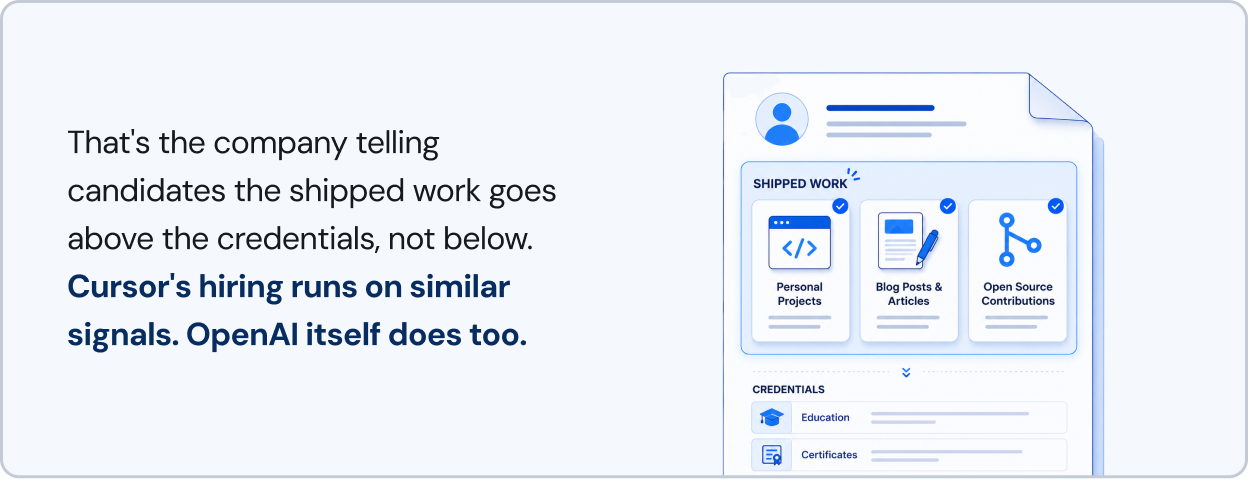
If OpenAI’s Jobs Platform ships as described, it codifies what the top of the market is already doing and pushes it down to everyone else.
If it doesn’t ship, the trend keeps moving on its own.
Either way, the signal you’d build for the platform is the same signal that’s already opening doors this week.
A shipped AI project is proof for a Boolean search, proof for a semantic model, proof for a warm intro through a founder DM, and proof in the first 30 seconds of a real interview.
That’s four scenarios covered by one artifact. Nothing else you can do in an afternoon hedges across that many outcomes.
Three things, in this order.
Step 1: Ship one AI project this week, at your actual job. Not a course, not a certificate, something you built and used. Something like: I rebuilt our weekly sales report with a Claude Skill and cut the analyst’s Monday morning from three hours to twenty five minutes.
Once it’s done, turn it into a resume bullet and post about it. If you’re not sure how to frame it, run it through Careerflow’s Resume Builder, which structures it as a what-you-did, how, what-happened bullet against a role you’re targeting.
Step 2: Fix your LinkedIn headline this week, not next month. LinkedIn stays dominant for at least the next two or three years even in OpenAI’s best case, and every recruiter you already know is there. “Aspiring AI-native Product Leader” gives neither system anything to grab onto. “Product Manager, built 4 Claude-based workflows for our ops team in Q2” is boring to read and impossible to miss.
Careerflow’s LinkedIn Optimizer rewrites your headline against your actual shipped work, not against the aspirational version of you that a recruiter Boolean will skip.
Step 3: Take one free OpenAI Academy course this weekend. Free, needs an OpenAI account, takes an afternoon. The badge won’t carry much weight yet since it’s completion-based, but the material is the same foundation the real certification will test on later, and you’d rather be ahead of that than catching up.
Fidji Simo wrote something in her launch post that’s stuck with me:
“At OpenAI, we can’t eliminate that disruption. But what we can do is help more people become fluent in AI and connect them with companies that need their skills.”
That’s the actual thesis. Not that AI replaces you outright, but that workers fluent in AI end up replacing the ones who aren’t, and this platform is being built to speed that swap along.
You don’t have to buy every word of it. What you can do cheaply is treat this as one of several possible futures and take the steps that leave you better off no matter which one shows up.
Three actions this week. That’s the whole play.
See you next week.
Puneet
P.S. Forward this to someone who's been meaning to "get better at AI." Now they have a deadline.
No posts
Comments
Nothing yet. Say the first thing.
Sign in to join the conversation.