
Lately I’ve been getting two kinds of DMs.
One says some version of “the market looks rough, I’m scared to leave, should I just sit tight?”
The other says “I’ve been here 18 months, what should I do next?”
What strikes me is that those are usually the same person, just a few months apart.
And underneath both questions is the same habit: thinking about one move at a time instead of thinking about the whole sequence.
Here’s what tends to happen. You only start thinking about your next role once the current one has worn you down enough to open the job boards.
By then you’re not really choosing, you’re reacting. You take what’s in front of you, which is rarely what you would have picked if you’d started a few months earlier.
iCIMS put a useful name to this recently. In their January workforce report, their head of talent acquisition insights, Trent Cotton, described a shift from "job hugging" to "job chaining."
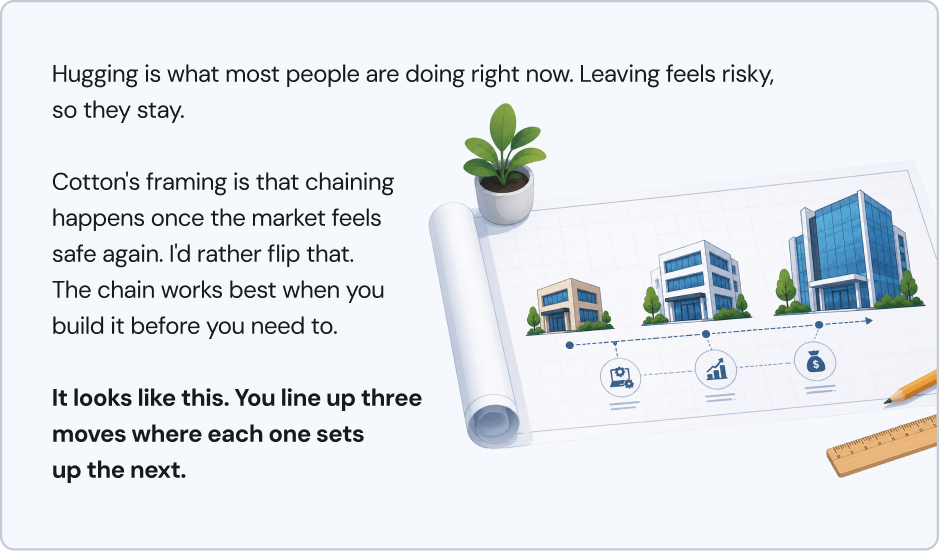
The first builds a skill that earns you the second.
The second builds the kind of role and pay that makes the third possible.
The catch is that it only works if you sketch it out before you need it, the same way it’s a bad idea to do your grocery shopping on an empty stomach. Walk in starving and you leave with a cart full of things you didn’t come for, and without the one thing you did.
None of this would be worth your time if the market punished people for moving. It’s doing close to the opposite.
Indeed’s Hiring Lab went through millions of work histories and found the median job now lasts about 18 months.
Three months into a new role, one in six people have already applied somewhere else.
The heaviest application activity shows up in software, data and analytics, marketing, and IT, which is to say, most of the people reading this.
So “job hugging” is what a lot of us say we’re doing. Without realizing it, plenty of us are already chaining.
ADP tracks the same workers over a year and reports the difference between the ones who switched jobs and the ones who stayed.

That leaves one question. Are the moves you make next planned or reactive?
Start with a blank page and write down three roles.
Role one is where you are now. Name the two or three things this job is still giving you that you couldn’t get anywhere else. The brand on your resume, a specific skill you’re picking up, a manager who’ll vouch for you for the rest of your career.
Once you’ve genuinely pulled those things out of the role, the move makes sense. If you can’t name a single thing you’re still getting, you’ve probably stayed too long already.
Role two is the next step, and the test for it is simple: what does it add that role one couldn’t? Maybe it’s a move from a large fintech into healthtech that opens the door to senior PM roles later.
Maybe it’s a senior title at a Series B that sets up a VP seat at a Series D. Maybe it’s a skill the market is paying a premium for, like the LLM application stack, that your current company will never teach you.
Role two earns its place by making role three reachable, not by paying a little more than what you have now.
Role three is where role two turns you into an obvious hire. You don’t need the exact company. You need the shape of the job, the skills it’ll demand, and the level.
Once you can picture it, role two starts to look different. The lateral move that pays a bit more but leads nowhere loses its shine, and the move that pays the same while building the exact stack role three hires for becomes the easy call.
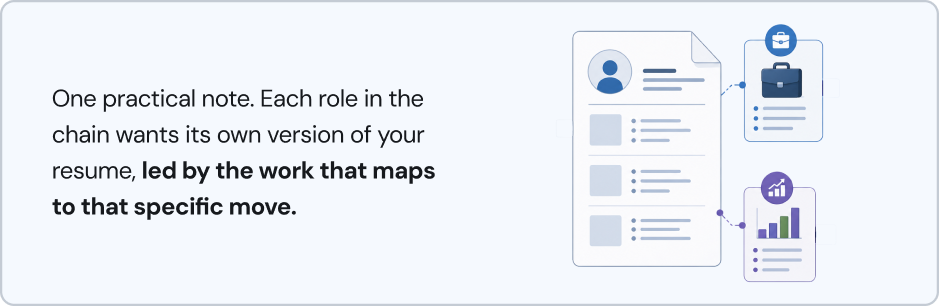
A single generic resume can't do this, because the story that lands role two is a different story from the one that lands role three.
That's the gap Careerflow's Resume Builder was made for: you hand it the job description you're aiming at, and it reworks your bullets to lead with the experience that matches. It runs in about three minutes per role, which is what makes keeping a few versions alive at once realistic instead of exhausting.
Once the map and the resumes exist, you have a plan. Running it is the harder half, and it’s where most people fall off.
The usual pattern is to write down the next role and then go quiet for a year and a half. No conversations with recruiters, no calls taken, no LinkedIn updates, no read on who’s hiring.
Then the current job goes sideways and you’re starting from a standstill, with no warm relationships and nothing in the pipeline to lean on.
What works better is to run the chain gently in the background while you keep doing your current job well.
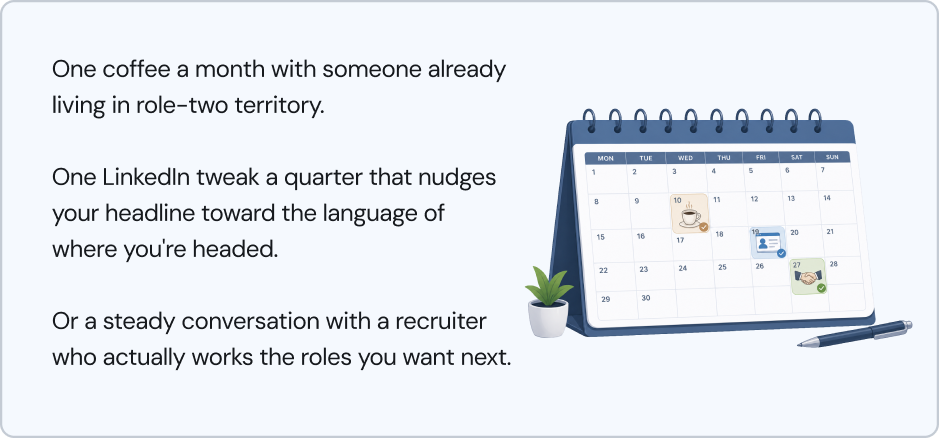
There’s no urgency to any single step. The whole point is to keep it warm, so that when the right role two opens up, you’re a few conversations in rather than emailing strangers from cold.
The thing that usually breaks this isn’t discipline. It’s that the entire pipeline lives in your head. Two recruiter chats in October, a warm intro in November, an interview that stalled in December, and by March you’ve lost the thread of who said what. That’s a chain coming apart, and most people don’t notice it’s happening until it already has. Keeping it somewhere you can actually see it is usually the difference between a plan you’re running and a plan you abandoned.
None of this thinking is original to me, by the way.
Andy Grove ran Intel through the years when cheap Japanese memory chips were close to sinking it. He was the company’s president at the time, and he and CEO Gordon Moore made the call to walk away from memory and bet everything on microprocessors. It worked. Intel became the largest chipmaker in the world, Grove went on to run it as CEO, and years later he wrote a book about all of it called Only the Paranoid Survive. The last chapter is the one I keep going back to, because it has nothing to do with chips. It’s about your career.
The lines that stuck with me:
“The sad news is, nobody owes you a career. Your career is literally your business. You own it as a sole proprietor. You have one employee: yourself. You are in competition with millions of similar businesses: millions of other employees all over the world. You need to accept ownership of your career, your skills and the timing of your moves.”
The people who map out their next few roles tend to end up at companies they didn’t even know were hiring.
The ones who don’t usually end up wherever a layoff happens to leave them. I’d rather you be in the first group.
See you next week.
Puneet
P.S. Forward this to someone who's been in the same seat for two years with no plan for the next one. They'll thank you in about six months.
No posts
Comments
Nothing yet. Say the first thing.
Sign in to join the conversation.