
A Careerflow user called me last week, mentioned that she’s been stuck on the same decision for six months.
She has a good job as a PM at a SaaS company. The work is stable but slow. She can feel herself starting to coast and not sure if she should stick around or start looking.
The other option is jumping to an AI-native company where there’s a lot of noise, except she’s convinced she isn’t “AI enough” to get hired there.
Both feel wrong. Which is why she’s staying put.
I told her there’s a third option. And it’s the one every AI-and-jobs headline for the last two years has missed.
For two years, the AI-and-jobs conversation has been running on two contradictory stories.
One says AI is going to eat jobs.
Marc Benioff at Salesforce cut 4,000 support roles last September and told a podcast, “I’ve reduced it from 9,000 heads to about 5,000, because I need less heads.”
Klarna did the same.
Microsoft has been cutting through 2025.
The other says AI is creating jobs. Every company is hiring for AI-related roles.
Every VC-backed startup lists “AI engineer” in their JDs.
Founder LinkedIn posts insist AI is a productivity boost, not a labor replacement.
The truth is both sides have been half-right, and until this quarter nobody had the data to prove it.
Three serious studies dropped in ninety days, from three different teams using different methods, and they all pointed at the same answer.
OpenAI’s Jobs Transition Framework, published in April, scored almost every US occupation on four dimensions.
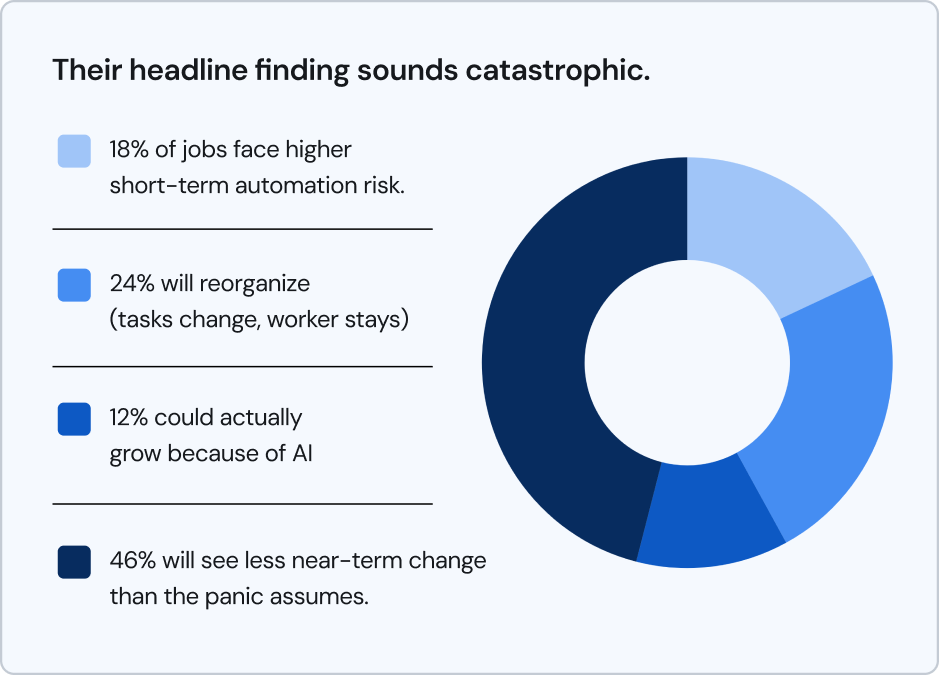
Ramp’s firm-level study with Revelio Labs, published June 30, matched corporate spending data from 21,559 US companies against workforce records. Firms adopting AI grew headcount 10.2% over the two years after adoption. At the ones spending seriously, roughly $30 per employee per month or more, entry-level hiring grew 12%. At the ones dabbling without spending, headcount stayed flat.
PwC’s Global AI Jobs Barometer, also from June, analyzed over a billion job ads across 27 countries. Companies most exposed to AI grew headcount 52% since 2018 versus 36% at the least-exposed. Wages at AI-exposed firms grew 24% versus 17%. The AI-skills wage premium is now 62%.
Three different teams using three different methods landed on the same answer.
Here is what the three studies say when you read them together.
AI is hollowing out specific tasks inside specific roles. That’s the Benioff piece.
Customer service scripts are getting automated.
Data entry work is shrinking.
Standard back-office roles are getting compressed.
Those cuts are real.
But the same companies doing that hollowing out are hiring aggressively across the roles where AI can’t take over.
Salesforce is cutting support and hiring sales and product.
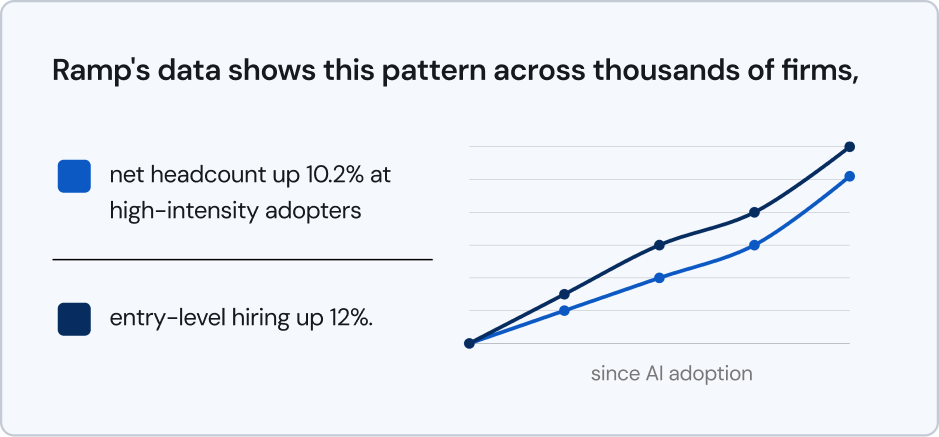
PwC’s billion job ads say the same thing at global scale.
Both stories are true at the same time. AI is genuinely eating some roles. AI-adopting companies are genuinely growing.
The reason both looked contradictory is that they’re measuring different things. The layoff stories are about specific functions inside individual companies.
And growth stories are about net effect across thousands of firms. Once you see that, the debate stops being a contradiction and starts being a map.
The picture the three studies together draw is this.
AI is not eliminating knowledge work. It is reshaping which tasks inside a knowledge job a human should be doing, and the companies willing to spend on that reshaping are hiring more people than the ones that aren’t.
The safe position in 2026 sits where three things hold at once.
One: the work is being reshaped by AI, not replaced by it.
These are the roles OpenAI puts in the “reorganize” and “grow” buckets. Software developers using Cursor and Claude to ship faster. Marketing analysts drafting with AI and spending saved hours on strategy. PMs compress research so they can push harder on judgment.
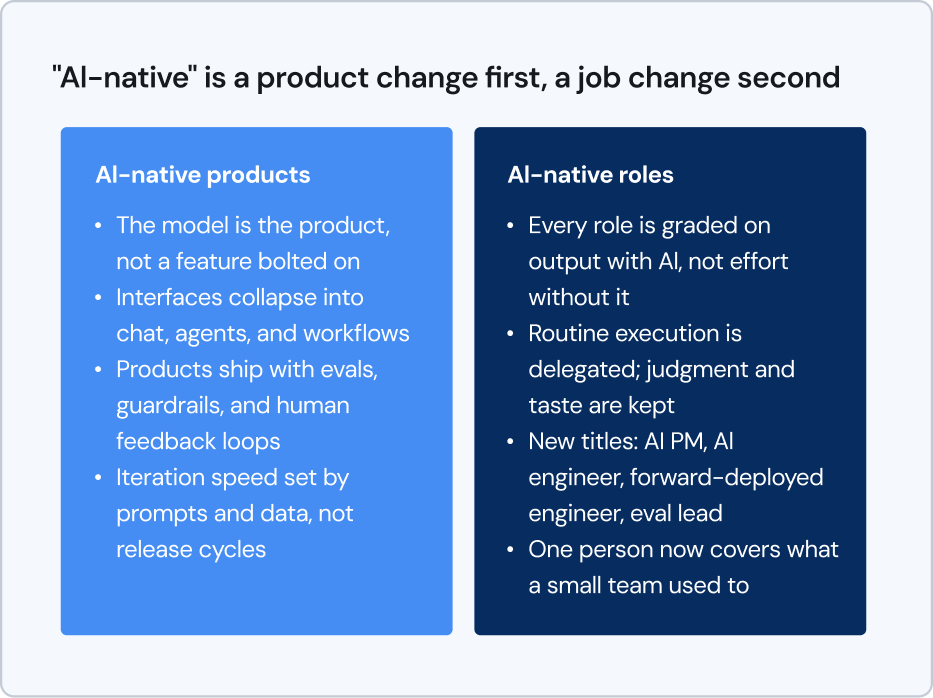
Two: the company is near the top of the AI spending curve.
A company can put “AI-first” on its careers page and be doing almost nothing internally.
The real ones ship AI inside the product, hire aggressively across AI-adjacent roles, and name specific tools inside JDs for jobs that have nothing to do with AI on the surface.
Notion, Figma, and a few hundred quieter names outside the AI-industry spotlight.
Three: the entry-level bar has moved up.
This is the wrinkle most job seekers don’t see coming. PwC found that entry-level roles at AI-exposed companies are seven times more likely to demand traditionally senior skills like judgment and leadership.
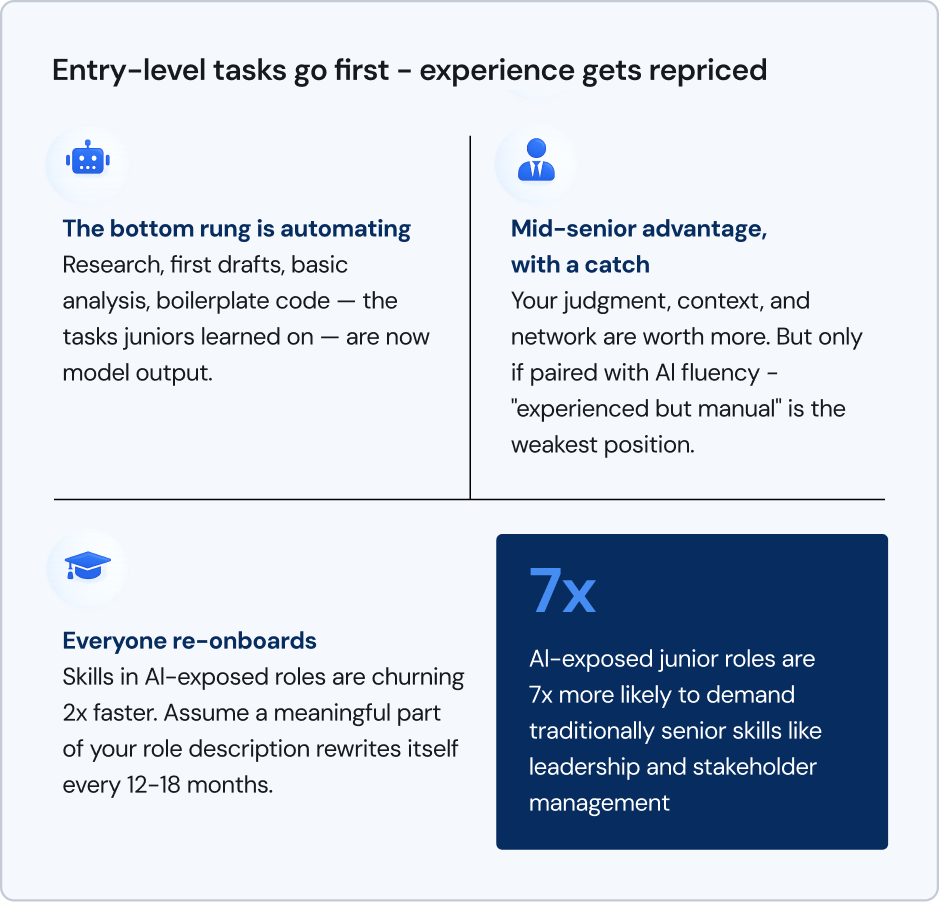
Same job title. Higher bar to clear. Which means the version of you a recruiter finds when they search needs to lead with the higher-judgment work you already do, not the tasks AI is quietly eating.
Here is how to actually land in it, in thirty days.
Days 1 to 10: Audit your own role.
Write down the ten things you actually do in a normal week. For each, ask:
Can AI already draft this today?
Does a human have to stay in the loop for legal, relational, or physical reasons?
If this got cheaper, would anyone want more of it?
The tasks where AI drafts, no human is needed, and demand is flat are the ones to shed.
The tasks in the middle, where AI drafts and your judgment finishes, are the ones to push toward.
Days 11 to 20: Build a real shortlist.
Pick fifteen to twenty companies you would genuinely want to work at. For each one:
Read six months of their engineering blog and changelog
Count how many entries touch AI shipped inside the product
Check their hiring velocity for AI-adjacent roles
Look at what the CTO actually posts about
Two or three signals lining up tells you what you need to know before you spend an hour on the application.
Days 21 to 30: Reposition how you show up.
Take a marketing analyst who runs weekly retention reports today. That is a task AI can draft. The reposition:
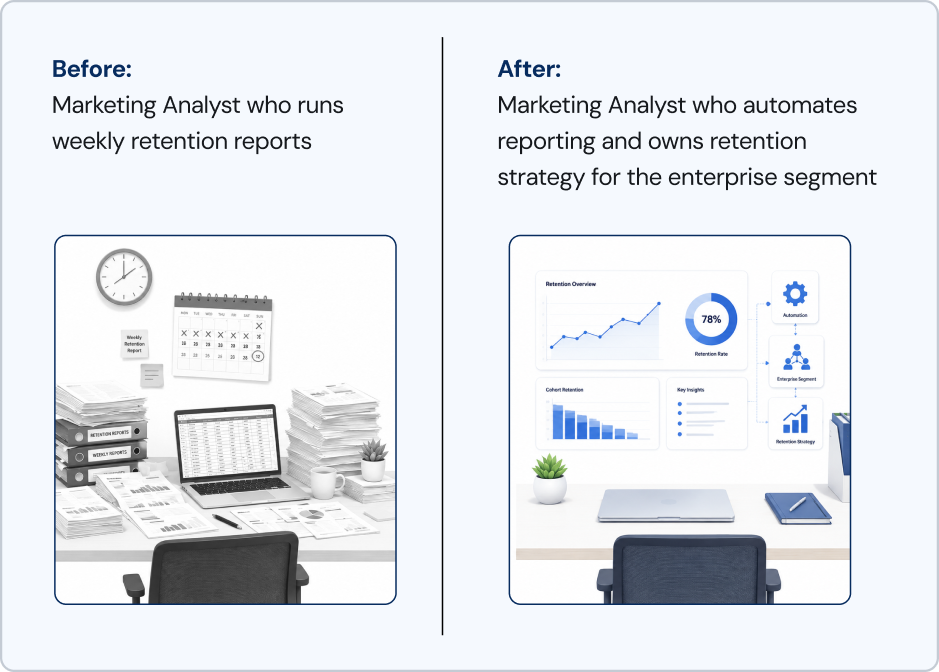
Same person. Same job. Very different profile from the recruiter’s side of the screen.
David Autor at MIT has spent two decades studying how technology reshapes work. He keeps coming back to a single distinction.
You can point technology at replacing people. Or you can point it at collaborating with them.
The first path quietly erases the expertise workers spent years building. The second makes that expertise more valuable and hands more of the gains back to the people doing the work.
Here is how he put it in an interview earlier this year:
“[Steering the technology] means using it in ways that collaborate with people to make their expertise more valuable and more useful.”
That is the third option I gave her on that call last week.
She does not need to leave her company to chase an AI-native one. She needs to find the version of her current role where AI is collaborating with her, at a company actually investing in that collaboration.
If her current employer will not get her there, the shortlist she builds in days 11 to 20 will point her to one that will.
See you next week.
Puneet
No posts
Comments
Nothing yet. Say the first thing.
Sign in to join the conversation.