
This is For The Firsts, a weekly letter for the “firsts” navigating career, money & life without a roadmap. Let’s get to work.

My dad was a plumber, and my Mom taught elementary school. So while we were a ways from poor, neither of my parents ever passed the six-figure mark. So when I passed that threshold at 25, as a consultant, I was feeling pretty proud of myself.
But I landed in over $10,000 of credit card debt later that year because I had no financial knowledge.
When you don’t have a lot, money can seem like something that would solve all your problems and leave you happy, healthy & weathy. There’s certainly a threshold, but it’s lower than you think.
This is NOT a conversation on whether or not money buys happiness. All things considered, I’m way happier now than I was frying chicken in the back of a fast food restaurant for $7 an hour. But that’s not solely due to the money I’m earning today.
And to my point, earing more without understanding how money works, and how to turn that salary into a system that builds on it’s own is useless.
But I didn’t come to this conclusion on my own
Throughout my career, and especially in the last few years, I’ve had to completely reinvent my financial mindset and invest in building out my financial education. My life changed overnight, and I had to get smart, fast. And lucky for me, I’ve had the chance to sit next to some very intelligent and wealthy people who’ve changed how I think about money and how to build wealth.
So here are three financial lessons that I wish I knew earlier:
I got my first savings account in middle school. As the son of an entrepreneur who dealt in cash a lot, my Dad was constantly at the bank. And as any millennial knows, seeing that vaccum deposit tube shoot up and dissapear into the sky immediatley captivated me, and I wanted to to be a part of it. So one day my Dad helped me open a savings account, and he put in my first $10.
And thus, my wealth journey began.
I was so grateful for that beginning, and I beleive that a savings account with 2-3 months of living expenses should be the first step of any financial plan (just make sure it’s a high-yield account!).
But if you include a dollar more, you are robbing future you.
The truth is that no savings account will give you the return of a money market account, or nearly any other investment. So once you’ve built some financial cushion, especially if you’re young, turn that energy towards investing in the things that can produce some real return.
The rich don’t work for money.
When I first read that, I was a little confused. Ok I was very confused. So what do rich people work for?
Leverage and relationships.
When I say leverage, I’m not just talking about your investments. If your work puts you in a room where you can hear where certain investments are being made in an industry, that information is leverage. If you live in a big city with access to more events and opportunires to meet interesting people, your location is leverage. If you grow an online audience and your price for a partnership goes from $700 to $3500 (even though it takes you the same amount of time to make the video/content) that’s leverage! Leverage is quite essentially any opportunity you have to get marginally more out of a situation because what you have access to.
So a job that pays you more, but isolates you from the information and relationships you need to truly move forward, is a bad investment.
One of the most misleading pieces of financial advice said to people is:
“The average millionnaire has seven streams of income.”
While functionally true, it’s missing an important point of clarification: They didn’t become rich by having multiple sources of income. They doubled down until they made real money, and then used that money to branch out into supporting assets.
Watch any interview with a massively succesful person and you’ll notice a very similar pattern: years of silent focus on one skill, one business, one job, one oppirtunity - until they become world class, and experience the rewards of that accomplishment. Only after that moment do they branch out into real estate, become an angel investor, start a podcast, or seriously invest in building their personal brnad.
The key is knowing what thing you need to concentrate on in order to have the cash to diversify. But don’t get distracted along the way.
If you’re reading this newsletter, it’s very likely that you’re the highest-earning person in your family.
And to be clear - that’s awesome!
You should feel incredibly proud of that. But I’ve learned the hard way that just because you earn a lot, if you don’t truly understand how to put that money to work for you, you’re just exchanging your finite amount of time for a marginally larger amount of money.
And the more you make, the more impact you can create.
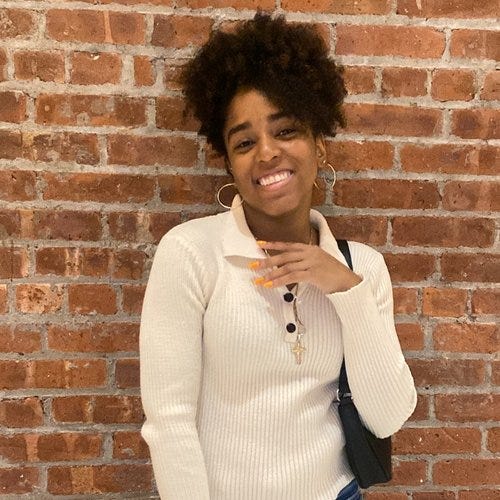
What’s a “first” you’ve done, or one you’re working toward right now?
I'm the first to receive my MBA in one-year.
What's been your favorite moment from an FTF event so far?
My favorite moment is not having my job title define me and meeting new people.
What’s something you’re a little obsessed with lately?
Trying new ice cream shops around the city.
What’s something you’re working on right now that you’re excited about? (Remember, no job titles)
Co-hosting social impact events.
‘First Up’ is our member spotlight series, highlighting the many incredible members of the FTF community. Want to be featured in a future spotlight? Fill out this form.
But that’s a far cry from where I started.
When my “little career videos” suddenly had to cover rent, I had to figure out very quickly what actually deserved my money.
These are the first four things that made the list.
1. A domain and an email address.
For about $20 you can get an email that isn’t tied to your current job or the address you made in high school, and that one purchase saves you a whole category of headaches later.
2. A business license.
A single-member LLC runs around $100 in most states, and you want this set up before the money starts rolling in because you’ll have to separate your personal income from the business’s revenue.
3. A business bank account.
I use Relay because I can create a separate checking account for every way my business makes money, and there are no hidden fees, no minimum balance, and the saving happens automatically. You can set it up now and get paid later.
4. The connections.
Then you take what’s in that business account and spend it on making connections. Coffee dates, conference tickets, dinners, that sort of thing. The highest return I’ve ever gotten came from money I spent meeting other people. And while skills may pay the bills, relationships will make you rich.
Get the boring things right early so the more exciting milestones have a solid foundation to land.
Relay is a financial technology company and is not an FDIC-insured bank. Banking services provided by Thread Bank, Member FDIC.
Our next For The Firsts meetup is tonight! It’s completely full, but you can register for our future events here.
Creator Economy NYC → September Mixer & Panel
Andrew Yeung’s Outlier Summit → Register here
These are affiliate links, but they’re genuinely the tools I rely on everyday
ManyChat helps me send all of my free and low-priced career guides to you all on Instagram and TikTok.
Claude Cowork keeps my desktop organized and helps my conduct research for my content.
Kit is the platform I use for email automation. It’s also where I send out my free Networking course! (comment “Networking” on any of my IG Reels)
read previous notes here
register for my next For The Firsts event here
host your own community events in NYC and Chicago at Fabrik
have me speak at your organization by filling out my speaker form
No posts
Comments
Nothing yet. Say the first thing.
Sign in to join the conversation.