
If you spend any amount of time in carbon capture circles or arguing with people who oppose it, you will eventually hear the same three names: Gorgon. Petra Nova. Kemper. The Cerberus of CCS failure. They are the evergreen projects used to justify the position that carbon capture and sequestration doesn’t work, is a fig leaf to the fossil fuel industry, and a distraction from the “real work” of decarbonization.
It’s a compelling narrative. Three high-profile projects, hundreds of millions in public funding, a trail of missed targets, cost overruns, and shuttered equipment. If you wanted to build a case against CCS, you could do worse than starting there.
But as in many cases, the truth is a bit more complicated than the narrative. This isn’t to say that there were no issues with Gorgon, Petra Nova, and Kemper. There were. But it’s important to understand what those issues actually were, what the reason for failure was, and how we can learn from that going forward. Because the lessons learned from those projects are far more nuanced than “CCS doesn’t work.” The three projects failed for very different reasons, almost none of which were fundamental flaws in the physics of carbon capture. And the habit of treating them as a unified verdict on the entire technology class is intellectually dishonest and, more importantly, inconsistent with detractors’ own interest in decarbonization. They say “CCS doesn’t work”, but they really ought to hope it does!
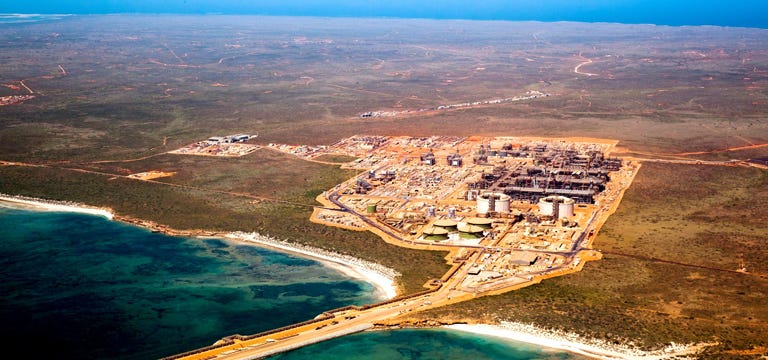
The Gorgon LNG facility, operated by Chevron with partners ExxonMobil and Shell off the coast of Western Australia on Barrow Island, is the world’s largest dedicated CCS project. Raw natural gas from the Gorgon and Jansz-Io fields contains CO2 that must be stripped out before the gas can be liquefied and transported. Rather than venting that CO2 to the atmosphere, Chevron was required, as a condition of the project’s environmental approval, to capture and inject at least 80% of the captured reservoir CO2 into the Dupuy Formation, a deep saline aquifer roughly 2.5 km below the island’s surface.
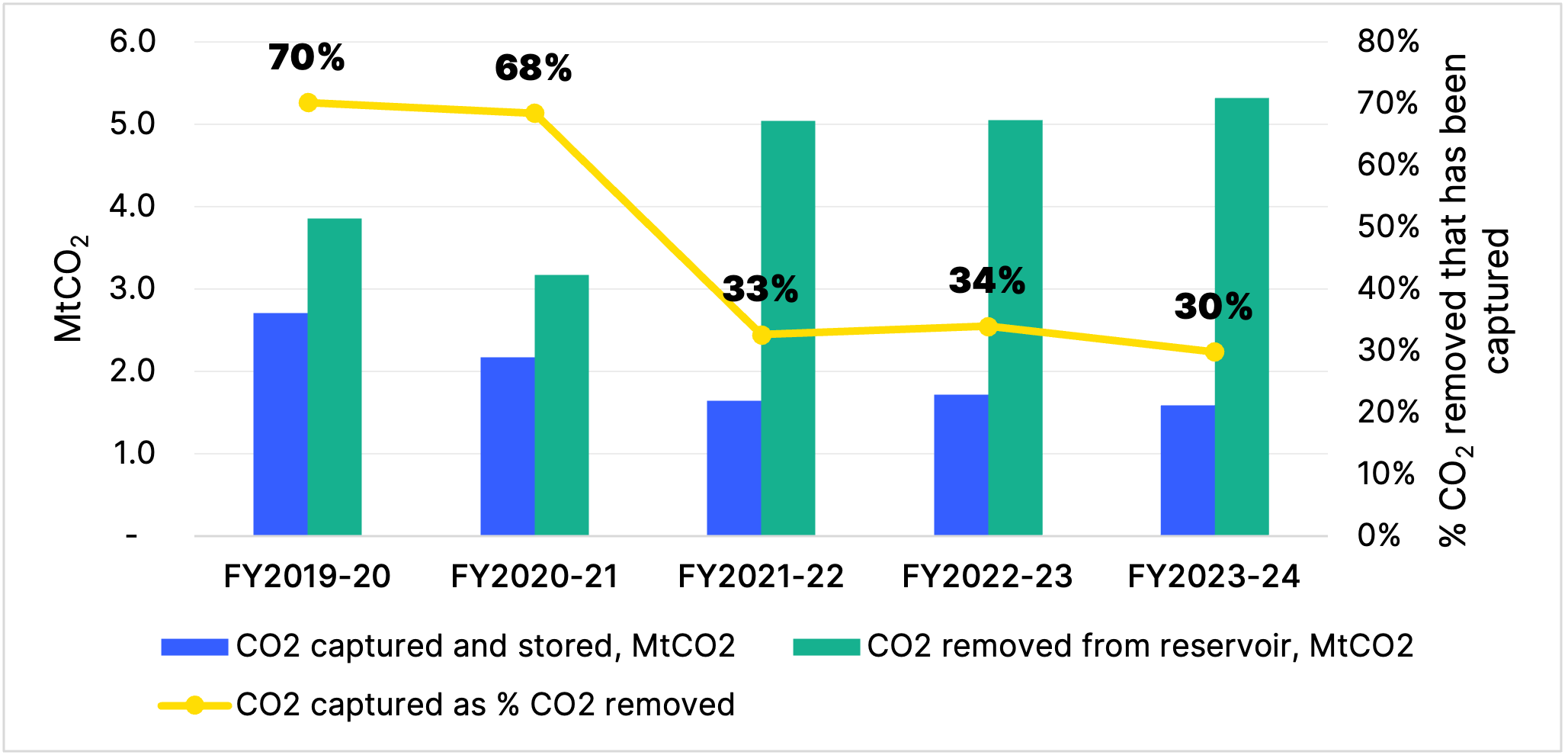
The project has, by any objective measure, underperformed that target significantly. Over its first five years of operation, it achieved roughly 50% of its target. By fiscal year 2024-25, that had fallen to around 25% of the CO2 removed from the reservoir, the worst year on record. The project has bought carbon offsets to make up the difference in capture rates and avoid fines, spending upwards of $230m based on the cost of offsets in Australia at the time.
So what happened?
The core technical problem at Gorgon is reservoir pressure management, not carbon capture. When you inject millions of tons of CO2 per year into an aquifer that, by definition, is full of fluids, pressure builds. If it builds too fast, injection rates must be throttled or shut down to avoid fracturing the rock that provides a seal for the subsurface CO2. That is called a caprock or a sealing unit. Chevron built a system of water production and injection wells to manage this pressure, but that infrastructure came online later than planned and has not performed to design. The result has been forced curtailments of CO2 injection.
An additional issue is that the CCS system itself came online three years after the LNG plant began producing gas. That gap meant roughly 9 million tons of CO2 were released before the first ton was ever injected. Regulatory oversight was insufficient to hold Chevron to a hard timeline, and the company faced no meaningful early penalty for the delay.
What Gorgon is not: a failure of carbon capture chemistry. The acid gas removal units that strip CO2 from the raw gas have largely worked. It’s also not a broad indictment of CO2 storage. We have captured and stored 383 million tons since 1996 with zero leaks to the atmosphere. Just because Gorgon had challenges in storing CO2, doesn’t mean we don’t have decades of success in doing it. We know how to store CO2 underground, it’s proven, safe and effective.
What Gorgon is: a problem in the proper site selection and characterization, specifically in the subsurface management of a complex and poorly characterized formation under injection pressure. Chevron is continuing to invest in the pressure management infrastructure, and injection rates have improved, though they remain well below target. There was also a lack of regulatory oversight on timelines to match up LNG production with the CCS facility.
What Gorgon teaches us: geology matters. It’s rocks all the way down. Formation characterization is critical before injection ever beings. The regulatory structure for large CCS projects needs to start far before injection, enforce timelines and create real penalties for non-compliance at any point in the project, rather than allowing offsets as a workaround. The decision to site the injection wells in a structurally complex aquifer, when better-characterized formations may have been available, looks in hindsight like a significant error.
The IEEFA and other critics are right that Gorgon has been an expensive disappointment. They’re wrong to use it as a blanket indictment of CCS. A formation management problem at Barrow Island is not the same as a global technology failure.
Petra Nova was the world’s largest post-combustion carbon capture system applied to a coal-fired power plant. Jointly developed by NRG Energy and JX Nippon, it came online in December 2016 at the W.A. Parish Generating Station southwest of Houston, Texas. The project captured CO2 from a 240-megawatt slipstream of flue gas from one of the plant’s coal units using Mitsubishi’s KM CDR Process, a proven amine-based capture technology. The captured CO2 was then shipped 130 km by pipeline to Hilcorp’s West Ranch oilfield for enhanced oil recovery (EOR).

Petra Nova was delivered on time and on budget. It won one of Power Engineering’s Projects of the Year in 2017. Over its three-year operational period, it demonstrated that post-combustion capture on a coal plant was technically achievable at a commercial scale.
In May 2020, NRG shut it down. That’s the part everyone remembers.
Why did it shut down? Low oil prices. The project’s revenue model depended on selling the captured CO2 to the EOR operator. In the spring of 2020, WTI crude collapsed to around $20/bbl in the initial shock of the COVID pandemic. At those prices, the CO2 had limited value to the oil producer, and the project’s economics fell apart. There was no long-term offtake contract with floor price protection, no carbon pricing mechanism, and the 45Q tax credit for CO2 used in EOR was only $35/ton at the time, not enough to bridge the gap.
What Petra Nova is not: a failure of carbon capture technology. The project exceeded initial capture rate targets over its lifetime (92.4% vs target 90%), and unplanned downtime from operational issues had declined significantly with each year of operation. The core Mitsubishi capture system worked. Over its operational period, the project demonstrated meaningful learning that Mitsubishi has used to reduce its capture technology construction costs by an estimated 30%, exactly the kind of first-mover experience that justifies building demonstration projects.
What Petra Nova taught us is: the business model for CCS tied purely to EOR revenue and low tax credit values is not sufficient or robust enough for long-term operations. It was a leveraged bet on oil prices. As a technology demonstration, however, it succeeded. The project was restarted in 2023 under new ownership (JX Nippon bought out NRG’s stake) after the Inflation Reduction Act raised the 45Q credit for CO2 used in EOR to $60/ton, substantially changing the economics. It’s operating again right now, with 45Q for EOR at $85/ton due to the One Big Beautiful Bill Act.
Calling Petra Nova a failure because it relied on a business model that broke after a historic drop in the price of oil due to a global pandemic misses the point and is a bit glib. Failure of projects during Covid isn’t unique to CCS, and the value of the business model is evident, as the plant is up and running again.
Kemper is the messiest of the three, and the one where criticism of the project itself crosses many political and socioeconomic lines. But it is also the most systematically misunderstood, because the failure at Kemper had almost nothing to do with carbon capture equipment itself, but rather the gasification unit.
Mississippi Power, a subsidiary of Southern Company, broke ground on the Kemper County Energy Facility in 2010 with an original cost estimate of around $2.4-2.88 billion and a target in-service date of 2014. The project would use a proprietary integrated gasification combined cycle (IGCC) technology, called Transport Integrated Gasification (TRIG), developed by Southern Company and KBR. The idea: convert low-grade lignite coal (of which Mississippi has vast reserves) into syngas, combust that syngas in a combined cycle turbine to generate electricity, and capture the pre-combustion CO2 stream for enhanced oil recovery at nearby fields. Up to 65% of CO2 emissions would be captured.
By the time Mississippi’s Public Service Commission ordered the gasification operations suspended in June 2017, the project had cost over $7.5 billion and was more than three years late. The gasification and CCS components never achieved steady-state operation. The plant was ultimately converted to run as a conventional natural gas facility. It has never captured a ton of CO2.
So what happened? The IEA put it plainly: CO2 capture was not the issue at Kemper. The TRIG gasification technology, which had only ever been demonstrated at a small pilot scale, was being scaled up by roughly two orders of magnitude to a 582-megawatt commercial plant. That leap — from a 1 MW pilot to a 582 MW commercial facility was massive, and it was made worse by a cascade of project management failures that added heavy cost increases. Those cost increases were initially allowed to be passed on to the customers of Southern in part, due to the Mississippi Public Utility Commission not conducting prudency hearings. That lack of oversight became a key piece of why the Mississippi Supreme Court ruled Southern Company must pay back those rate increases. At the end of the debacle, Southern and shareholders were on the hook for $6.4B, ratepayers for $1B, and around $400m from taxpayers via federal grants and tax credits.
The project ran engineering and construction in parallel, designing at the same time as building, in a practice the team itself called a “compressed schedule.“ This is a well-known recipe for cost overruns. The company miscalculated pipe specifications across the facility, requiring expensive rework after construction had already begun. The project’s scheduling software was supplemented by manual spreadsheets that couldn’t track commodity cost growth. And critically, Southern Company rushed to meet a 2014 in-service deadline to qualify for a federal tax credit, a decision that appears to have prioritized the subsidy window over sound engineering pacing.
Meanwhile, the fracking revolution was gutting the economic rationale for the project from the outside. Natural gas prices collapsed after 2008, and by the time Kemper was struggling to start up, the simple-cycle gas plant that existed at the same site could generate electricity far more cheaply than the IGCC system ever could.
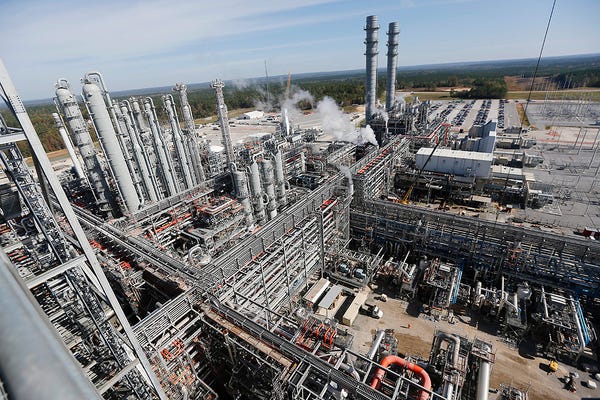
What Kemper is not: a failure of carbon capture. The capture technology that was meant to be applied to the syngas stream, established, commercially available solvent-based absorption, was never the problem. The problem was that the novel gasification system upstream of it never worked reliably enough to produce a consistent feedstock. You can’t capture CO2 from syngas you can’t make.
What Kemper is: a first-of-kind scale-up of novel upstream processing technology carries enormous project risk, and that risk is compounded by poor project management, misaligned incentives (tax credit timing driving construction pace), and an absence of adequate pilot scale data. The CCS community has absorbed this lesson: the current generation of industrial CCS projects is overwhelmingly focused on capturing CO2 from existing, well-understood emission streams: natural gas processing, ethanol production, cement, steel, hydrogen. Rather than trying to bolt novel upstream technology onto novel downstream capture in a single first-of-kind package.
Stand back and look at the three projects as a set. One failed because of a reservoir pressure management problem in a complex and undercharacterized subsurface formation. One was shut down because oil prices crashed and the business model lacked a stable policy floor. One collapsed because of scale-up risk in a novel gasification technology paired with serious project management failures. These three failures also do not negate the success of the technology.
Not one of them failed because the core chemistry of carbon capture is fundamentally flawed. Not one of them failed because CO2 cannot be injected and stored underground in the proper reservoir. The IPCC’s SR1.5 report, the IEA’s Net Zero by 2050 scenarios, and essentially every major decarbonization modeling effort on the planet include substantial CCS deployment. Not because of some oil and gas conspiracy, or because people like me need a policy job, but because the physics of the global energy system demands it. At least for now. Hard-to-abate industrial sectors like cement, steel, and chemicals have no viable pathway to deep decarbonization that doesn’t include CCS, in the near to mid-term. We have great technologies that can produce all these commodities without fossil fuels and CCS, but they are decades away from large-scale deployment.
The critics who point to these three projects as evidence that CCS is a failed technology are, implicitly, making a standard that they almost certainly do not apply to their favorite climate technology. It would be facetious to judge solar power by the performance of Solyndra or Ivanpah. The same could be true of wind energy, by the failures of early offshore projects in the North Sea or the avian destruction caused by the Altamont Pass Wind. We do not evaluate battery electric vehicles by the fire safety recalls during early EV production. Every technology has failures.
The experience curve is real. First-of-kind demonstration projects have real value when their data is published, their failures analyzed, and their lessons applied, which can reduce the cost and risk of subsequent projects. Mitsubishi cut its capture system costs by 30% from learning at Petra Nova. The CCS industry knows more about formation selection and subsurface pressure management because of what happened at Gorgon. Those are not small things.
The question of CCS working has been resolved. We understand, technically, how to pull CO2 out of a variety of different flue stream concentrations. This should be abundantly clear since over 100 companies are working to pull CO2 directly out of the air!
The question, if you are interested in limiting emissions and decarbonization (which is not to be overstated because some are not) is, “Are you willing to adequately incentivize CCS for deployment today or pay for all of those emissions later with more expensive carbon removal?”
The answer to what we need is fairly clear from the evidence, including the three projects above. We need stable, long-term, durable policy incentives, not just tax credits with expiring windows that encourage rushed timelines. We need rigorous pre-injection subsurface characterization to avoid formation management problems, which many countries, including the US, already have in place. We need to separate the genuine technology risks from the business model risks and address each appropriately. We need demonstration projects that are set up to succeed and to generate public data, not to chase subsidy deadlines or the winds of politics.
And yes, we need to be honest that the sector has had real failures and real underperformance. Gorgon has been a disappointment. Petra Nova’s business model was fragile. Kemper was a management and engineering debacle. None of that means the technology doesn’t work. It means the hard work of deploying first-generation commercial infrastructure in a complex, capital-intensive sector with inadequate incentives or markets is, in fact, hard. This should surprise no one.
The CCS sector today looks meaningfully different from the generation of projects that produced Gorgon, Petra Nova, and Kemper. There are now dozens of operational projects, many more in development, and a new generation of industrial hubs across the globe that are structurally better designed, better financed, and built on a foundation of actual project experience.
Every decarbonization pathway requires gigatons of CCS. Are we going to learn from the early failures, and adequately incentivize deployments, or use three imperfect first-generation projects as a reason to avoid the hard work entirely, and leave the even bigger bill to our children with CDR technologies that don’t yet exist at scale? Those are the two options right now.
No posts
Comments
Nothing yet. Say the first thing.
Sign in to join the conversation.