
Hello, readers:
As you may have noticed, I’m knee deep in a writing project I hope to finish by the end of this month. Seeing as it’s the height of summer and camp, camp, camp is all the rage, I hope you’ll indulge me in a three-part series featuring an excerpt from Church Camp over the next three Thursdays.1
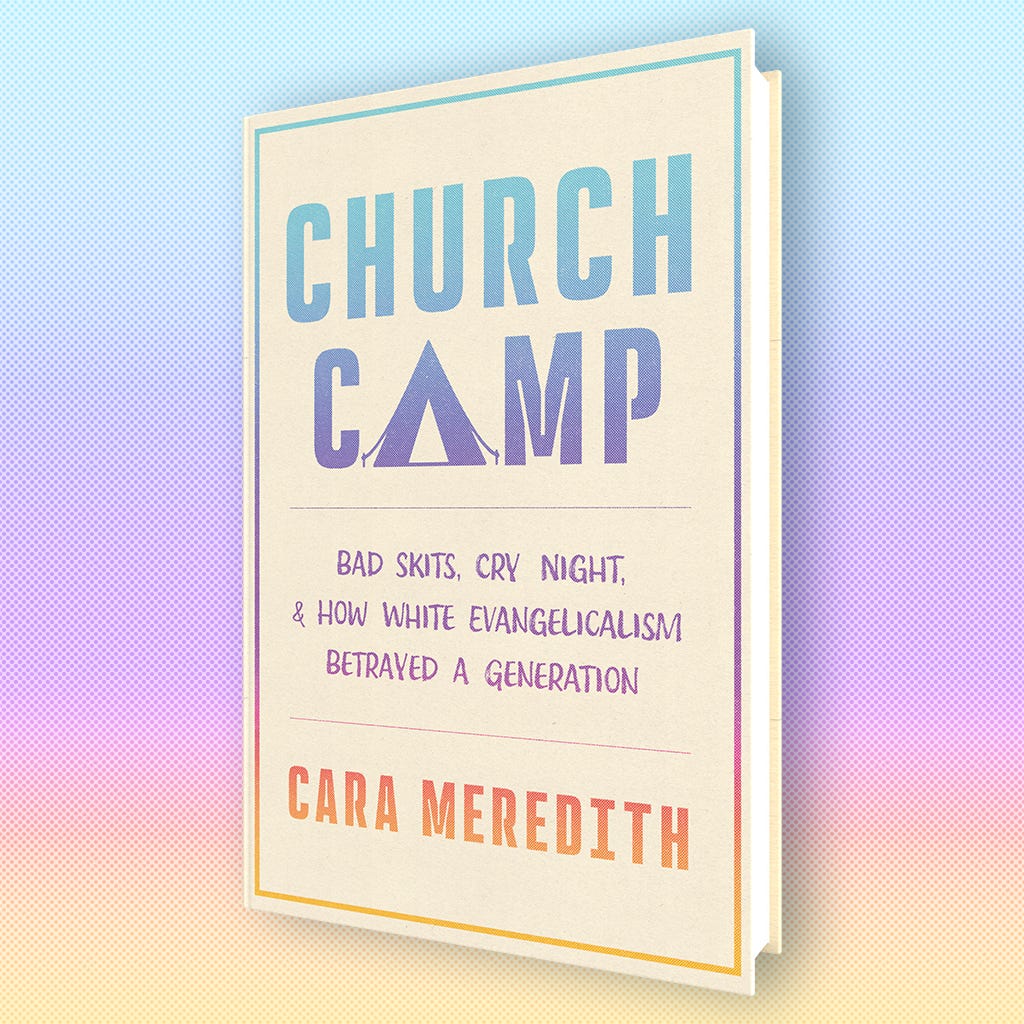
In every conversation I’ve had since the book released last April, the topic of patriarchy, purity culture, and its connections to Christian nationalism have hands-down been the hottest of all.
Former evangelicals want to understand how our minds (and our bodies!) got so twisted into believing this was the only way, the truth, and the life. Those who aren’t spiritual or religious in any way, shape or form often want to understand what this whole thing was in the first place.2 Folks worried about the continued rise, presence, and acceptance of Christian nationalism in our country want to know how we got here and how we can now get out of here.
Regardless, over the next couple of weeks, I hope you’ll see how part of this chapter paints a larger picture of white evangelicalism — by way of white evangelical church camps — and perhaps provides a couple of answers along the way.
Here’s Part I of the excerpt, the rest to follow over the next two Thursdays:
We weren’t wrong in our devotion, nor could our earnestness have been purer. But we were wrong in clinging to notions of God that could only be known through the love of a father, whom we believed a man and solely referred to as a male figure. The more we clung to this image, the more we upheld values of the patriarchy, a word writer Ashley Easter defines as a “social organization marked by the supremacy of the father in the clan or family, the legal dependence of wives and children, and the reckoning of descent and inheritance in the male line; broadly: control by men of a disproportionately large share of power.”8 At church camp, we made it easier for men to succeed than women: a man wasn’t questioned about whether or not he could speak at camp. He wasn’t told there were certain roles for which he lacked qualifications; instead, his penis single-handedly qualified him for anything he wanted to do.9 But try to hand a woman a microphone, and her qualifications, her desire, and her entire identity will be questioned—not only because this goes against the norm of who an audience expects to see but also because it defies expectations of who a woman is expected to be at camp. One woman I interviewed was called the devil’s handmaiden in one breath and a Jezebel in the next, simply because she was the first female camp speaker the white evangelical Christian camp had ever seen.10 (Because this had also never been modeled to her, in the months before she was to speak, she went and purchased a pair of khaki pants and a button-down shirt, an outfit far from her usual attire. She bought into a belief that she had to be as masculine as possible to embody the role of camp speaker.) Another woman was invited to take a predominate leadership role on stage because “she’s female, but she’s funny”—as if the attribute of humor was finally enough to let her play in the big leagues. The number of times someone told me, “You’re a really good girl speaker” is laughable, if this can even be a situation to which humor applies. I say this not to emphasize my ability to open my trap but to point out the doubtfulness of my male colleagues receiving a pat on the head for being “a really good boy speaker” after telling a story ’round the old campfire. Good boy. Good boy, now sit!
More often than not, in a church camp setting, men and women buy into complementarian beliefs of womanhood and manhood, believing that men and women have different but complementary roles and responsibilities in marriage, family life, and especially in religious leadership settings. In a way, the word complementary can sound rather innocuous, as if a woman is to a man what a tablespoon of peanut butter on one slice of bread is to a tablespoon of jelly on another slice of bread. Far from equal measures of beloved lunchtime sandwiches, the roles and responsibilities within a complementarian system are often hierarchical and connected to power dynamics. When a woman is actually given a seat at the table or offered a position of leadership, it doesn’t come without consequence. She might question her place in the system, and then, because she is seen as an outlier by other women, she doesn’t fit in anywhere else. She might try to mimic her male counterparts in words, actions, and, as we saw earlier, dress—not because she actually wants to speak or act or dress like a man but because his is considered the accepted norm, her most desirable goal.
Systems of the patriarchy rear their ugly heads in a thousand different ways in a church camp setting. Head to a camping website and count the number of (white) males in leadership positions. Do the same in a survey of major Christian camps that list upcoming speakers for each week of the summer. Many different facets of the patriarchy trickle down from there, but when it comes to cultural manifestations of male headship and female submission, there is no better illustration than purity culture.
Be sure to subscribe for Part II of the excerpt, which will undoubtedly talk about purity culture.
P.S. Thank you for your continued support. I read every note that comes into my inbox, even if (especially if) I’m not always so good at replying to all those notes. As I hunker down with this other writing project, know that I’m grateful to be on the continued journey with you.
P.P.S. It was a little too much fun being a guest on the Church Jams Now podcast. Have a listen wherever you like to listen to podcasts! And a huge thank you to our Seventh Day Adventist friends for their review in Spectrum Magazine.
Huge thanks and mad props to whose post yesterday provided the inspration for this idea.
Read Yesteryear, then head to chapter 2 of Church Camp, I’d say if asked today.
Comments
Nothing yet. Say the first thing.
Sign in to join the conversation.