
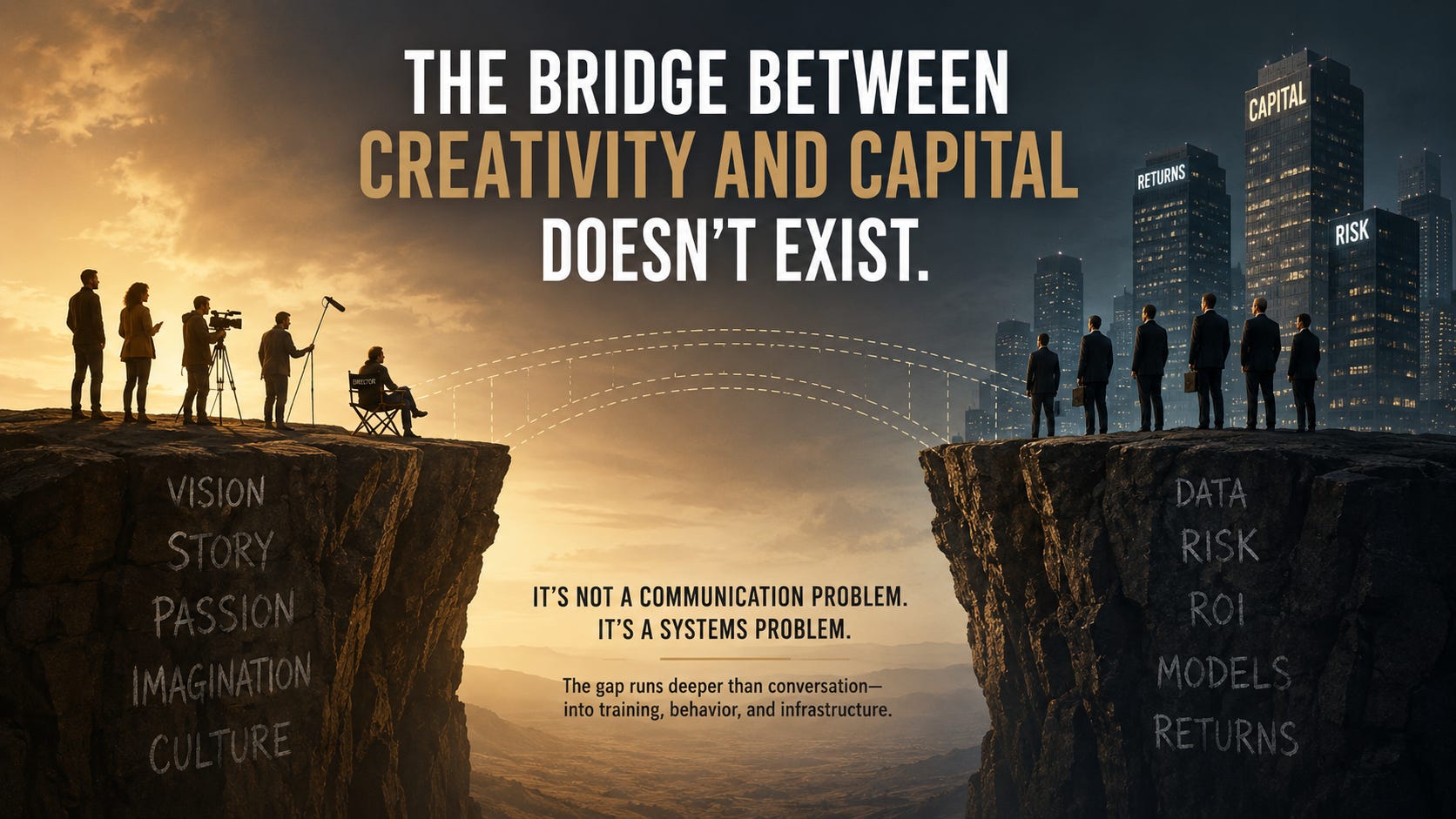
The Real Inconvenient Truth: It’s Not a Communication Problem. It’s a Systems Problem.
A thoughtful piece circulating on LinkedIn this week puts its finger on something every independent producer knows in their bones: the people with the greatest creative capability rarely have access to capital, and the people with capital rarely have meaningful connection to creative vision. The diagnosis is correct. The framing of the solution is where the conversation needs to go further.
Because the gap between creativity and capital in independent film is not primarily a communication problem. It is not solved by teaching filmmakers to speak investor language or coaching investors to appreciate artistic vision. The problem runs deeper than that — into the training pipeline that produces filmmakers, the behavior patterns of the capital that funds them, and the structural infrastructure of an industry that was never designed to serve either side efficiently.
This is the fuller indictment.
The Training Pipeline Is Broken at the Source
Every year, film schools across the country graduate thousands of writers, directors, and producers with exceptional craft skills and almost no functional knowledge of how films are actually financed. They can break down a three-act structure, light a scene, and cut a sequence. They cannot read a waterfall recoupment schedule, structure a limited partnership, or build a finance plan that a lender will accept.
This is not a personal failing. It is an institutional one.
The curriculum that trains creative talent in this industry was designed to produce artists, not entrepreneurs. There is no standardized pathway — no accredited program, no industry certification, no apprenticeship structure — that takes a talented filmmaker from craft competency to capital formation literacy in any systematic way. What exists instead is a loose collection of festival panels, industry workshops, and hard-won experience acquired through expensive trial and error on real projects with real investor relationships at stake.
The result is predictable: filmmakers arrive at the financing conversation underprepared, often making avoidable mistakes that damage investor relationships and project credibility before the first dollar is committed. Telling those same filmmakers to “learn financial literacy” and “translate their vision into business language” without acknowledging that the industry provides almost no infrastructure to teach them how is an incomplete prescription for a structural wound.
The training gap is not a character flaw in creative people. It is a systemic failure of the industry to invest in the professional development of the producers it depends on.
The Other Side of the Table Is More Broken Than Anyone Admits
The conversation about the creativity-capital divide almost always focuses on what filmmakers need to learn. Far less attention is paid to the behavior of the capital itself — and that imbalance distorts the diagnosis.
Film investors are among the most challenging capital sources in any asset class. Not because they lack resources, but because they frequently enter the film business with motivations that have little to do with financial return: ego, access, glamour, tax positioning, the desire to attend premieres and attach their name to something culturally significant. These are not illegitimate human motivations. But they create investment relationships built on misaligned expectations that no amount of filmmaker preparation can fully compensate for.
The investor who commits to a project because they want a producer credit and set visits will become the investor who panics when principal photography hits its first weather delay. The investor who enters with unrealistic recoupment timelines — expecting returns on the schedule of a real estate development rather than a film distribution cycle — will become the investor who destabilizes a financing stack at the worst possible moment. The investor who doesn’t understand that a film’s value is realized across a multi-year distribution window, not a single theatrical weekend, will make decisions that damage the project’s long-term position.
Independent film has no standardized investor education infrastructure either. There is no accredited pathway that takes a high-net-worth individual or a private equity fund from general interest in film investment to a realistic understanding of the asset class they are entering. What exists instead is a combination of optimistic pitch decks, incomplete disclosure, and the assumption that capital sophistication in one domain transfers cleanly to another.
It frequently does not. And producers pay the price.
The Infrastructure Was Never Built for This
Here is the argument that almost never gets made in public: the legal, financial, and distribution infrastructure of independent film was built by and for a different era of the business — one defined by studio leverage, robust DVD revenues, and territorial distribution markets that no longer exist in their original form.
What independent producers are left with is a system that creates friction, opacity, and cost at every level. Distribution agreements that run to hundreds of pages of definitions designed to minimize what a distributor owes a producer. Recoupment waterfall structures so complex that even experienced entertainment attorneys argue about their interpretation. Rights frameworks built around territorial fragmentation that the streaming era has fundamentally disrupted but not yet replaced with anything coherent. Legal and accounting costs that consume a disproportionate share of a micro-budget film’s resources before a single frame is shot.
None of this infrastructure was designed with the independent producer or the independent investor in mind. It was designed to protect the interests of distributors, studios, and financiers operating at a scale where these costs are absorbed without consequence. At the independent level, the same structures create barriers that are genuinely prohibitive.
The producers who navigate this system successfully are not doing so because the system works. They are doing so in spite of a system that was never designed for them — through relationships, hard-won knowledge, and a willingness to absorb costs and complexity that would be unacceptable in almost any other investment category.
That is not a communication problem between creative and capital. That is a structural problem that requires structural solutions.
Thanks for reading Capital Meets Story! This post is public so feel free to share it.
What the Conversation Actually Requires
The creativity-capital divide is real. The people who understand both sides of it — who can build a finance plan and break a story, who can speak to an equity investor and a director of photography in the same afternoon — are genuinely valuable and genuinely rare.
But the path to closing that divide runs through three reforms that the industry has been slow to pursue.
Film schools need to teach capital formation as a core competency alongside craft. Not as an elective, not as a festival panel, but as a structured curriculum that produces producers who understand waterfall structures, gap financing, tax incentive architecture, and investor relations before they ever sit across a table from a financier.
The investment community needs honest education about film as an asset class — its actual return timelines, its genuine risk profile, its distribution economics — delivered by people with no stake in making the investment sound more attractive than it is. The current model, in which producers pitch and investors decide based on incomplete information dressed up in optimistic projections, serves no one well in the long run.
And the infrastructure itself needs redesign. Standardized deal frameworks for independent films at different budget levels, transparent recoupment structures, distribution agreements that don’t require a six-figure legal bill to negotiate — these are not radical ideas. They are the basic conditions that would make independent film a functional marketplace rather than an obstacle course.
The inconvenient truth is not that creativity and capital don’t speak the same language.
It is that the industry has never seriously invested in building the bridge between them — and until it does, the most talented filmmakers and the most well-intentioned investors will keep finding each other across a gap that preparation alone cannot close.
Comments
Nothing yet. Say the first thing.
Sign in to join the conversation.