
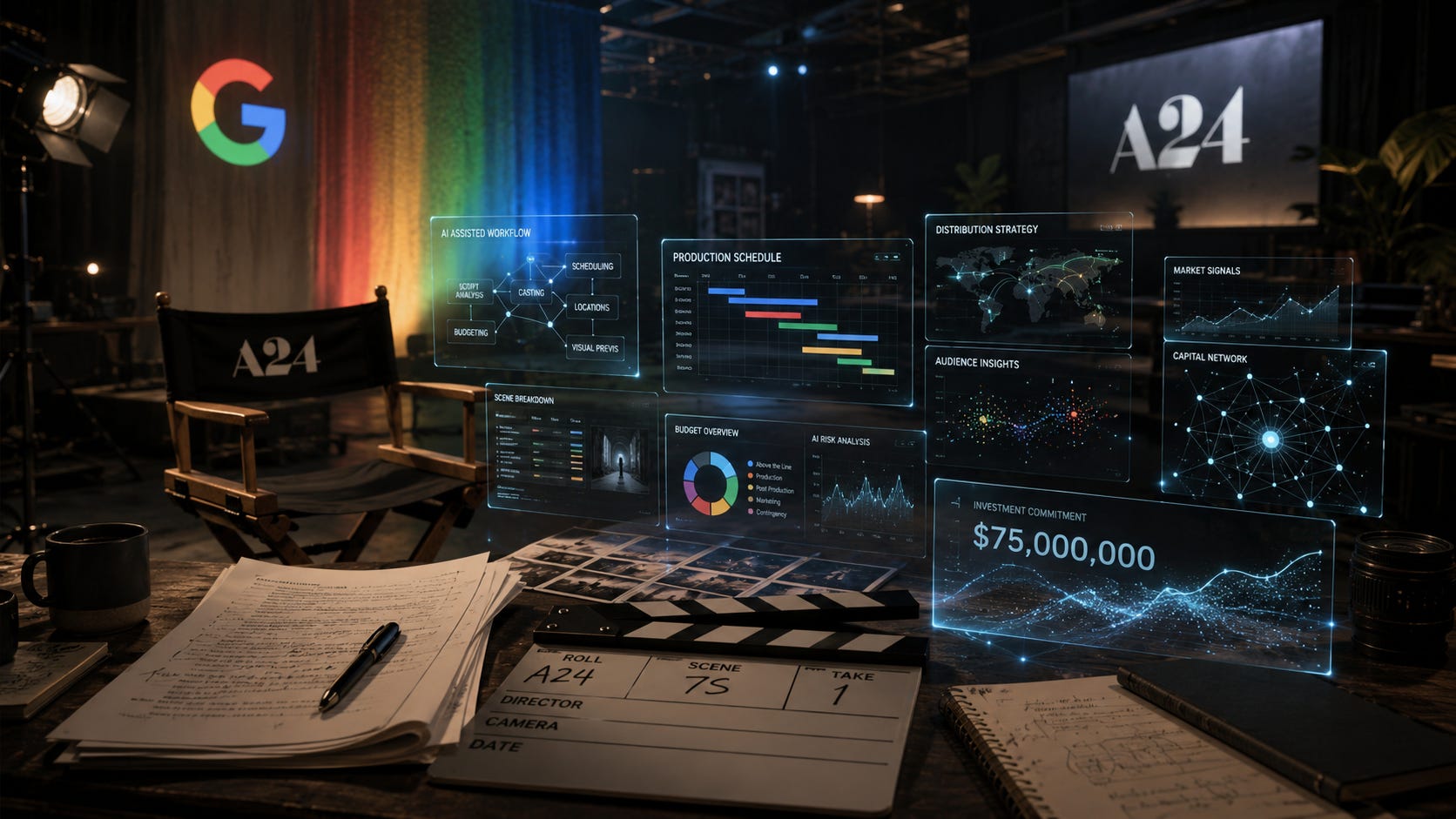
I took the past week off from Capital Meets Story to break down a script I plan to produce and direct.
As any producer, director, assistant director, UPM, or line producer will tell you, that is tedious work. Necessary work, but tedious. You are sorting scenes, locations, cast, time of day, page counts, production assumptions, budget implications, and dozens of other details before a single dollar is raised or a single frame is shot.
And most of us are still doing it with legacy tools, that honestly, weren’t built for indie producers.
That has had me thinking constantly about how much of the process could be streamlined.
Before my years in entertainment, I spent eight years in the Air Force as a computer systems analyst and programmer. After that, I developed software for a major bank. So when it comes to applying technology to entertainment, I do not fear it.
But I do recognize its limitations.
Technology is only useful when it understands the work it is trying to improve. In film and television, that work is not just data entry. It is judgment. It is context. It is creative intent. It is knowing why one location can double for another, why one scene belongs before lunch and another does not, why a small scheduling decision can become a major budget problem.
I have even toyed with coding my own in-house software for my use.
I will get to it one day.
But Google’s partnership with A24 may get there long before I have a chance to set my ideas in motion.
That is why this story caught my attention.
For years, the entertainment industry has talked about artificial intelligence as if it were still standing outside the studio gate.
That was always a mistake.
AI is not coming to Hollywood.
AI is already inside the business model.
Google’s reported $75 million investment in A24, through a multi-year partnership with Google DeepMind, is not just another technology headline. It is not just another “AI is changing movies” story. And it is certainly not just another studio partnership.
It is a capital story.
It is a credibility story.
And it may be one of the clearest signals yet that the next phase of film and television financing will not come only from studios, streamers, banks, private equity, tax credits, or distributors.
Some of it will come from technology companies that see entertainment not only as content, but as a proving ground for tools, workflows, audience behavior, and creative infrastructure.
That distinction matters.
Because Google did not choose a desperate studio. It did not choose a collapsing production company trying to survive on trend chasing.
It chose A24.
That is what gives this story weight.
A24 is not just another independent film company.
Since its founding in 2012, A24 has become the rare independent studio whose name means something to audiences. Not just to critics. Not just to filmmakers. Not just to festival programmers.
Audiences.
That is almost impossible to do in the modern entertainment business.
Most viewers do not know who financed a movie. They do not know which distributor acquired it at Sundance. They do not know which sales company handled foreign rights. They often do not even know which studio released it.
But they know A24.
That brand was built through risk.
A24 matters because it is not a legacy studio trying to cut costs. It is arguably the most culturally influential independent film company of the last decade, with a brand built through films it has produced, financed, backed, or released — from Moonlight, Everything Everywhere All at Once, Hereditary, and The Whale to Lady Bird, Uncut Gems, Past Lives, The Zone of Interest, and Ex Machina.
They were specific.
They were filmmaker-driven.
They were often strange, personal, uncomfortable, stylish, or formally ambitious.
And A24 turned that sensibility into a business.
That is the part Hollywood should pay attention to.
A24 did not become valuable by imitating legacy studios. It became valuable by understanding that taste itself can be an asset. Curation can be an asset. Trust can be an asset. A direct relationship with a younger audience can be an asset.
That is why Google’s support carries weight.
This is not AI trying to attach itself to Hollywood from the outside. This is AI capital attaching itself to one of the few modern film brands that still has cultural permission to experiment.
The lazy version of this story is predictable.
AI company invests in studio. Artists panic. Studios celebrate lower costs. Crews worry about jobs. Writers worry about theft. Directors worry about replacement. Everyone retreats to their assigned corner.
There are legitimate concerns in all of that.
AI in entertainment raises real questions about copyright, consent, compensation, authorship, labor, and control. Those issues cannot be waved away by calling a tool “innovative.”
But the Google-A24 story is more interesting than the usual panic cycle.
The reported structure of the partnership appears to be focused on developing tools for production and distribution, not handing Google the keys to A24’s content library. That matters. It suggests this is less about dumping a film archive into a machine and more about building workflow tools in collaboration with filmmakers.
That does not eliminate the risk.
But it changes the question.
The question is no longer whether AI will be used in film and television.
It will.
The better question is: who shapes the tools?
If AI tools are developed only by technologists, financiers, and cost-cutters, filmmakers will be forced to adapt to systems built without them.
If those tools are developed alongside artist-driven companies, there is at least a chance that creative use cases are built into the architecture from the start.
That may be the strategic importance of A24.
A24 gives Google something money cannot easily buy: creative legitimacy.
Google gives A24 something most independent studios rarely have at scale: research muscle, capital, and technical infrastructure.
That is not a traditional film financing relationship.
It is something closer to a strategic operating alliance.
Thanks for reading Capital Meets Story! This post is public so feel free to share it.
For decades, film finance has largely been organized around the project.
A producer assembles a script, talent, budget, tax incentive plan, sales estimates, debt, equity, gap financing, maybe a distributor, maybe a streamer, maybe a completion bond. Everything revolves around getting one film or series across the line.
That model still matters.
But it is no longer the whole game.
The Google-A24 partnership points to something different: financing attached to capability, not just content.
Technology companies are not only looking at films as finished products. They are looking at the production process itself: story development, visualization, pre-production, marketing, distribution, audience targeting, localization, analytics, and workflow.
That is where AI becomes a business tool.
Not as a magic button that makes movies.
But as a layer that could affect how projects are developed, pitched, budgeted, visualized, marketed, sold, and distributed.
For independent producers, that is the part worth studying.
Because the future may not belong only to companies with the best scripts. It may belong to companies that understand how creativity, capital, workflow, and audience data connect.
A24 has already understood part of that equation. It built a brand around audience trust. It turned theatrical releases, merchandise, memberships, social identity, and filmmaker relationships into a broader ecosystem.
Google’s interest suggests the next layer may be technological.
That does not mean every indie producer needs to become an AI company.
But it does mean ignoring the shift is no longer a serious option.
Legacy studios have spent the last several years chasing certainty.
Sequels. Franchises. Known IP. Algorithms. Global brands. Pre-awareness. Risk reduction.
A24 built its value in almost the opposite direction.
It made uncertainty part of the brand.
That is why this partnership should make studios uncomfortable.
If Google had placed this bet with a traditional studio, the industry might have dismissed it as another corporate technology initiative. But A24 gives the partnership cultural cover. It gives AI experimentation a filmmaker-forward wrapper.
That matters because Hollywood’s biggest AI problem is not technical.
It is trust.
Writers do not trust studios with AI. Actors do not trust studios with AI. Crews do not trust studios with AI. Many viewers do not trust studios with AI.
Some of that distrust has been earned.
The entertainment industry has a long history of using technological change to squeeze labor before sharing upside. So when a studio talks about AI, many artists hear a threat before they hear a tool.
A24 is one of the few companies with enough cultural credibility to complicate that reaction.
Not erase it.
Complicate it.
Independent producers should pay attention for a different reason.
This partnership reveals where the financing conversation is moving.
The old independent model was built around scarcity: limited capital, limited access, limited distribution, limited marketing, limited leverage.
The new model is being built around systems.
Can you build an audience before production?
Can you reduce uncertainty for investors?
Can you use tools to visualize the project earlier?
Can you create a more convincing package?
Can you test demand?
Can you generate better investor materials?
Can you understand your market before you ask someone for money?
Can you make the capital stack more legible?
That is where AI may become relevant for independent film and television. Not as a replacement for the artist, but as a force multiplier for the producer who already understands the story, the audience, and the business case.
Used badly, it creates more noise.
Used well, it may help close the gap between creative ambition and capital readiness.
That gap is where too many independent projects die.
The Google-A24 story is not that AI has won.
It has not.
The ethical questions are real. The labor questions are real. The copyright questions are real. The creative questions are real.
But denial is not a strategy.
The more useful lesson is this: AI is no longer just a software conversation.
It is becoming a financing conversation.
Capital is beginning to flow not only toward films, series, and libraries, but toward the companies that may define how films and series are made, marketed, and distributed in the next decade.
That is why Google’s investment matters.
That is why A24 matters.
And that is why this deal should be read as more than another tech headline.
It is a signal that the future of entertainment financing may not be divided between art and technology.
It may belong to the companies that learn how to make both work together without destroying what made the art valuable in the first place.
Comments
Nothing yet. Say the first thing.
Sign in to join the conversation.