
A new PNAS study tackles a counterintuitive trend: political polarization has risen sharply, even as people report having more close friends. Using survey data from Europe and the United States alongside network-theory models, the authors show that these two developments may be causally linked.
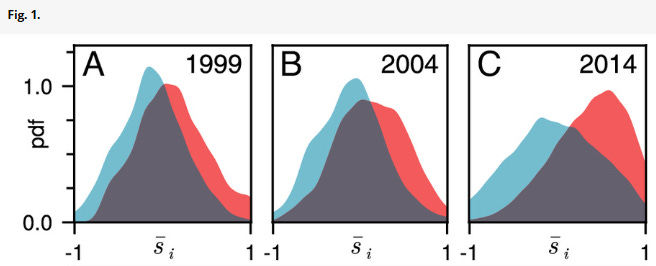
The number of close social ties people maintain has roughly doubled since the early 2000s. At first glance, this should foster understanding. But the paper’s core insight is different: once close-friend networks become dense enough, societies can tip into a polarized state. Above this threshold, tightly knit clusters form that reinforce shared beliefs and discourage disagreement across groups.
Phase transition
They actually use the term “phase transition” and the idea is that when social networks are sparse, opinions remain mixed and fluid. As connectivity increases, however, the model predicts (and the survey data confirm) a separation into ideologically homogeneous camps.
The mechanism is both behavioral and structural. With more close friends available, people are more willing to drop relationships that involve disagreement, subtly sorting themselves into like-minded circles. The result: more intimacy at the individual level, less cohesion at the societal level.
Gender equality paradox
Reading the paper got me thinking about the so-called gender equality paradox, which hinges on a similar mechanism: when constraints are relaxed, and choice expands, outcomes can become more segregated rather than more integrated.
In the PNAS study, the key variable is social choice. As people have more close friends available, they can afford to be selective. In the gender-equality paradox, the variable is occupational and educational choice. As formal barriers fall and welfare states cushion risk, men and women are freer to follow small average differences in interests or preferences. Those differences, once amplified by institutional and cultural feedback, lead to greater gender segregation in fields of study and work—especially in highly egalitarian societies.
Sources:
Thurner, Stefan, Markus Hofer, and Jan Korbel. 2025. ”Why more social interactions lead to more polarization in societies”. Proceedings of the National Academy of Sciences 122(44): e2517530122.
Breda, Thomas, Elyès Jouini, Clotilde Napp, and Georgia Thebault. 2020. ”Gender stereotypes can explain the gender-equality paradox”. Proceedings of the National Academy of Sciences 117(49): 31063–69.
Comments
Nothing yet. Say the first thing.
Sign in to join the conversation.