
I have a confession.
I’ve been losing sleep over an acronym.
At my age, I should probably be worrying about my blood pressure or whether I remembered to lock the van. Instead, my brain has decided that the pressing issue is whether I should say TRR, TRRP, TRP, or TSR.
I realize this is not normal.
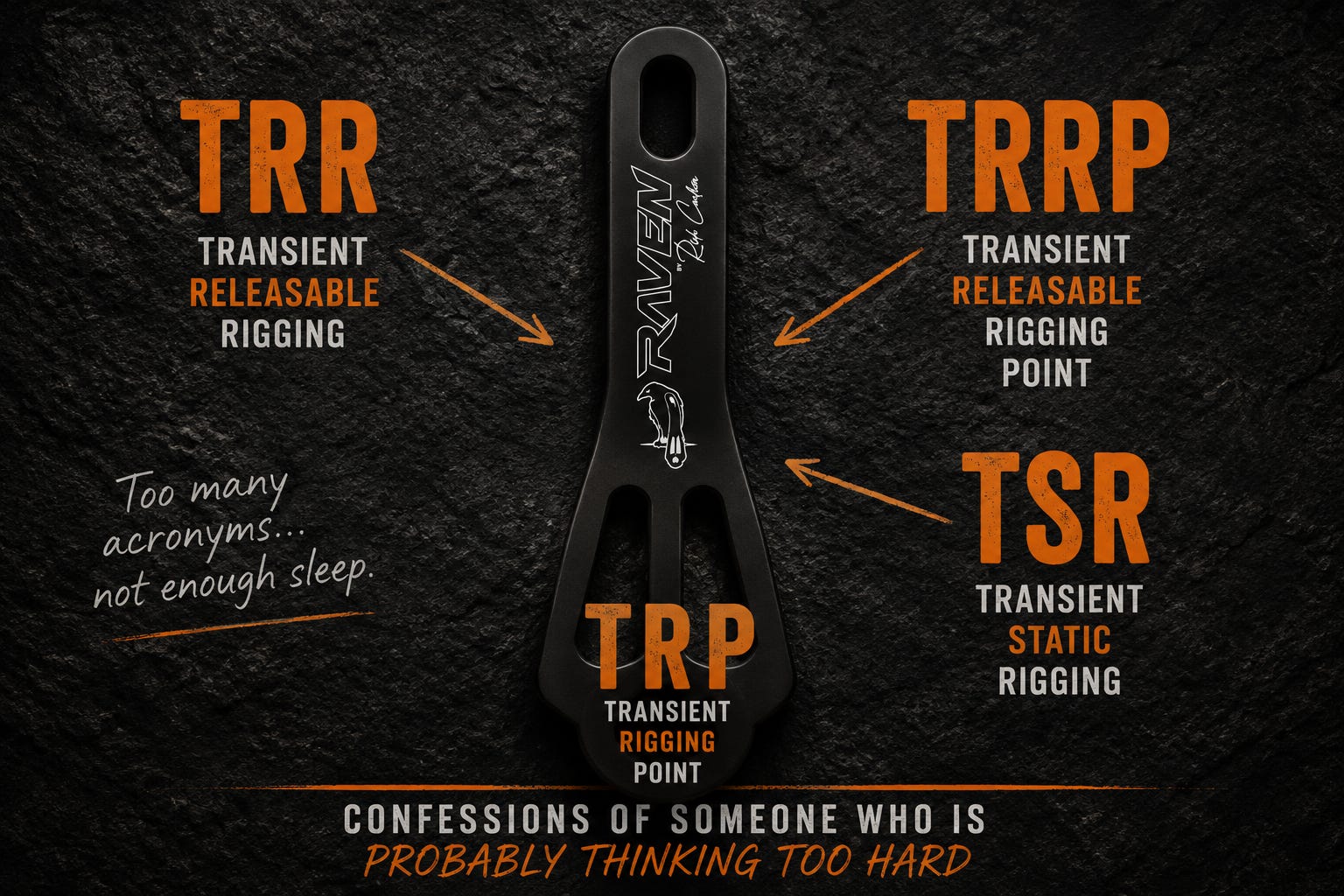
Not long ago, my friend and former student, Adolfo Isassi, introduced the term Transient Releasable Rigging (TRR). It filled a genuine gap in our vocabulary.
Historically, we had releasable rigging—systems like the munter-mule-overhand that allow a load to be lowered after it has been weighted.
Separately, we had retrievable rigging (often called “ghosting”), where the anchor and rigging can be recovered so nothing is left behind.
Then along came systems that do both.
They provide a releasable contingency for everyone except the last person, and when the rappel is complete, the entire system can be retrieved. Transient Releasable Rigging described this beautifully. It wasn’t just releasable. It wasn’t just retrievable. It was both.
Problem solved.
Or so I thought.
Then I started watching how devices like the Raven are actually used.
Sometimes the transient rigging point is configured as a releasable contingency.
Sometimes it isn’t.
Sometimes it’s simply a clean, elegant, retrievable static rigging point.
The hardware doesn’t change.
Only the way it’s being used changes.
That got me wondering whether calling every transient rigging setup TRR is really accurate.
My first attempt at solving this imaginary crisis was TRRP—Transient Releasable Rigging Point.
It technically worked.
It also sounded like I had sneezed.
Then I considered TSR—Transient Static Rigging—for configurations that are intended to remain static.
That felt more accurate, but now we’re asking students to decide between TRR and TSR before they’ve even finished rigging the anchor.
Then another thought occurred to me.
Maybe I’m trying too hard to make the name describe the function.
Perhaps the simplest term is simply TRP—Transient Rigging Point.
It’s transient.
It’s a rigging point.
Whether it’s configured as releasable or static depends on how it’s being used, not on what it fundamentally is.
That seems refreshingly simple.
Think of it this way.
A car is still a car whether you’re driving to work or to the grocery store. We don’t invent a new name every time its purpose changes.
Maybe a transient rigging point deserves the same courtesy.
Does that mean TRR disappears?
Not at all.
I still think TRR is an excellent description when the rigging is intentionally configured with a releasable contingency. In those situations, the term communicates something important about the system.
But when discussing the hardware or the rigging point in general, TRP may be the cleaner, more inclusive term.
Of course, there’s an excellent chance that I’m overthinking all of this.
Actually, there isn’t much chance.
I definitely am.
Fortunately, canyoneers are remarkably tolerant of people who obsess over rope systems, friction, carabiner orientation, anchor geometry, and now apparently... acronyms.
If this is the biggest problem I have to solve today, life is probably treating me pretty well.
Still, I’d love to hear what others think.
Just don’t be surprised if your answer costs me another night’s sleep.
No posts
Comments
Nothing yet. Say the first thing.
Sign in to join the conversation.