
Cantilever is a curated music streaming service, subscribe to get our updates directly into your inbox.
On a recent episode of the No Tags podcast titled “Will the AI Slopwave Ruin Music for Good?”, the hosts incisively delved into the AI music generation app Suno. The thing that struck me the most from their analysis were the “nuggets of conventional wisdom”, that they saw being shared on the forums related to the app.
“Suno's like a Swiss Army knife”, begins one user on the Suno forum, “lots of tools, but do you know how to use them all? Bottom line: if people doubt your music, keep working, learning, and experimenting.”
“When it’s 4am after 10 hours straight struggling with extensions to finalize a hidden gem, go to bed, don’t release it yet.” Another commenter on the forum replies, “wait until the morning to listen and decide if it’s any good or not.”
Surely the same kind of conversation is happening all the time on the forums attached to standard digital audio workstations like Ableton Live and Logic. And before this — putting speed of release aside for a moment — it’s conventional wisdom that could be shared between musicians in a recording studio. Stop stressing, go to bed, see how it sounds in the morning.
Will Suno and other AI music generation tools simply become the new digital audio workstations? Will they resemble the synthesiser, the drum machine, Ableton, Logic and other kinds of tools – with varying degrees of autonomy – which musicians simply use as part of their arsenal?
It’s possible that some music fans may not mind if the artists they like use AI in some form. The artist Holly Herndon recently expressed views to this end, claiming that “the human / AI binary is not going to hold, and will become a matter of superficial optics.” A swift movement from noteworthy to unremarkable is common for new technologies. As tech analyst Benedict Evans cogently points out, no one uses the term “automatic elevator” anymore as the idea of a manually operated elevator has simply disappeared into the distant past: “When it works, it just disappears. We don’t see it anymore, it just becomes software.”
But will the optics be superficial? And is some level of AI orchestration on top of an already largely human-made track really the issue here? Or is there something more fundamental to be concerned about?
Something qualitatively different about AI music generation tools vs. current digital audio workstations is the scale at which they can produce complete tracks. According to their own investor pitch deck, Suno produces “an entire Spotify catalogue’s worth of music every two weeks”. If you could make a couple Lo-fi Beats to Study and Relax To a day on Ableton perhaps, now you can autogenerate a constant stream of them, likely hundreds at a time in parallel. For some, as Tom Lea says on No Tags, Suno may be “the latest in a list of ways for people to try to make money online with minimum effort.”
At the same time, the major labels and Merlin (who represent the digital rights of a large chunk of the independent sector) have recently signed licensing agreements which allow Suno and competitor Udio to train their models on licensed works, so long as the constituent labels and artists have specifically opted-in. These deals involve the rights holders receiving the royalties of any music output trained on their licensed data.
So long as he is opted-in then, Drake will see the revenue next time an AI track, trained on his music, goes viral. It’s hard to deny that having control over how and where your intellectual property is exploited is better than simply having your IP stolen and remunerated without you seeing any return, which is how Suno was operating prior to these deals. But it doesn’t necessarily follow that it’s better than not having it exploited at all. Plus, in an AI licensing landscape, established catalogue — which takes up the vast majority of listening on streaming services (over 70% by some metrics) — no longer just persists but actively compounds. While it remains to be seen if fans will actually want to do this; what will the long term effects on trying to break new music be if firm favourites can be endlessly iterated upon?
Post-licensing, users paying for the higher-tier of Suno will receive better outputs, trained on real artists, but be unable to see the revenue. Those on the lower tier are already blocked from monetisation. Suno creations can only be monetised if they are trained on copyright you personally control. These distinctions lead to big questions about what the end goal of most Suno users actually is: will it primarily be used as a fun gimmick? A digital audio workstation augmentation tool, as Holly Herndon might be pointing towards? A generic content-farm? Or the audio equivalent of fan-fiction? It seems too early to tell.
By way of antithesis: Bandcamp recently announced a zero tolerance policy towards AI-generated music. While considered a positive symbolic gesture for many fans, it strikes me that Bandcamp is already structurally resistant to the worst effects of AI music, because the platform has centred “money, rather than attention, as the basic unit of exchange”, to quote Andrew Thompson’s recent piece for Components (which is actually referring to Substack, but seems applicable here).
If Bandcamp were to be suddenly flooded with substantively-AI artists — as is currently happening on mainstream streaming services (Deezer says 34% of the songs uploaded to its streaming service - about 50,000 per day - are AI-generated)— what would actually happen? Given Bandcamp doesn’t pay for streams, only purchases, it’s not possible for background engagement with the platform to cannibalise revenue that should be paid to real artists. On platforms like Bandcamp where users typically buy from artists that they already know and trust, or are pointed towards new artists by thoughtful, well-researched editorial, the likelihood of substantively AI artists resonating with users enough to generate purchases seems slim. There are humans in the loop too; the platform will be self-policing, they say:
“If you encounter music or audio that appears to be made entirely or with heavy reliance on generative AI, please use our reporting tools to flag the content for review by our team. We reserve the right to remove any music on suspicion of being AI generated.”
If AI will enter into digital music services, it will primarily target those where “attention”, not a direct exchange of money, remunerates the creator. It will be used in the hope of remaining un-noticed. In the most pernicious use of AI, the optics won’t be superficial but at once substantive and covert.
The coming years may spell the end of human-made lean-back listening. If people weren’t really paying attention to background Perfect Fit Content anyway (music commissioned by streaming platforms to suit a particular mood or setting, paid out at low or no royalties to the creators) how would they know and why would they care if this kind of music were made by AI? AI will make generic, functional music more or less free and certainly abundant. If they weren’t already, those artists making playlist-friendly music for Spotify, with little genuine audience to speak of, are in a very precarious position. Or maybe Suno will save them by virtue of scale.
Over the coming years, knowledge about the provenance of the music we listen to may be what separates potentially “superficial” optics into separate categories, valued differently. Knowing that the artists we are listening to are real may become an increasing user demand, either by explicit labelling on mainstream streaming services, or, as Deezer have implemented, using tools that filter out the stream of AI slop. The wholesale AI artist cannibalising streaming revenue and AI being used in the creative process by real artists is a sliding scale of course, but here again is where the context and provenance of the music — a substantive part of the Bandcamp experience — will become increasingly crucial.
As if in assent to the “minimum effort” requirements of the platform, on a recent podcast, Suno’s CEO claimed that “a lot of people don’t really enjoy the time they spend making music… it takes a lot of time, it takes a lot of practice, you need to get really good at an instrument or really good at a piece of production software. I think the majority of people don’t enjoy the majority of time they spend making music.”
I’m not going to take the bait here to lambast the Wall-E-esque universe that he clearly envisages. But one crucial detail he’s missed out, is that (for many) a lot of the enjoyment of making music comes from making it with other people. I too have been fatigued by making electronic music alone on Ableton; the endless list of options and my own disappointing results can make it feel like more “screen time”. Making music in a room with my peers though? It’s a qualitatively different experience.
Similarly, in my view, there is a qualitatively different experience to listening to music on algorithmic playlists because I like the sound and the vibe, and listening to music made by musicians who I definitely know (by virtue of context) have played live shows, collaborated with other musicians, and participated not just in the creation of sound, but in music culture more generally, of which recorded music is just one small part. As now, not all listeners will care, but those who do will care more and more.
For what it’s worth, Cantilever has a no-AI policy for all music featured on the platform.
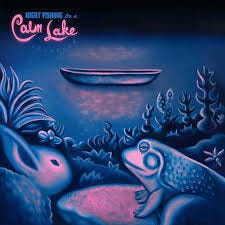
“I think I used to be a lot more subliminal with where I was coming from. The difference is in the speed at which I wrote the lyrics. I used to change little bits, I’d write the same lyrics for months and months changing bits around. But this time, the first thing I said was often the lyric, which isn’t necessarily the most poetic thing, but felt the most real.
I want to be a character, but I have to confront what’s real. For the first time I really couldn’t hide. I think recording this album was the most confrontational time in my whole life.”
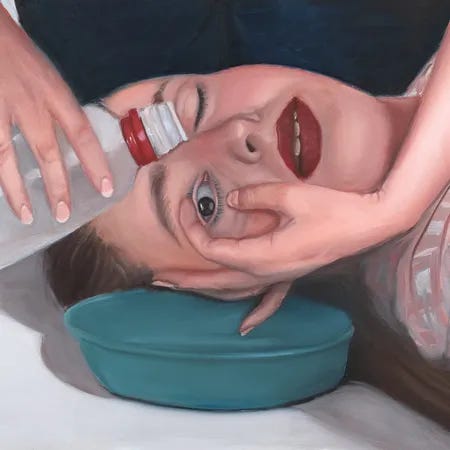
Florence Shaw was an arts lecturer before being approached to join the band, and her sensibilities as a visual artist clearly inform the often-cryptic, collage-like lyrics at the heart of the project. Hers is a found-object approach akin to Tracey Emin, Lorna Simpson, and Marcel Duchamp: it incorporates pre-existing written, spoken, overheard elements into new, mosaic assemblages. While her lyrics for the band’s early music "recycle[d] material from newspapers, YouTube comments, advertisements, conversations", Secret Love finds her scoring deeper into the peculiar “brainrot” of our current techno-political moment.
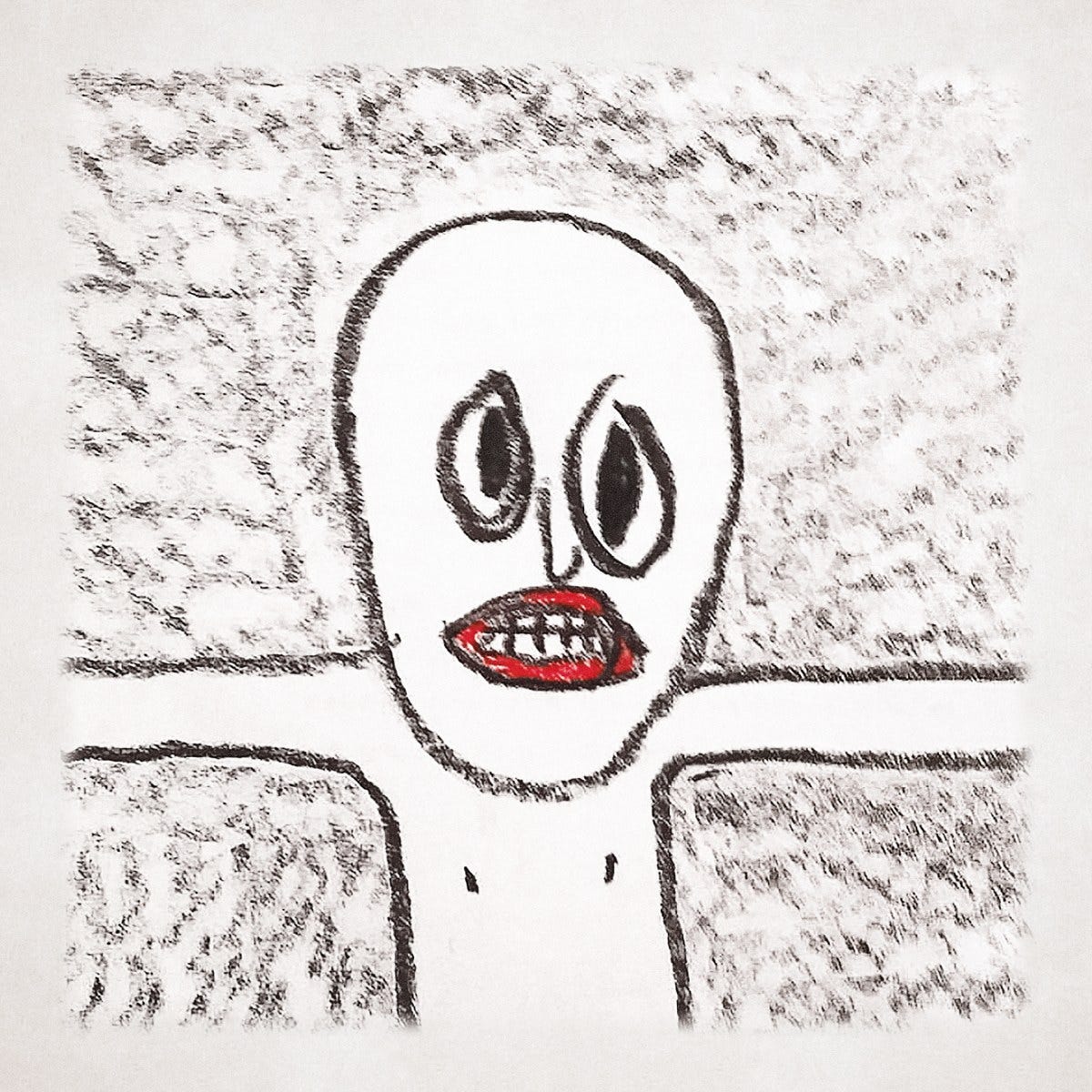
Inspired by the writing of American author John Fante and his paranoid, claustrophobic novels known as The Bandini Quartet, Archer crafts a string-heavy sonic narrative ostensibly centred on a week of his life; a week when, he explains, he was thinking about mortality, and the cyclical nature of life and death.

“People have to lean into it and make an active step towards you to listen, to understand,” says Mann. “It’s not something that can be passively absorbed.” And that’s the case whether listening on headphones at home or standing at the barrier. Mann recalls frequent skirmishes with live sound engineers who confuse quietness with weakness, confounding the artist and the art.
“When I’m playing shows and the sound engineer is like, “God, you’re so quiet with your acoustic guitar,” I’m like, “That’s the whole point! Don’t turn it up.” You know?”
No posts
Comments
Nothing yet. Say the first thing.
Sign in to join the conversation.