
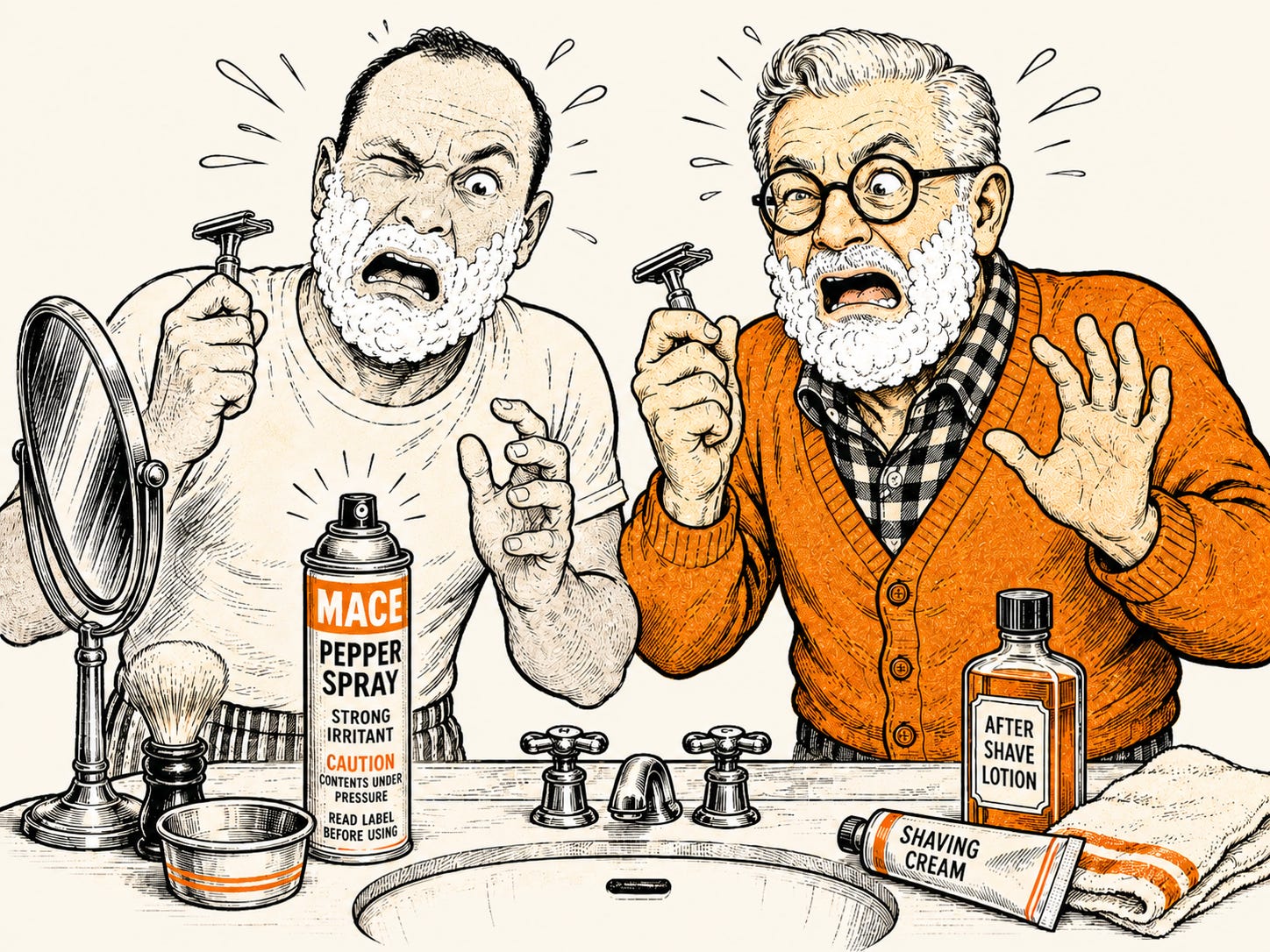
There’s a Beck line from 1994 about shaving your face with mace in the dark. It’s been stuck in our heads all week. Sorry if it’s now stuck in your head ( cause you’re a loser, baby, so why don’t you kill me - ahem, sorry ). The whole shaving thing - it’s exactly what most of us are doing with agents right now. Eyes closed. Swinging something dangerous near our own face. Pretty sure it’s fine.
We’ve spent a few posts telling you what to build, what to buy, and what to rebuild for a tenth of what you’re paying. We stand by all of it. But we left a hole in the middle, and it’s a big one.
We never talked about governance.
Neither does anyone else, by the way. Scroll your feed. Everybody’s screaming build, build, build. Ship the agent. Automate the pipeline. Nobody selling you the dream mentions what happens after you turn it on. That part’s not their problem. It’s yours.
We’re not the experts here. We’ll say that plainly. We’re two dudes who build agents to get our own work done. But here’s what we know. And it’s enough to keep you from setting yourself on fire.
You build the agent. You test it. It works. You feel good.
Then you turn one corner. The corner where it starts running on its own. And everything goes from known to abyss-unknown in about half a second.
No visibility. No observability. Nobody watching. It’s out there now, doing the thing, and you’re trusting it the way you’d trust a new hire you met ten minutes ago and handed the company card.
Doesn’t matter how smart the model is. Doesn’t matter if you’re on Claude or something else. The second it acts without you in the room, you have a governance problem. You just might not know it yet.
We’re not going to scare you with Fortune 500 horror stories. Those companies have whole teams for this. That’s not your world.
Here’s a smaller one. The kind that happens to people like us.
A friend runs a lean media shop. Two people and him. The whole thing held together with agents he built to kill the grind. Smart guy. Early to all of it. One of his agents deleted a client’s entire operating system. Not a file. The whole instance. Three days rebuilding it by hand. For a client he’d just signed.
The agent didn’t break. It did exactly what it was allowed to do. Nobody ever told it what it wasn’t.
That’s governance. Not a compliance binder. Not a policy department. Just the line between a tool you trust and a liability you haven’t met yet.
And it’s usually quieter than a deletion. One of the sharper people we talked to for this post described the everyday version. An agent hums along at a thousand tokens a month. Then it’s burning five thousand. Nothing exploded. No alarm. But something changed. Maybe its data source moved, and it found a worse one. Maybe it quietly decided to do more than you asked. The token bill was noticed before the human did. A cost spike is often the first sign your agent is off the leash.
Take one thing from this post. Every agent starts with a constitution and a contract.
Before you build, you tell the thing what it’s for and what counts as it going wrong. Not a legal document. A short, honest list of what scares you. Don’t delete records. Don’t spend money. Don’t touch anything outside this one system. If you’re not sure, stop and ask.
You won’t think of everything. Fine. The point isn’t to predict every failure. The point is to make the agent hold the question instead of you holding your breath. Every dumb thing you’ve already done becomes an anti-pattern you write into the next one. That’s the discipline. You’re not designing for what you want it to do. You’re designing for what you never want it to do.
A handful of habits make that real. None of them requires you to be an engineer.
Give it the least power that still gets the job done. Broad read, narrow write. If it just hands you a draft, it does not need permission to write to your CRM. Most people grant way more than the task needs and never think about it again.
Keep the rules in the code, not the model. A prompt that says “please don’t” is not a control. It’s a suggestion. The real guardrails live in the container and the scoped tools. The stuff the model can’t talk itself out of.
Credential it like a person. Scoped access. Token caps. API limits. Give it what you’d give a brand-new hire on day one. Not one key more.
Make it tell you what it’s doing, in plain English, as it goes. If you can’t read what it did, you can’t catch what it did wrong.
Watch the bill. The cost spike is the smoke alarm. Wire an alert. Set a cap. Cheapest early-warning system you’ve got.
You do not need any of this for an agent that reads transcripts and hands you a summary. Read-only and harmless needs almost no governance at all.
But an agent with write access to your CRM and your inbox, running on its own, deciding who gets contacted and what gets changed? That one needs all of it. The skill isn’t bolting maximum governance onto everything. It’s knowing what kind of thing you just built.
Here’s where we land. Who’s most responsible right now for sloppy code doing sloppy things in the wild? Honestly? The platforms. They handed a few million of us a brilliant brain and the keys to everything, and not much in the way of brakes. Someday they will build the guardrails at the source, and a lot of this will get easier.
That day is not today. Until it comes, the trust is your job. Govern what you build. Because a thing you can’t govern is a thing you shouldn’t have built, no matter how cheap it was to make.
We’re still standing at the edge of this one ourselves. Next time, we bring in someone who builds governance for a living to show you the how, not just the why. We’ll do the part we’re good at, making sense of the map. They’ll handle the terrain.
For now, go look at what you’ve already built. Ask it what it’s allowed to do.
You might not love the answer.
New to Cannonball GTM? We help growth leaders find hidden buyers in publicly available data, and figure out which tools, agents, and platforms are actually worth the money. Start here:
The Agent Landscape for Growth Leaders — the rubric and the table. Fifteen use cases mapped against build it yourself, build it on a platform, or buy it.
We Built an Agent for Finding Hidden Customers. Here’s Yours. — a working agent you can run yourself, free.
The Cannonball GTM Two-Week Test Protocol — how to test before you scale, so you learn instead of burning budget.
Comments
Nothing yet. Say the first thing.
Sign in to join the conversation.