
Want to start a fistfight? When there’s a lull in a sales call, bark out:
Never call into a non-responsive account!
Not “call less.” Not “deprioritize.” We’re talking never. Never-ever, even.
Brace for fisticuffs.
The tried-and-true (and tired) five-to-seven-email sequence with a follow-up call baked into every step no matter what the prospect does… that’s TAM spam (and it screws up your email deliverability). Sure, it’s a playbook that works if by ‘works’ you mean throwing enough darts eventually hits a bullseye. But, it’s not what you should do if you have a real number attached to your pipeline.
Instead, treat the phone call as a signal-triggered action. Not just a step in the cadence.
The call only happens because something told me to make it. And figuring out what “something” means is the whole game.
From One Baseline to Two
You already know your meeting booked rate. If you don’t, go run the stripped-down campaign we walked through in Punk Rock Campaigns. A pain-only segment with a mediocre message typically lands a meeting request rate of around 1%, a real point-of-view message can push it to 4%.
While you’re establishing that baseline, also establish a second one at the same time: your signal rate. This is the layer underneath the booked meeting. It answers a different question: When a meeting didn’t get booked, how many people still did something? Checked out the site, poked around, showed up in your first-party data in a way that’s invisible to them but visible to you.
With a mediocre message, that’s usually 20 to 30% of the list. With a message built around a real point of view, we’ve seen it hit 40 to 50%. The better the message, the higher the signal strength, which makes sense, because signal strength is really just a measure of how much the message actually landed. All it takes to generate the signal is a brand name in your email signature. No tracked links, no clever UTM games. Doesn’t matter.
Who Gets a Call (and in What Order)
Signal strength is what determines who gets a phone call. Not opens, not clicks on collateral, not “let’s circle back.” Here’s the order:
Anybody who has shown interest in a meeting. They replied with the email with some version of, “Yeah, let’s set something up.” Don’t respond with an email. Someone should call immediately. Ten-minute window, sometimes five. This isn’t a discovery call and you’re not making friends. Book the meeting and get off the phone. Don’t qualify the account. Pretend to be your admin and say “this is Frank, I’m so-and-so’s admin, he asked me to call and get this scheduled.” You’re not trying to sell anything. Just schedule the meeting and close the loop.
Anybody who crossed the signal threshold. They hit the site. They’re checking whether you’re for real. Maybe they’re mildly annoyed that you know something about them. That’s fine, that’s a good sign, as long as you don’t act as if you know it.
A positive email reply other than a meeting request. That’s in third place. Here’s why:
Why an Email Reply Ranks Behind the Signal
Most SDR managers assume a positive reply is the hottest thing short of a booked meeting. It should rank below website signals. Again, this is where Friday Night Smackdown usually starts.
Here’s the logic:
A reply that isn’t accompanied by any signal activity (no site visit, no follow-on behavior) is weaker than it looks. It’s just words or “Words, words, words” if you’re feeling Shakespearean.
The people who reply and show up in your signal data convert at a real rate. The people who reply with “interesting, send me more info” and never touch the site again almost never convert. Still call them, though. The sample’s small enough that it’s worth the dial. But now you know that’s your third tier, and you shouldn’t get excited about that reply the way they want to.
Don’t Get All Annie Wilkes About It
Don’t be a stalker. For all that is holy, never say to a prospect, “Hey, I saw you were on our site.”
That’s creepy, and it kills the relationship you’re trying to build. All you’re doing is following up on the content of the email. Speaking to the offer, not the behavior.
The example we use most: A client shipping software patches for code vulnerabilities that large orgs didn’t know they had. The follow-up call wasn’t “I noticed you looked at our vulnerability page.” It was “Hey, calling to make sure you’ve got everything you need with the patch. Here’s my direct line if you need anything else.” (Put a pin in this for later: We’d also give them a dedicated URL just for their account. People would type it in directly. That’s its own post.)
Whoever makes that call has to actually know the details of the patch. Not “let me get my boss to explain that.” The call is about the offer, so the caller has to be able to talk about the offer. That is why the person booking meetings and the one taking the meetings are often different people.
Tell your BDR manager to stand down while you’re establishing signal strength. That’s usually the hardest sell in the whole system. Everyone wants to hit the list with everything at once. If you do that, you can’t isolate what’s actually working.
The 10-Minute Rule (and an Honest Caveat)
When a signal trips, you want the call to happen inside 10 minutes. That number isn’t magic; it’s a proxy for “respond at the speed of your data.” If your signal source is genuinely real-time, 10 minutes is achievable and worth chasing. If it isn’t (and a lot of first-party tracking lags more than people realize), you’re really operating in a 24-hour window, and pretending otherwise just means your reps are chasing cold signals.
There is Such a Thing as a Bad Activity
The instinct every client has is to take their TAM spam muscle memory and apply it here: They want to call everybody, email everybody, all the time. Don’t. People block your calls. It’s a bad brand impression, and there’s no upside to it: They either forget you immediately or they’re annoyed at you, and you’ve wrecked your reputation.
A BDR manager once spammed a whole list against our best advice, and it produced exactly two extra meetings. Both of which turned out to be accounts we’d already flagged as high signal strength and simply hadn’t called yet. The spam didn’t win those meetings. The signal system had already found them.
Layering in Facebook: Same System, Second Weapon
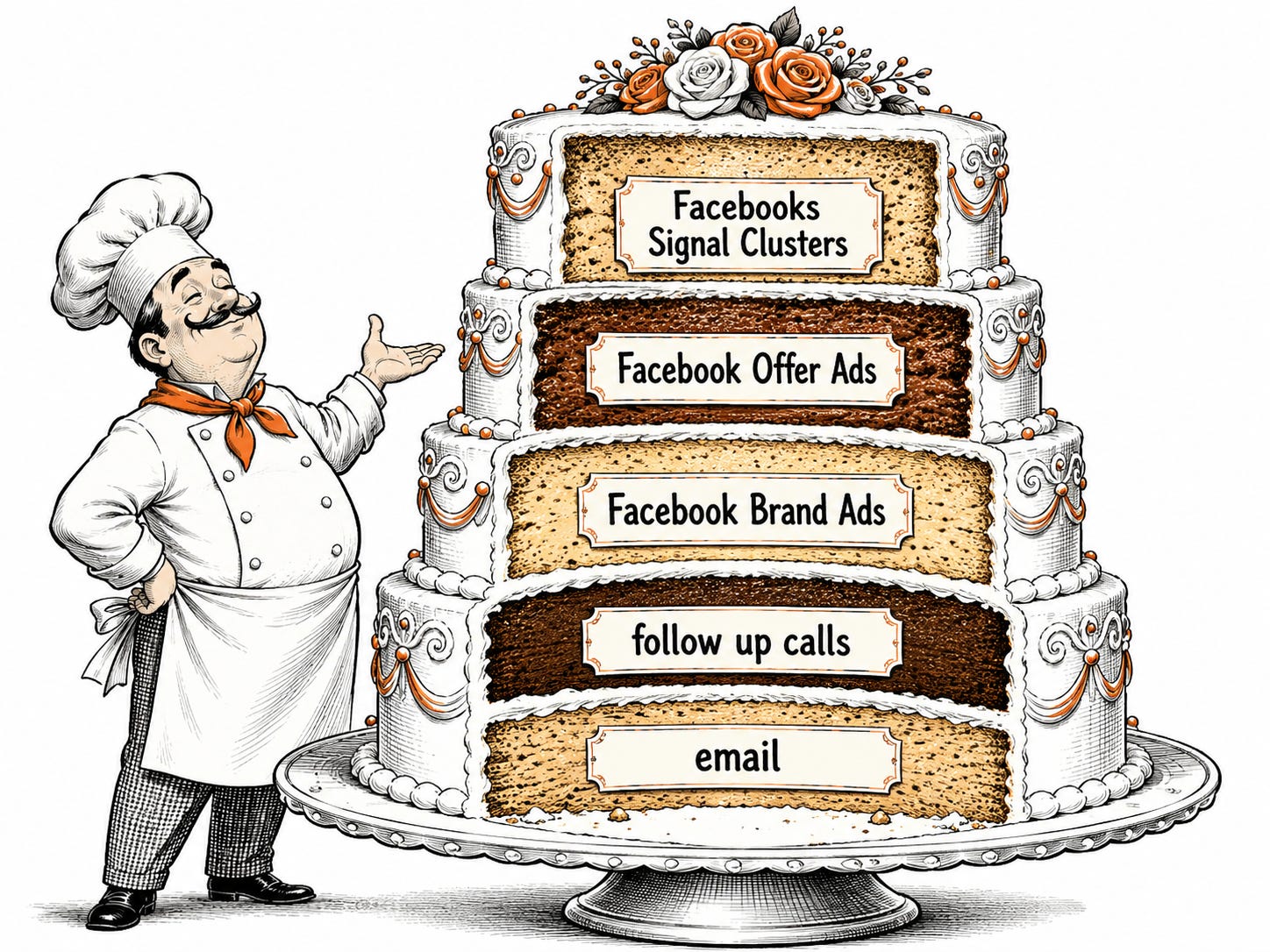
Everything above works as a standalone motion with email and calling. But once you’ve built the signal system, Meta becomes a second layer you can run in parallel, not in lieu of calling, but as an alternative worth testing against.
The mechanism starts with a hyper-targeted audience: you can now pull Meta IDs for people on your list (Clay can handle this enrichment), which means you’re advertising to exactly the accounts in your campaign, not a lookalike approximation.
There are three layers here, and they stack the same way the call hierarchy does:
Brands ads: Brand awareness ads running against the list for two weeks before the email campaign starts, continuing through about five days after the last email sends. Pure warmup: the same list, seeing your name repeatedly, so the email doesn’t land cold.
Offer ads: These run in parallel with the email. A companion offer that speaks to the same pain as the email (in the vulnerability example: a guide to the specific class of exploit). Almost nobody clicks it, and that’s fine; it’s not about the click. It’s secondary validation that the email they got is legitimate. The market’s warmup playbooks all say brand-only, no direct response. Try doing the opposite on purpose. The ad and the email are supposed to bracket the prospect.
Signal-triggered clusters: The same signal logic as the calling hierarchy, aimed at ads instead of a phone. People showing signals get grouped, in one campaign, built around the most common triggers, and served an ad that feels individually targeted even though it’s built from a cluster. Run this well, and you can push the meeting booked rate to 3-4%, on top of the 1-2% baseline lift from the layer alone.
Prove Each Layer Before You Combine It
The reason any of this is trustworthy instead of “just vibes” is the testing discipline underneath it. Run the email-only baseline. Then run one sample with email plus calling, and a separate sample with email plus Facebook, in parallel, isolated from each other. Measure the lift in each. Combine the winners into the final motion. Most people run everything at once and eyeball the result, which means they can never tell you which layer actually did the work. Petri dishes first, then the stack.
The Math on List Size
This approach only works if your total addressable list is big enough to survive the funnel. Signal rate runs around 20% of the list at best. That signal-triggered layer (the most precise and most expensive one) is only ever working a fifth of your TAM. For that math to justify the spend, you want something in the neighborhood of 7,000 to 7,500 accounts feeding the top of the funnel. Below that, your clusters get too small to target efficiently, on Meta or anywhere else.
What to Start Tomorrow Morning
If you already have a baseline meeting booked rate and nothing else: stop adding volume and start watching signals.
Get first-party website tracking wired to whatever CRM you’re running (HubSpot makes this closest to native).
Build your hierarchy: hand-raisers first, signal-crossers second, positive replies third.
Tell your SDR manager to hold off on blanket dialing while you isolate the layer.
Then, once you trust the signal, decide whether the second layer you test is a human on the phone or an ad in the Meta feed, and prove it in its own sample before you let it anywhere near the rest of the list.
Comments
Nothing yet. Say the first thing.
Sign in to join the conversation.