
Tacitus, narrating the fatal year in which Rome consumed four emperors, recorded what came to be called the arcanum imperii, the secret of empire: the humiliating realization that a Caesar could be manufactured far from Rome by the will of legions encamped in distant provinces. The formula stuck. Over twenty centuries, canonists, court jurists, and princely counselors employed it to designate that particular category of knowledge the state retains for itself because it judges the knowledge too dangerous to circulate among the governed. Reason of state, secrecy of justice, time-limited classification, national-interest designation: the names alternate according to the era and the administration’s sense of propriety, while the operation remains rigorously identical since the Flavians. There are things the power knows and things the power does not tell, and the line separating one category from the other is drawn by power itself, without witnesses, without appeal, and, what is aesthetically most striking, without scandal.
I say this because today, in the New Mexico desert, there is a property of a little more than three thousand hectares that functions as an empirical demonstration of the thesis, and whose recent history I would like to submit to your patience.
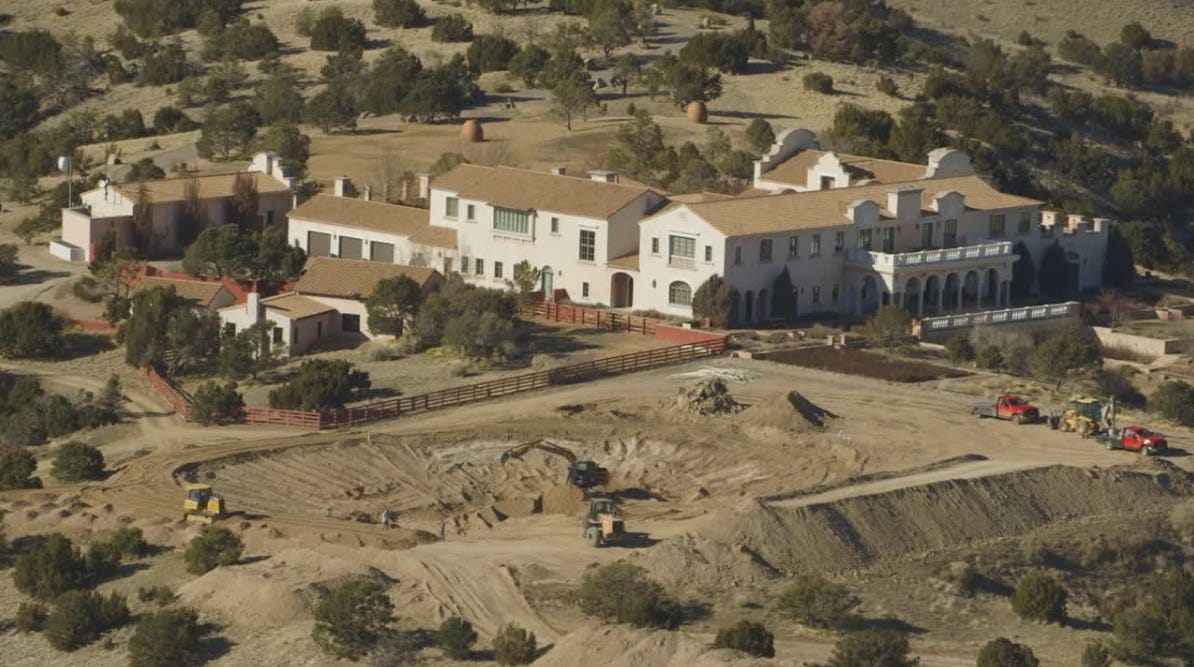
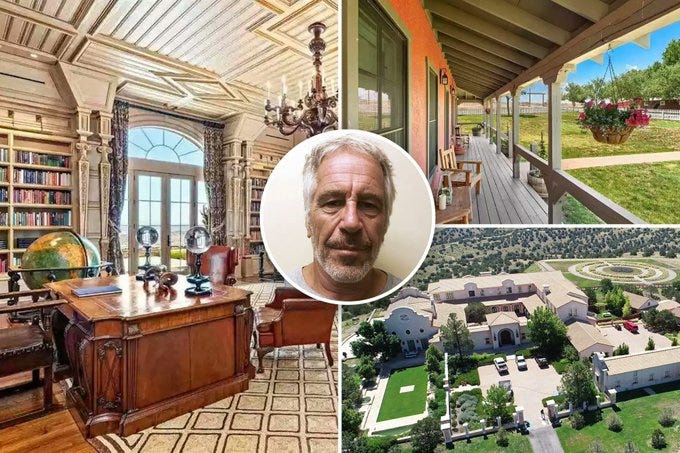
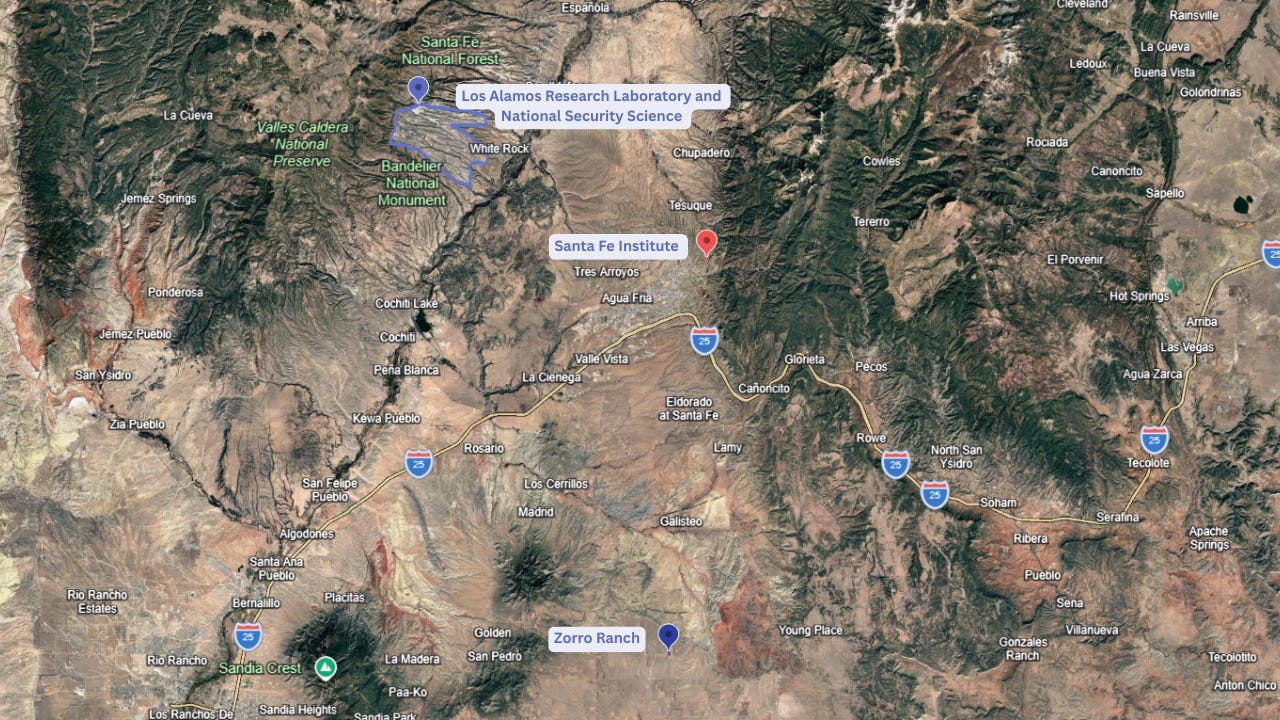
The place is called Zorro Ranch, or was called, since the current owners have rechristened it with the name of a saint, which in the circumstances sounds less like devotion than like an exorcism. Jeffrey Epstein bought the ranch in 1993 from former Democratic governor Bruce King, erected there a twenty-six-thousand-square-foot house, a runway, a hangar, a helipad, and its own fire station, and over two decades received in that desert a quantity of people whose names today appear, duly covered by black rectangles, in the files of the United States Department of Justice. When the financier was arrested in July 2019, federal agents searched the Manhattan mansion, searched the Palm Beach residence, searched the island of Little Saint James in the Caribbean. They did not search the ranch. An internal FBI email dated 23 August of that year, whose signatory remains hidden under redaction, informed colleagues that it was not believed there were items of value to the investigation on the property. Congresswoman Melanie Stansbury would later summarize the point with an administrative dryness that needs no rhetoric, observing that Zorro was the only major property where there were known allegations of sexual crime and where the federal government simply did not request a warrant.
It did not request a warrant, and it requested something else. Hector Balderas, then attorney general of New Mexico, states that he received instructions to stand down. The state investigation was suspended at federal request, the inquiry was handed over to authorities in Washington, and the survivors were left without any accounting of what might have occurred on state territory. This was in 2019, during Donald Trump’s first term, with Epstein already dead in a federal cell in Manhattan and therefore with no risk that the diligence would interfere with the prosecution.
The two emails that slept six years in a drawer
In November 2025, pressured by an improbable parliamentary coalition, Trump signed the Epstein Files Transparency Act, which required the Department of Justice to release the investigative collection. On 30 January 2026 roughly three million pages became public. And it was inside that documentary ocean that two 2019 communications appeared, six and a half years later, communications the FBI had received at the time and about which it had done nothing.
The first was an anonymous email addressed to Eddy Aragon, an Albuquerque radio host, alleging that two young foreign women had been buried in the hills near the ranch. It is worth recording, in the name of the intellectual hygiene that professional-outrage journalists usually dispense with, that the sender also demanded payment in bitcoin for supposed audiovisual material, that the originating account was later deactivated, and that nothing in the released documents corroborates the allegation beyond the message itself. It is an unverified denunciation and must be treated as such. The second communication came from a retired New Mexico state police officer, someone of the craft, who pointed to specific structures on the property worthy of a second inspection, among them a barn whose door had been built in the form of a security lock and a chimney that, in his assessment, required a technical explanation. Both messages reached the FBI. Neither generated any diligence.
A federal agency that possesses indicia and chooses not to convert them into investigative acts produces, over time, something worse than the impunity of the suspect. It produces the material impossibility of proof. Witnesses age and move away, traumatized memories degrade, physical traces disappear, properties change owners and are renovated. Time, the most faithful of public servants, works invariably in favor of those who have an interest in silence.
One hundred and thirty days
What followed has the melancholic beauty of belated things. On 16 February of this year the New Mexico House of Representatives approved by sixty-two votes to zero the creation of a truth commission dedicated to the survivors, endowed with subpoena power and a two-million-dollar budget, and including, among others, a former prosecutor of sex crimes and a retired FBI agent. Three days later Attorney General Raúl Torrez reopened the state criminal investigation. In March, with the cooperation of the current owners, the state finally searched the ranch, employing cadaver-sniffing dogs and drones. It was the first time in more than thirty years that any authority had done on that property what is routinely done at any suspicious crime scene.
And then, the gesture made, came the wall. Because what New Mexico now lacks is no longer access to the ground, but access to the archive. Torrez needs the federal documents without redaction, since every covered name is a line of investigation his office cannot follow, every blocked image is a person who cannot be identified, every suppressed date is a piece of chronology that cannot be reconstructed. The first formal request was filed on 13 February. On 30 June, after half a dozen requests and verbal assurances of cooperation that converted into nothing, Torrez wrote to Todd Blanche, acting attorney general and former personal lawyer to Donald Trump, a letter that became public on 9 July. In it he records that more than one hundred and thirty days have passed since the initial request, that no substantive response has been presented, and that the delay is unreasonable under any criterion of reasonableness. He adds, with the coldness prosecutors reserve for when they are speaking seriously, that every day of retention erodes the foundation on which a state prosecution could be built.
The Department of Justice replied through a spokesperson that it had already responded substantively the previous month, that it welcomes the New Mexico investigation, and that it stands ready to help, including in the event the state discovers federal crimes, which constitutes one of the most refined forms of institutional mockery ever produced in the English language. Two weeks later Torrez sent a new letter fixing 31 July as the final deadline, after which he will treat the request as denied and resort to every available legal remedy. We are therefore witnessing the spectacle of a state attorney general threatening to sue the federal government of his own country in order to obtain documents that a federal law already ordered delivered.
The black bar as method
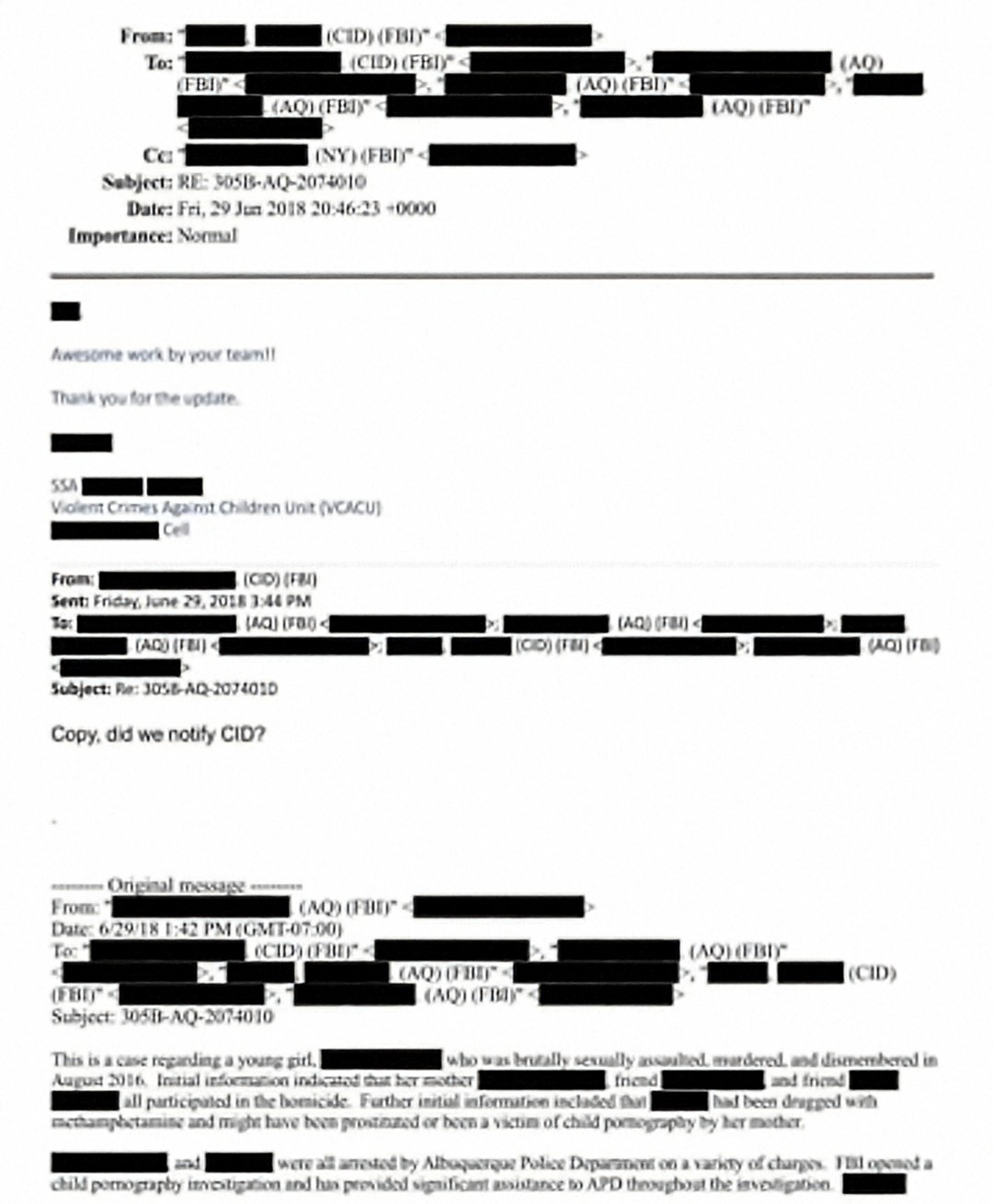
It is now necessary to name the thing, for naming is the first operation of intelligence, and the available vocabulary does not account for the phenomenon. Let us call it tarjocracy. It is not censorship in the classical sense, which prohibits the circulation of the entire document and publicly assumes responsibility for the prohibition. It is something more refined: delivering the document, formally complying with the transparency law, allowing journalists to photograph stacks of released paper, while reserving the sovereign power to decide which syllable inside that paper remains invisible. Tarjocracy does not deny the archive. It returns it emasculated, and returns it with the signature of the one who fulfilled the judicial order.
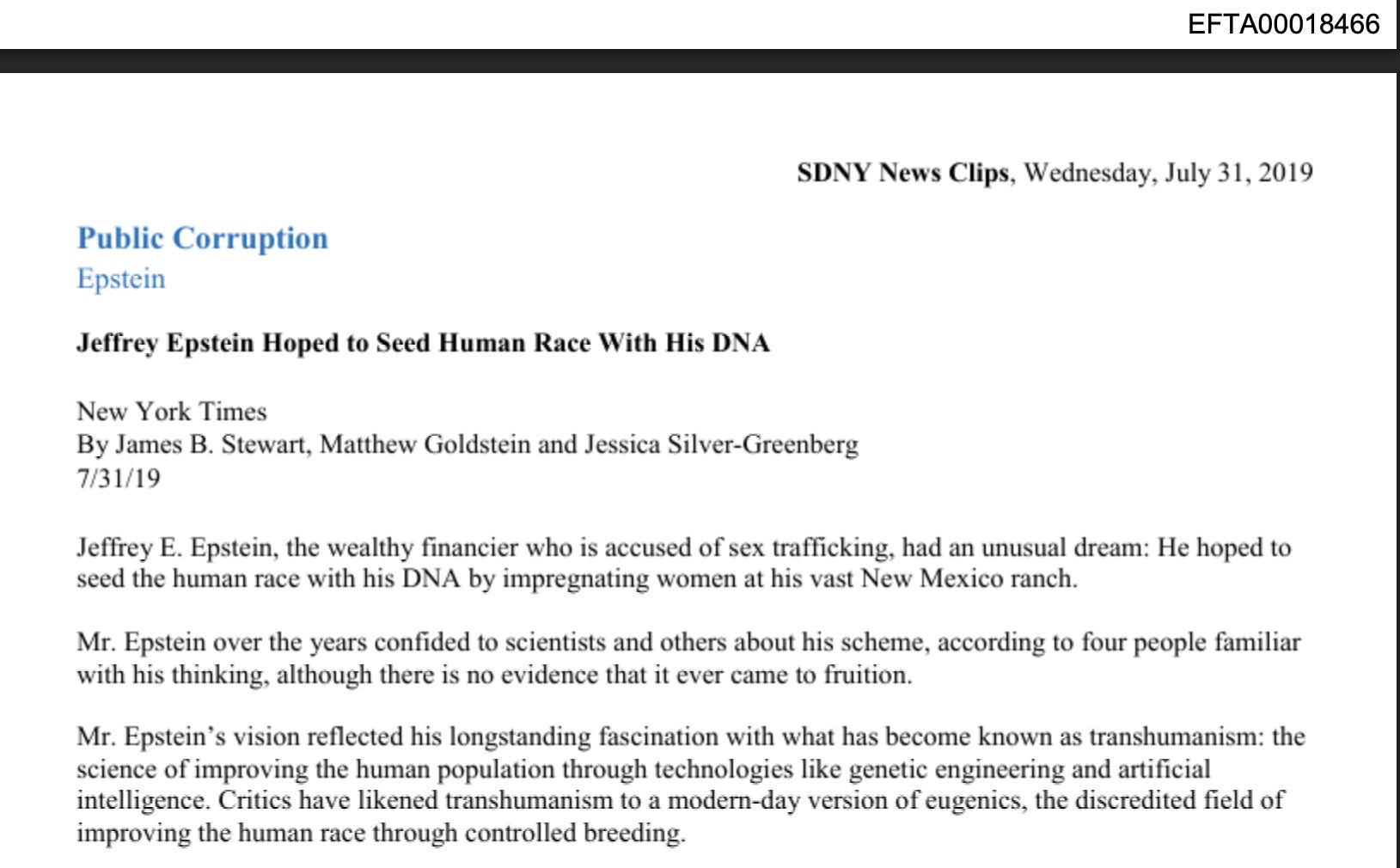
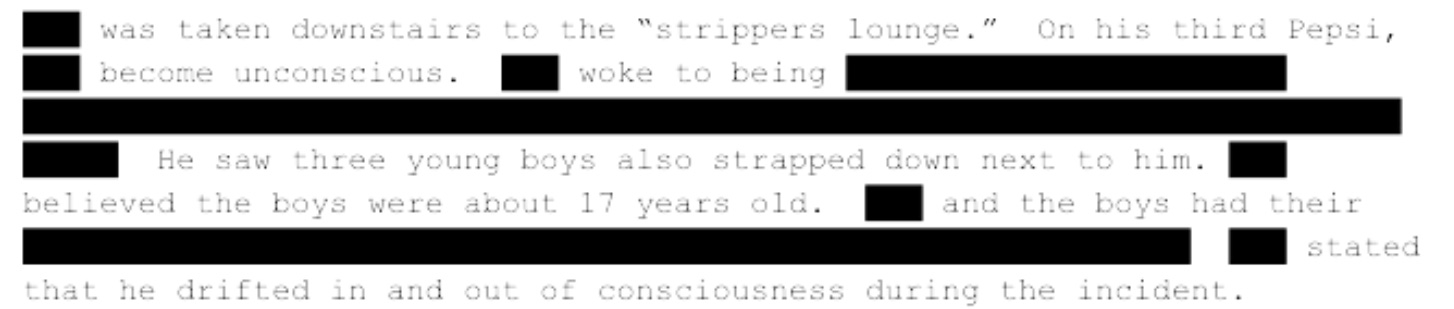
What makes the American case worthy of study, and what should particularly interest the Brazilian reader, is the direction of the scalpel. Lawyers representing more than two hundred alleged victims denounced that the January disclosure left exposed the names of at least thirty-one of them, as well as images that should never have ended up on a government website, an episode they qualified as the most serious violation of victim privacy to occur in a single day in the history of the United States. Simultaneously, the names of the alleged co-perpetrators remained under black rectangles. Congressman Raja Krishnamoorthi reported that a document produced by the Department of Justice itself in 2019, identifying various Epstein co-perpetrators, returned to Congress with at least six identities suppressed, none of which have been disclosed to this day. Of the entire universe of people involved in that structure, exactly two were prosecuted, and one of them, Ghislaine Maxwell, is seeking presidential clemency.
EFTA00150847
Note, dear reader, the surgical precision of the instrument. The same bureaucracy that declares itself incapable of processing six million pages within the legal deadline proved fully capable of identifying, among millions of lines, exactly which names should disappear. The apparatus did not fail. The apparatus worked, and worked in a single direction, exposing those who were violated and protecting those who violated, which in any decent manual of public administration would be called a total inversion of the purpose of the service.
The money, which never lies
There remains the financial chapter, and it is here that the matter leaves the terrain of suspicion and enters that of arithmetic. The Senate Finance Committee and the House Judiciary minority documented more than one and a half billion dollars in suspicious transactions reported to the Treasury by four banks that operated accounts linked to Epstein, among them JPMorgan Chase and Deutsche Bank. The detail that synthesizes the entire era is the following. Between 2002 and 2016, the period in which the scheme operated, JPMorgan reported seven suspicious-activity communications covering a little more than four million dollars. After Epstein’s arrest in 2019 the same bank filed reports covering roughly five thousand transfers and one billion three hundred million dollars. The amount the bank judged worthy of alert while the crime was happening is an infinitesimal fraction of what it judged worthy of alert once the crime could no longer be prevented.
These reports continue to be withheld from Congress. Krishnamoorthi attributes the blockage to Treasury Secretary Scott Bessent. The Treasury does not confirm. It is recorded as a parliamentary allegation, not as a proven fact, which is how parliamentary allegations must be treated. The proven fact is simpler and more depressing: the FBI itself admitted, in a congressional hearing, that it had not followed the money.
On 15 July a group rare in its composition, Republican Thomas Massie and Democrats Ro Khanna, Teresa Leger Fernández, Jeff Merkley, and Ben Ray Luján, introduced the bill that became known as the Epstein Files Transparency Act II, creating a dedicated cause of action so that state prosecutors, members of Congress, and victims can sue the Attorney General of the United States for retention, delay, or improper redaction, and guaranteeing victims the right to obtain the records that concern them. Massie explained the necessity of the second text with a frankness that deserves to be preserved, admitting that it had never occurred to them, when drafting the first law, that the highest official charged with enforcing the law would simply fail to comply with it. Massie, incidentally, leaves Congress at the end of this session, having lost the party primary in May to an opponent backed by the president. The coincidence proves nothing, and it is precisely because it proves nothing that it is so unsettling.
The estate has no homeland
The Brazilian reader who has come this far will already have recognized the architecture, for it is familiar to us to the point of tedium. Raymundo Faoro described with unsurpassed precision the bureaucratic estate that appropriates the public apparatus and converts it into the patrimony of a caste, and what we are observing in New Mexico is an Anglo-Saxon variation of the same phenomenon, with better letterhead and the same outcome. Here, when the bill came due for a group that had confessed to corrupting more than one thousand eight hundred politicians, a single ministerial stroke of the pen sufficed to suspend ten billion three hundred million reais in fines and, in the same movement, to grant the company access to the investigative material, arming the investigated against the investigator. There, the archive is delivered with redaction. Here, the archive is delivered to the defendant. The technique differs; the doctrine is one and the same: whoever controls the record controls the past, and whoever controls the past dispenses with the need to control the present.
Lobaczewski, who studied the colonization of institutions by organized moral deviations, noted that captured structures develop a language of their own to render diagnosis impossible. Administrative deadline, documentary volume, protection of the victim’s privacy, integrity of the ongoing investigation. Each of these expressions, taken in isolation, describes a legitimate concern of any serious prosecutor’s office in the world. Gathered and applied precisely at the point where the archive would cease to protect the institution and begin to accuse it, they form what can only be described as a method.
In the end there remain the numbers of the American government itself. Of roughly six million documents identified as potentially relevant, approximately three million have been published. The word “Zorro” appears nearly fourteen thousand times in that collection. A state of the federation searched the ranch with cadaver dogs and could not read its own files. A state attorney general needs a second federal law in order to be able to sue the guardian of the first. And while New Mexico’s truth commission prepares its preliminary report, the survivors whose names were revealed await the disclosure of the names that remain hidden, in the scarcely reasonable hope that the same machine that exposed them will one day consent to expose the others.
Roughly speaking, this is exactly what the transparency law produced. The archive was opened, and out of it came, first and most clearly, the names of the girls. What the American state managed to protect, in the end, was only itself, and no one needed to disobey anything for that result to be achieved. Tacitus would have understood it all in three lines. We, who dispose of three million pages, continue to wait.
Comments
Nothing yet. Say the first thing.
Sign in to join the conversation.