
On the collapse of cultural transmission, the anti-human utopia, and the late discovery that the wall had been protecting people who had already changed sides

Ortega y Gasset left behind a phrase that crossed the last century without losing its edge, and Mário Ferreira dos Santos, a Brazilian philosopher of considerable depth and almost no readership, had the patience to expand it into an entire book in 1967, at a moment when his country was persuaded it had more urgent business at hand. The vertical invasion of the barbarians. The image offends by its simplicity, insofar as it dispenses with the consoling mythology of hordes descending from the steppes on shaggy horses, since the barbarian, according to the Spaniard and with rather greater metaphysical rigour according to the Brazilian, arrives from nowhere abroad. He is born here, among us, in an air conditioned maternity ward, his birth duly registered by the notary, and he rises vertically through the social body for the elementary reason that nobody bothered to civilise him.
Every child is, technically speaking, an invasion, and culture amounts to the long and unglamorous process by which that invasion gets negotiated, disarmed and finally absorbed into continuity. When the process fails, and it has been failing for three generations now with a regularity that can no longer be charged to accident, what comes out the other end is a barbarism holding a degree, fluent in institutional jargon, credentialed by a graduate programme, perfectly capable of demanding the extinction of the human species in the name of saving the planet. Which is a rather different creature from the mere absence of civilisation, and considerably harder to argue with, given that it can cite sources.
Hayek, writing *The Road to Serfdom* in the darkest years of the war, arrived at the same wall from the economic side and produced a conclusion that today sounds almost naive for being so obvious, namely that the more the state plans, the harder planning becomes for the individual. Moreover, and here is the point that admirers of central planning prefer to leave unexamined, the case for individual liberty rests on the inevitable ignorance of all of us rather than on any presumed intelligence of free men, and it applies with particular force to the sort of person who volunteers to direct other people's lives. The naked state, stripped of the omniscient benevolence it wears at ceremonies, is ignorance multiplied by an apparatus of coercion. And yet *homo credulus* keeps marching down the road, flattered by his intellectuals and browbeaten by his elites, convinced that organisation from the top is the way forward and that safe passage will be granted to him in exchange for one more slice of his liberty, a slightly larger tax bill and a bit more enthusiasm at the next election.
Consider the full catalogue, since it deserves to be recited aloud at least once. Rent controls and price caps, labour legislation that freezes the very market it claims to protect, compulsory unionisation, taxes on income and on property and on consumption and on inheritance, sanctions, tariffs, and the whole apparatus of permits and licences whereby the state first forbids a right and then charges you for the privilege of exercising it, to say nothing of the central bank, the manipulation of interest rates and the control of capital. Broadly speaking, man behaves at the open bar of the state exactly as he behaves at any other open bar, which is why the road to serfdom remains the busiest route on the map and the only one with no toll booths at the entrance.
Do the arithmetic, my friend. Twelve generations of men crossed oceans in ships that sank, buried half their children before the age of five, drained swamps, dug tunnels, froze in trenches over a hundred metres of mud, and endured the hard wind of history without any reasonable expectation of ever seeing the reward. All of that accumulated labour and terror now culminates in a barista who serves the morning coffee and resigns from the future of life on earth with an indignant roll of the eyes, because, you see, she simply can't even. The pyramid took four thousand years to build and it exists so that its summit may announce that the whole thing was a mistake.
Rome, therefore, becomes unavoidable. Rome seldom falls because barbarians are hammering at the gates, since Rome falls when those already inside the walls have auctioned off the grain, corrupted the magistracies, debased the currency of civic trust and taught the population to mistake ceremonial virtue for functioning order. The men who destroy a republic are ordinarily seated within it, robed in legitimacy, speaking the language of compassion with practised fluency, managing the funds, awarding the posts, hosting the conferences, collecting the donations and congratulating one another on their humanity while the structure they swore to maintain rots in plain view. Call it barbarocracy, for want of a less flattering word, since the thing has offices, a communications department and a diversity policy.
Brazil knows the mechanism intimately, though it insists on treating it as a foreign novelty imported by container. The ESG utopia collapsed here as everywhere else, and the retreat was ordered from inside the global financial centre itself rather than by any marginal sceptic, once the green catechism stopped paying dividends and the banks began walking out of their climate alliances with the discreet haste of men leaving a cult before the photographers arrive. In the matter of our great state sponsored champions we learned once more that Brazilian law behaves like a spiderweb, catching the small fly and tearing open before the large beetle, a lesson repeated when a justice of the Supreme Court suspended billions in fines attached to confessed crimes with a single stroke of the pen. Every form was observed along the way, the rites were performed, the legal opinions came out duly signed and stamped, and the patrimonialism that Raymundo Faoro diagnosed a lifetime ago went on breathing quietly under all that paperwork.
Which is precisely what Mário Ferreira dos Santos anticipated by several decades, since the vertical invasion does not topple institutions. It occupies them, empties them and preserves the rind with enormous care while the insects finish the fruit inside. The walls of the city are in excellent condition, freshly painted, certified, admired by visiting delegations. We keep paying the guards, and the guards, to be fair to them, perform the ceremony of guarding beautifully. Civilisation will arrive at its appointed end perfectly on schedule, with all licences current and a certificate of sustainability attached.
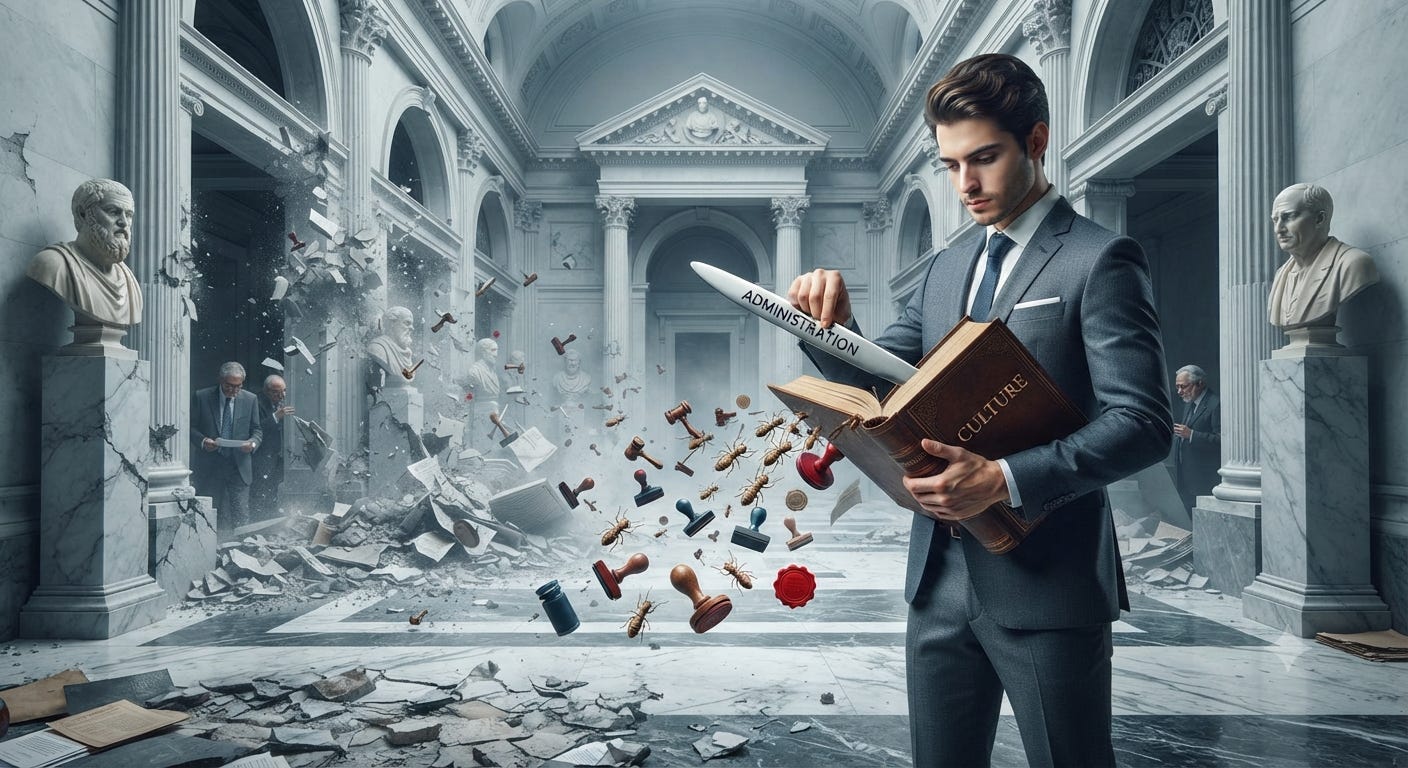
So the trouble with the West has less to do with anyone's arrival than with our own persistence. We built magnificent walls and financed the armies to man them, we argue about borders and immigration quotas with considerable passion, and somewhere along the way we stopped explaining to our children what the wall had been built to protect. Perhaps that is the only good news in the whole story, since vertical barbarism, unlike the mounted hordes, never has to be defeated in open field. It has only to be educated, an operation that costs very little money and rather more effort than anyone appears willing to spend.
Comments
Nothing yet. Say the first thing.
Sign in to join the conversation.