
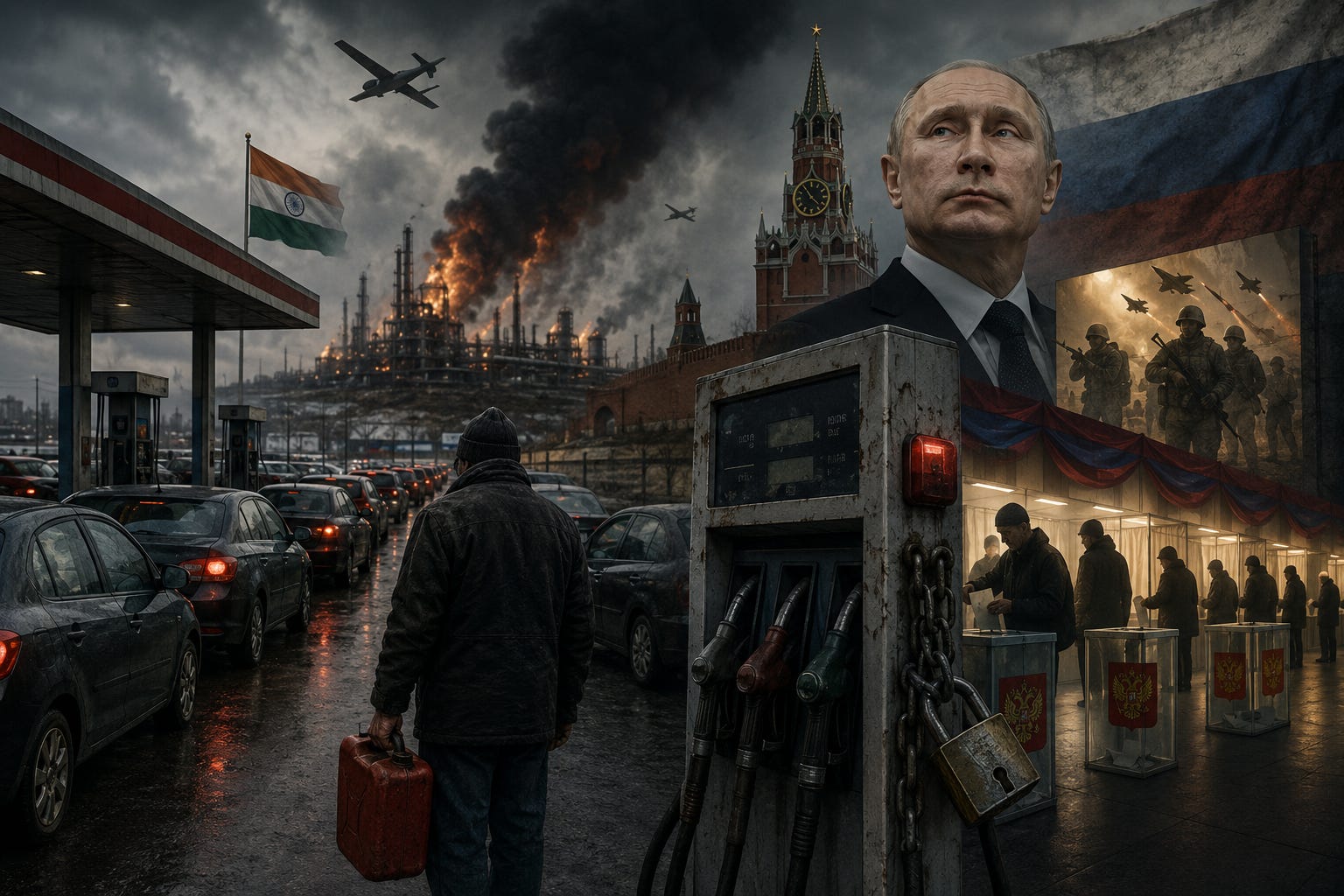
Thucydides, who knew war from within before he knew it as a historian, wrote that armed conflict is a violent teacher precisely because it reduces men's temperament to the level of their circumstances. The phrase, forged twenty-five centuries ago to explain Corcyra's moral decomposition, gained in 2026 an involuntary and almost didactic illustration. The planet's largest hydrocarbon producer, the country that for two decades wielded gas as a diplomatic argument and petroleum as geopolitical artillery, now rationed gasoline to its own population. Hours-long queues at filling stations, suspended fuel exports, degraded fuel quality standards by decree, and to complete the portrait with that touch of irony History reserves for distracted empires, Russia buying gasoline from India. The gas pump with nuclear warheads, as an American senator once jeered, had run dry. The warheads, those remain.
Al Jazeera's Moscow correspondent, Yulia Shapovalova, summarized the situation in a dry sentence while reporting that the crisis is deep. Ukrainian strikes on Russian refineries and fuel storage facilities, increasingly frequent and striking ever deeper into Russian territory, compromised the supply chain to the point where the government declared a state of emergency in Crimea and admitted the possibility of shutting down industries to guarantee harvest diesel. Moreover, the country that once dreamed of importing only technology and arrogance now negotiates the import of hundreds of thousands of tons monthly of gasoline from wherever it can get it, with the predictable effect on an already squeezed balance of payments ravaged by war and sanctions. An empire, broadly speaking, is measured by the distance between what it promises and what it supplies. And Russia in 2026 does not supply even its own citizen's fuel tank.
The Kremlin's semantic alchemy
Confronted with the crisis, the Russian president produced one of those phrases that deserve a place in any future anthology of State euphemism. He said the situation is not critical. Now, not critical for whom, one might ask the driver from Voronezh in the fourth hour of a queue. Not critical for whom, the farmer would ask, who does not know whether there will be diesel for harvest or employment afterward. The answer, evidently, is that it is not critical for whoever formulates the phrase, since the author of that assessment fuels at pumps that know no scarcity.
Yet the Kremlin's verbal alchemy goes further still. Putin refuses to call war the strikes Ukraine delivers deep into Russian territory. He prefers to classify them as terrorist acts against civilian targets and infrastructure. The vocabulary choice is not innocent, and the reader who has followed my texts on Brazilian pseudoducational environments will recognize the mechanism, for it is rigorously the same. Walter Lippmann explained a century ago that the public rarely sees the naked fact, it sees the frame around it. The Kremlin governs the frame with far more zeal than it governs fuel supply. If there is no war, no defeat is possible. If there is only terrorism, one merely administers the consequences, rations the fuel, buries the dead discreetly, and carries on. Reality, however, has an inconvenient habit. It does not read official communiques.
Indeed, we are in the fifth year of what Russian bureaucracy still insists on calling a special military operation, an expression that was old at birth and today sounds like those diminutives families use to avoid naming the patriarch's illness. Four and a half years of a conflict that was supposed to last weeks, against an adversary that the Kremlin itself once described as an artificial state governed by comedians. For purposes of historical comparison, and the comparison is cruel, Stalin's Red Army took less time to break the Wehrmacht's spine, then the most feared military machine on the planet. The contrast dispenses with adjectives, so I merely register it.
September 2026, or the election as analgesic
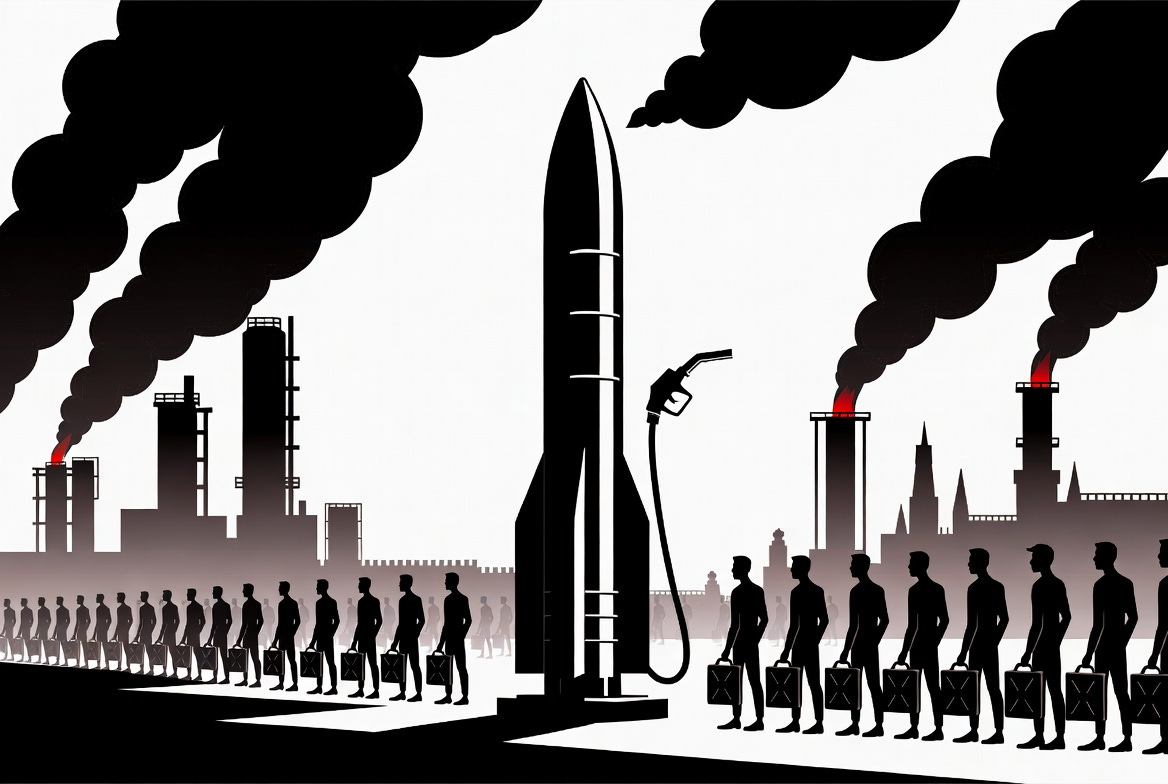
And it is in this scenario of rationed bombs and falling bombs that Russia prepares for its Single Election Day, scheduled for September, when a new Duma is elected. Backstage reports circulating among analysts of Russian political systems describe a Presidential Administration in full pre-electoral mode, treating the government's declining popularity not as crisis, but as an administrable variable. The precedent comforts the Kremlin's technocrats, for the legislative elections of 2011, 2016, and 2021 were likewise not accompanied by popular enthusiasm, and yet the outcome was nonetheless the expected one. Managed democracy has such conveniences. The voter votes, the system counts, the Kremlin wins, and the only genuine uncertainty is the size of abstention that will need disguising.
The novelty of this cycle, nonetheless, is fatigue. The social weariness of a war entering its fifth year ceased being academic hypothesis to become acknowledged background risk for the regime's own strategists. Their response, dear reader, is of a cynical elegance deserving record. Unpopular measures were discretely postponed until after the ballot, while the campaign is being reframed as a referendum on security. Observe the subtlety of that displacement. A referendum on government performance would ask why there is no gasoline in a country floating on petroleum. A referendum on security asks only whether the voter is afraid. And fear, let us grant, is the only commodity the Kremlin still produces with a surplus.
The rest of the Russian party landscape completes the opera with its circus acts. The Communist Party, nominal heir to Marx, just filed a manifesto in the Duma dedicated to the Russian people as state-forming, breaking with proletarian internationalism to compete for the nationalist electorate, which amounts, broadly speaking, to a vegetarian opening a steakhouse for reasons of commercial survival. Zhirinovsky's party, orphaned from its founder, bets on the dead man's posthumous sanctification, transforming a politician into a relic and a political banner into a chapel. The New People party must demonstrate legislative effectiveness. And Fair Russia must demonstrate, according to a formulation that circulates priceless among analysts themselves, that it exists. Behold pluralism Moscow style, a garden where every flower is plastic and the gardener works for the Presidential Administration.
When even friends begin to ask
There is, however, a symptom more interesting than the queues and more revealing than the electoral choreography. The most pointed criticisms of how the war is being conducted no longer come only from Kyiv, Brussels, or Western newsrooms. They come from within the very ecosystem of commentators who spent years defending Moscow. Paul Craig Roberts, American polemicist veteran who built a reputation denouncing Washington's hegemony and openly sympathizing with Moscow's reasons, now asks in exasperation why a first-rate military power cannot defeat in four and a half years an adversary he himself classifies as third-rate. Roberts even speculates, and I register that this is declared speculation and not established fact, whether pro-Western forces within Russia's government itself might be sabotaging the war effort, and provokes with the rhetorical question of whether Putin might be an unwitting agent of the West. Gilbert Doctorow, another analyst historically sympathetic to Moscow, raised a similar interrogation. And the truly significant detail is that both texts were translated and published in the Russian press.
Pause there a moment, dear reader. In a regime that imprisons citizens for calling war by its name, domestic newspapers publish foreign columnists asking whether the czar knows what he is doing. This admits two readings, and neither is reassuring for the Kremlin. Either censorship has weakened because the system no longer has the energy to police all its narrative frontiers, or someone within the apparatus wishes the question to circulate, which would suggest that informal succession struggle has already begun in the cellars while the facade celebrates stability. In either case, the message is identical. The monopoly on the frame, to return to Lippmann, has begun to crack.
The uncomfortable mirror
It would be comforting to end here, with the West in the audience laughing at the gasless czar. But the reader who follows my work knows I do not write to comfort anyone, and intellectual honesty obliges turning the mirror around. The technique the Kremlin applies with brutality, we apply with varnish. Here too governments prefer to administer perception rather than correct fact, here too elections are reframed so the uncomfortable question never reaches the ballot, here too technical language serves as armor against diagnosis, as I have already demonstrated by dissecting Brazilian education and the ESG utopia. The difference between Moscow's managed democracy and the West's anesthetized democracies is one of degree and method, not nature. There they ration gasoline and manufacture consent. Here we ration truth and outsource consent to consultancies.
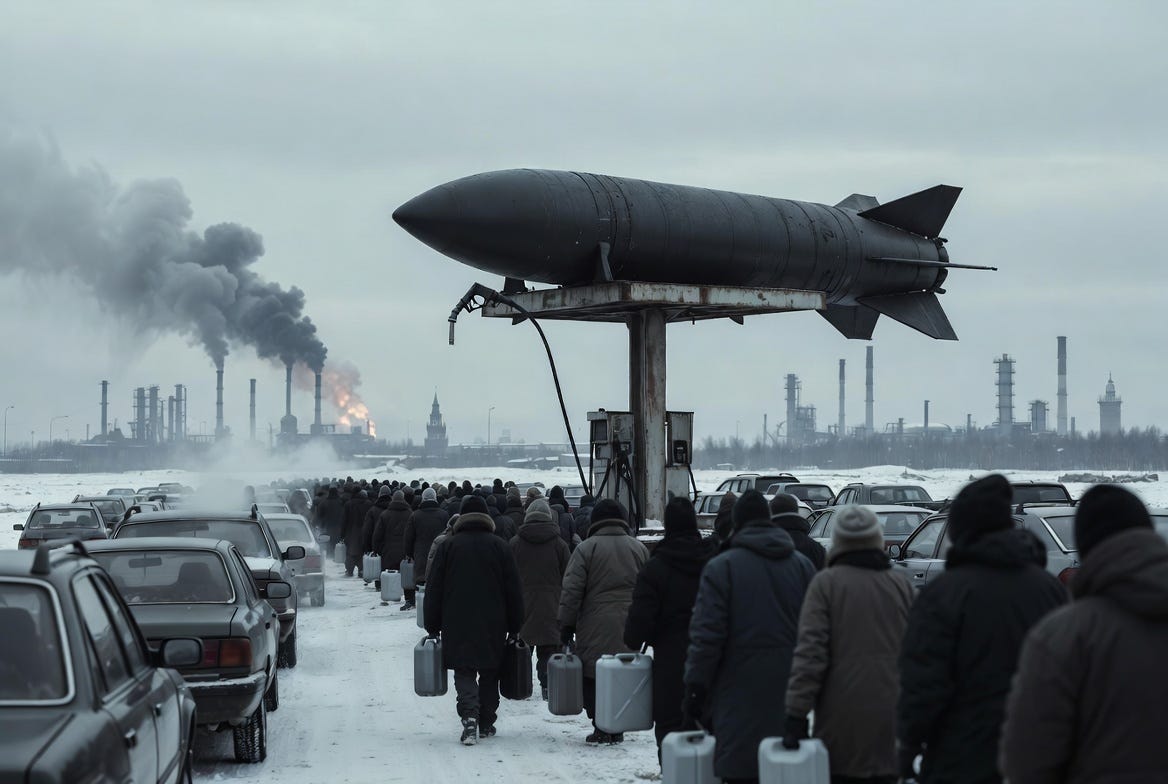
The war was conceived to demonstrate that Russia was a great power. Four and a half years later, it has demonstrated the opposite with an eloquence no enemy could achieve. And September's election, designed as a referendum on security, will be in practice a referendum on fear, that fuel the regime distributes without rationing and without queues. Thucydides, who saw Athens rot from within while triumphing from without, would recognize the plot without difficulty. The empire does not die when the enemy reaches the gate. It dies when the citizen, having stood four hours in a filling station queue, looks at the campaign poster and finally understands that the empty tank is the only official communique he can still trust.
Comments
Nothing yet. Say the first thing.
Sign in to join the conversation.