
There was something about the Canal Zone that stayed with you.
Not just the heat, or the jungle pressing against the back fence, or the sound of ships moving through the Cut in the dark. It was the feeling of the place — the particular ease of a community that knew itself completely. Neighbors who left their doors open. Kids who ran between houses like the whole street was one long yard. Friday night lights at Balboa Stadium. The commissary. The clubhouse. The smell of rain on concrete in the rainy season, which came every year like a promise kept.
Zonians did not just live in the Canal Zone. They belonged to it. And for the better part of a century, it belonged to them.
That belonging had a legal foundation. The Hay-Bunau-Varilla Treaty of 1903 granted the United States rights to a ten-mile-wide zone across the Isthmus of Panama — rights of use, occupation, and control that were, in the treaty’s own language, granted in perpetuity. That word appears seven times in the 1903 treaty. It was not accidental. It was a declaration. The Zone was not a lease. It was not a temporary arrangement. It was permanent American territory, established by treaty, protected by law, built to last.
And so Zonians built accordingly. They built schools designed to prepare children for any grade in the United States. They built hospitals, churches, golf courses, theaters, Little League fields, and commissaries. They built communities — Balboa, Cristobal, Gamboa, Margarita — with the quiet confidence of people who expected to be there forever. Because the treaty said they would be.
In perpetuity.
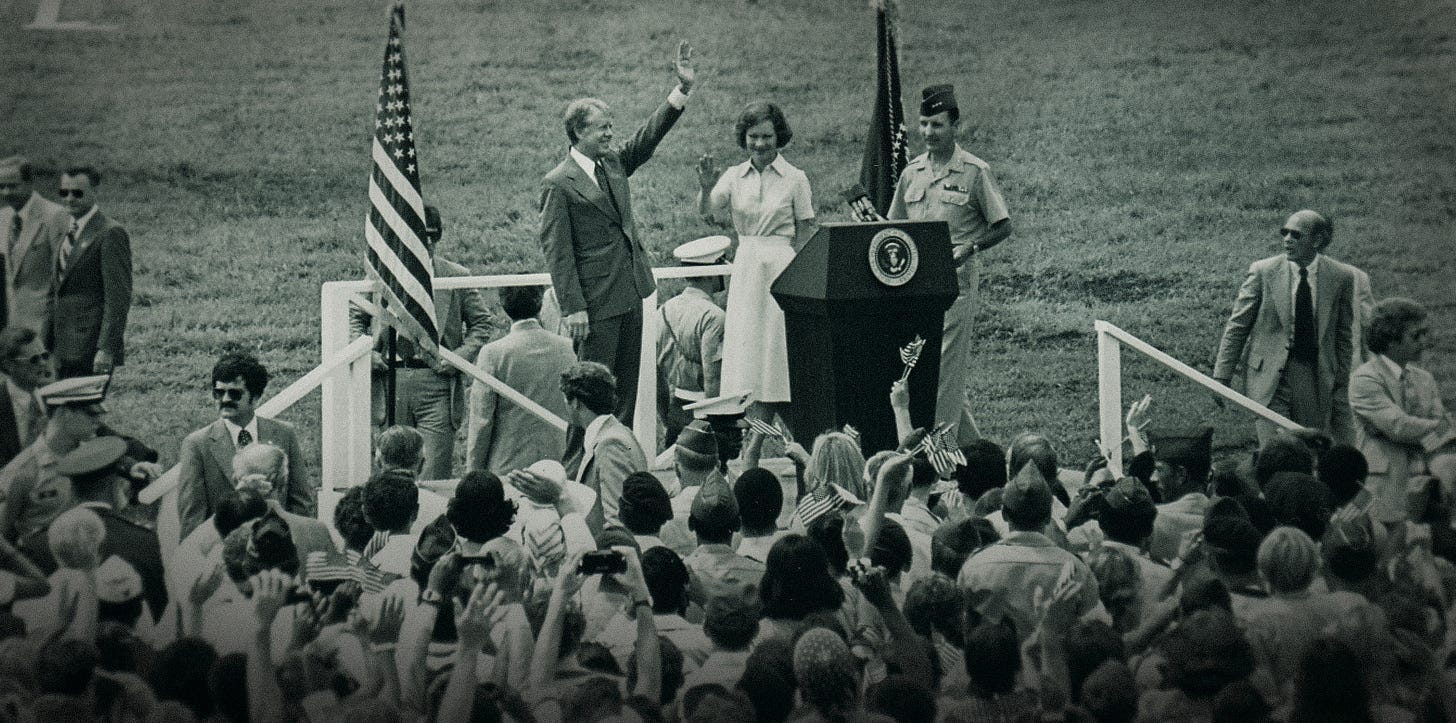
On September 7, 1977, President Jimmy Carter and Panamanian General Omar Torrijos Herrera signed two new treaties at the headquarters of the Organization of American States in Washington, D.C.
The Panama Canal Treaty — formally, Treaty Document 95-14(A) — opened with an act of legal erasure. Article I terminated and superseded the Hay-Bunau-Varilla Treaty of 1903, along with every agreement that had followed it. Seventy-four years of treaty language, including every instance of the word perpetuity, was struck from the record in a single article.
Article II stated the new terms in plain language:
“This Treaty shall terminate at noon, Panama time, December 31, 1999.”
That sentence — twenty-two words — is the legal moment the Canal Zone’s future changed. Not 1979. Not 1999. 1977. The treaties were ratified by the U.S. Senate in early 1978: the Neutrality Treaty on March 16, the Panama Canal Treaty on April 18, both by a vote of 68 to 32 — one vote above the required two-thirds majority.
The margin tells you something. The country was not certain. But the vote was cast.
Zonians who feel that 1977 was the end are not wrong about what they felt. The sentence had been handed down. The home they had built on the word perpetuity had been given an expiration date. The grief was real, and it was immediate, and it deserves to be named as such.
The treaties entered into force on October 1, 1979. This is the date most commonly cited as the end of the Canal Zone, and it is worth being precise about what that date actually changed — and what it did not.
What changed on October 1, 1979:
The Canal Zone ceased to exist as a named legal jurisdiction. The Canal Zone Government was dissolved. U.S. district courts in the Zone closed. The Panama Canal Company was reorganized into the Panama Canal Commission, a U.S. government agency operating under a binational board with both American and Panamanian members. Panamanian law began to apply in areas that had previously operated under U.S. jurisdiction. Certain lands were transferred to Panama immediately.
These were not small changes. For Zonians who had grown up understanding the Zone as unambiguously American territory, October 1, 1979 represented a rupture. The legal architecture that had defined their community — U.S. courts, U.S. government, U.S. jurisdiction — had been fundamentally altered. The order had been executed.
But consider what remained.
American families still lived in Zone housing. American children still attended Zone schools — Balboa High School, Cristobal High School, Curundu Junior High. American employees still reported to work at the Panama Canal Commission. The commissary system continued. The military remained: Fort Clayton, Howard Air Force Base, Rodman Naval Station, Fort Gulick, Fort Sherman, Quarry Heights. The social fabric of Zone life — the churches, the civic organizations, the sports leagues, the neighborhoods — continued to function.
Anyone who was present in the Zone in 1981 — two years into the transition — would not have found a community in collapse. They would have found a community under pressure. Changed, yes. Uncertain, yes. But alive.
The distinction matters. The legal jurisdiction ended in 1979. The community did not.
What followed October 1, 1979 was not a sudden end but a prolonged and systematic unwinding — an institutional dissolution that proceeded gradually, deliberately, and on a schedule written into the treaties themselves.
The Implementation Agreement signed alongside the Panama Canal Treaty specified that American housing would transfer to Panamanian authority in phases: twenty percent within five years, thirty percent within ten, forty-five percent within fifteen, sixty percent within twenty. Military bases would be vacated on a negotiated schedule. Employment in the Canal system would shift toward Panamanian nationals, with U.S. staffing required to decrease by at least twenty percent within the first five years.
Schools closed. Not all at once, but one by one, as families departed and enrollment numbers could no longer sustain them. Businesses that had served Zone residents for decades shuttered or relocated. Military installations that had defined the Zone’s geography since the construction era were handed over, emptied, and transferred.
Families left. Some early, reluctant to watch the dismantling proceed. Some late, holding on until the last possible moment. Each departure took something with it — a neighbor, a household, a thread in the community’s fabric.
By the early 1990s, the Zone had been transformed. It was not gone. But it was no longer what it had been. The transition period was doing exactly what it was designed to do.
The Panama Canal Treaty terminated at noon on December 31, 1999.
Not at the moment the Senate voted. Not when the treaties entered force. Not when the first property transfer occurred or the first school closed or the first military base was handed over. The treaty itself — the controlling legal document — specified its own termination date, and that date was December 31, 1999.
On that day, all remaining property transferred to the Republic of Panama. All remaining U.S. military forces departed. The Panama Canal Commission ceased operations and was replaced by the Panama Canal Authority, a Panamanian government agency. Full sovereignty over the Canal and the former Zone passed, completely and finally, to Panama.
Balboa High School had graduated its last class earlier that year. The school that had educated generations of Zonian children, that had sent its graduates into American universities and careers and lives built on the assumption that the Zone would always be there — graduated its final class in 1999 and closed.
That is not a 1979 story. It is a 1999 story.
The treaty said 1999. The treaty was right. The Zone — the legal jurisdiction, the physical community, the institutional apparatus, the living reality of the place — concluded in 1999 when the treaty that governed it reached its specified end.
Each of these years carries its own truth:
1903 gave Zonians the promise of perpetuity and the life that word made possible.
1977 took that promise away and replaced it with a date.
1979 began the execution of the order — the systematic, treaty-mandated transfer of authority that would proceed for the next twenty years.
1999 completed it.
To say the Zone ended in 1979 honors the grief of those who felt the legal ground shift beneath them when the jurisdiction changed. That grief was real. It should not be dismissed.
But the treaty does not end in 1979. The community does not end in 1979. The schools, the families, the military, the institutions — none of these end in 1979.
The Zone ended when the treaty said it would end.
At noon. Panama time. December 31, 1999.
Canal Zone Documentary is preserving the full story of the Canal Zone and the Zonian community. To support this work, visit canalzonedocumentary.substack.com.
No posts
Comments
Nothing yet. Say the first thing.
Sign in to join the conversation.