
⭐ Before you begin
If this content resonates with you, we’d love for you to subscribe, share it with someone who might benefit, drop a comment with your thoughts, and/or follow us on Instagram! Every share, like, and conversation helps us reach more people and build a stronger community around these crucial topics. We’re grateful for you.
Andrew Tate has returned to the center of public conversation following his and his brother Tristan Tate’s arrests on July 18, 2026. They were both arrested in Miami following a request from British authorities seeking their extradition on multiple criminal charges including rape and sex trafficking.
Anytime Andrew Tate (or any powerful misogynistic figures) return to the headlines, we see the same cycle of conversations start. We start asking if this arrest, or another court appearance, or a bigger wave of media coverage will convince people to stop listening to their messages. I understand that hope, especially when it comes to the Tate brothers. They have become synonymous with online misogyny, and it’s comforting to think that removing them from the public sphere would remove the problem. After nearly a decade facilitating consent and sexual violence prevention workshops, I’m confident that we’re asking the wrong question, no matter how well-intentioned and hopeful it is.
The thing is, Andrew Tate’s influence isn’t really about him as an individual. It’s about unpacking why his platform built on dominance, rigid gender roles, and an open contempt for women’s equality found such a large audience.
Like many folks, I started hearing about Andrew Tate online – both appearing independently in my feed and through other prevention educators trying to sound the alarm of this influencer on the rise. His videos and ideas started appearing offline fairly quickly: while facilitating workshops, sitting in classrooms, and connecting with other educators who weren’t sure how to address this yet. Teachers, administrators, and parents were rightfully concerned. Students were being shown this man who was ‘successful’ by the metrics our society had given them: money, physical dominance, respect from men, and beautiful women around him. Tate was proudly flaunting all of this, while openly identifying as a misogynist. He has continually argued that women’s value is rooted in beauty and femininity, that women need dominant men to lead them, that women are unsuited for leadership roles, and that feminism has weakened our society (and that’s just the tip of the iceberg).
None of these ideas are new. Andrew Tate certainly didn’t invent a dedication to harmful forms of masculinity, and prominent, powerful, misogynistic men didn’t arrive with him, or even with social media – that’s been woven into the fabric of our world for a long time. The thing that Andrew Tate did incredibly well was packaging these misogynistic ideas into something aspirational. He showed off a life of luxury, attaching his beliefs to promises of wealth, physical dominance, and an unquestioned authority over the women around him. He transformed these longstanding beliefs into a lifestyle brand, and it worked. His audience didn’t emerge despite his misogyny. In many ways, it emerged because of it.
These ideas also weren’t new to me when they came packaged with Andrew Tate – throughout my work in sexual violence prevention, there have always been people who cling to traditional gender roles. People who are carrying victim-blaming beliefs they may not even recognize in themselves. People who want to ask the most provocative question they can just to see what happens. Knowing how to navigate that has always been a part of the job, and it’s both a challenge and a learning experience. However, Andrew Tate, Donald Trump, and the manosphere ushered in a new era of open misogyny without shame. I began to see participants stating these beliefs plainly – without worry of how to package these ideas. More and more men began to challenge my expertise and qualifications outright. And this is where I understand the instinct to tie Tate to all of these issues. But it’s important to remember that most young men are just trying to figure out what kind of man to become, and if the loudest voices offering a clear perspective on masculinity are equating being a man with dominance and control, it’s not surprising that people might listen.
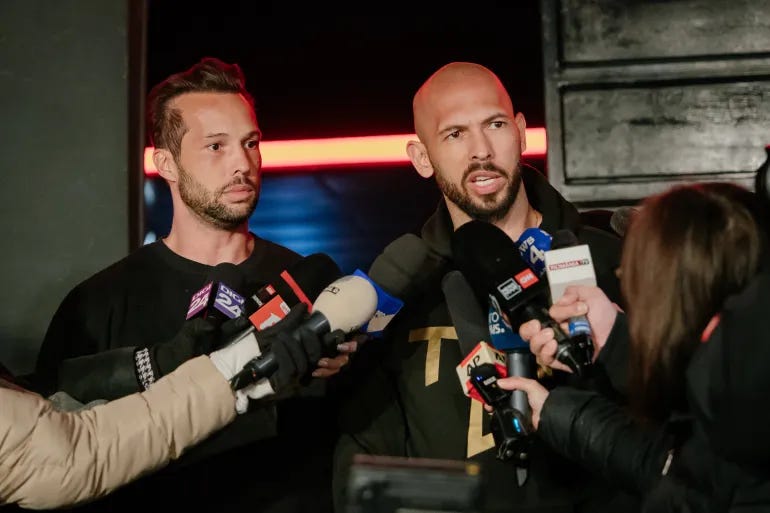
It’s tempting to believe that removing Andrew Tate solves the problem. But misogyny has never depended on a single person.
All of this seeps into the zeitgeist. People might be repeating Tate’s messages and language around masculinity and relationships without even realizing it. The shift that I’ve seen the most isn’t that these ideas are being talked about – they always have been. But there’s a stronger confidence in these beliefs now. Participants aren’t asking me questions out of curiosity, or even trying to challenge me based on their own beliefs – they’re openly challenging the premise of sexual violence prevention and consent education. Conversations about consent have become more nuanced because they increasingly come from opposing assumptions about gender and relationships. Before we even talk about consent, I often have to unpack beliefs about power, gender, and equality – and sometimes it feels like the middle ground to start from is getting much smaller.
This is why a focus on Tate individually, or even on his criminal process, can miss the point. The legal process matters. Accountability is incredibly important. But regardless of what happens with Andrew and Tristan Tate, we’re still left with some big cultural questions to answer:
Why were so many young men either looking for someone or drawn to someone who framed control as strength, vulnerability as weakness, and women as obstacles or possessions?
Why were so many adults willing to dismiss concerns as internet drama while teachers, parents, and prevention educators were already watching those ideas surface offline?
Regardless of what happens in this case, whether we see convictions, acquittals, extraditions, or just a continued cycle of appeals over the next decade, these questions don’t disappear. New men will take his place, because the space created for these messages didn’t begin with Tate to begin with. It will continue until we’re willing to invest beyond media coverage and internet outrage: with ongoing conversations about consent, healthier models of masculinity, communities that challenge sexism before it escalates into violence, and education that treats respect as something to be practiced rather than something to be discussed after harm has already occurred.
I hope Andrew and Tristan Tate are held accountable for these crimes. I hope they have to face consequences for the enormous amounts of harm they’ve caused. But regardless of the outcome, we shouldn’t mistake their criminal case for the resolution of a much larger problem. You can extradite people – but you can’t extradite misogyny.
Comments
Nothing yet. Say the first thing.
Sign in to join the conversation.