
A recent leadership session I facilitated reinforced something I am hearing across industries right now: people are not just trying to learn AI tools. Leaders, and increasingly professionals at every level and across every function, are trying to understand how their role fits as work itself is being redesigned.
That uncertainty is showing up everywhere. People are experimenting with AI tools, learning prompting techniques, trying to understand what skills will matter, and quietly asking themselves where they fit as more tasks become automatable.
Most of the advice focuses on learning how to use AI. That is necessary, but it is not sufficient.
What we are living through is not just the introduction of better tools. It is a systemic redesign of how work gets done. Tasks that once required human coordination are increasingly handled by software, while work that once centered on execution is shifting toward judgment, direction, and oversight. The advantage is slowly moving from doing the work to shaping how the work gets done.
This is why we need to expand what we mean when we talk about AI fluency.
I prefer to think about this more broadly as digital fluency, because the real skill is not mastering one technology. It is developing a set of capabilities that allow you to navigate continuous technological evolution without having to start over every time something new emerges. Digital fluency is not just the ability to use technology. It includes systems thinking about how technology shapes decisions and workflows, applying critical thinking to outputs, staying adaptable as capabilities evolve, recognizing risks and tradeoffs, and exercising the judgment needed to decide when to rely on technology and when human intervention is necessary.
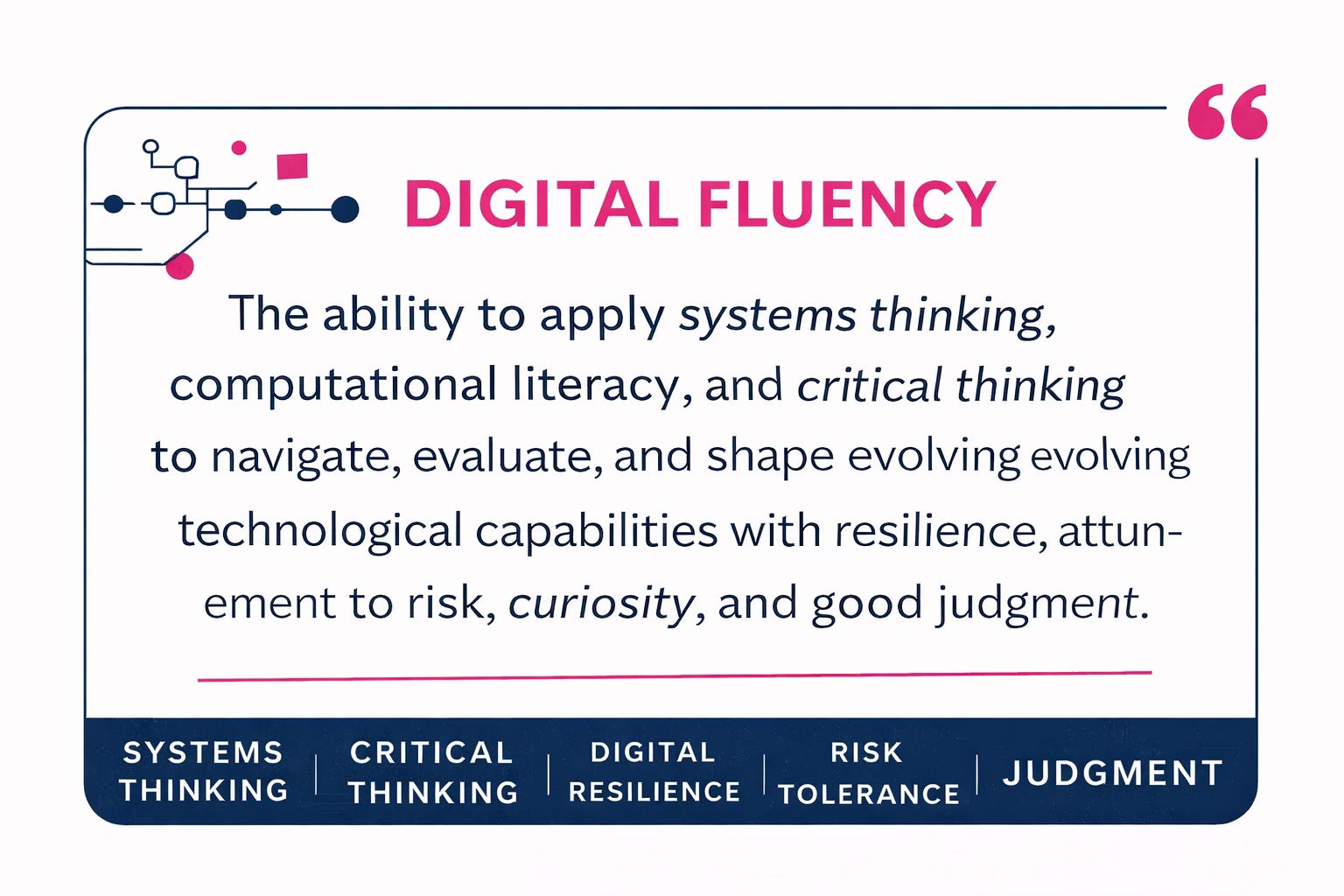
At its core, digital fluency is about understanding how technology reshapes decisions, incentives, and authority so you can operate inside that change rather than react to it.
In practice, this shows up as the ability to:
recognize what work should be delegated to systems and what should not
understand that introducing AI often requires redesigning how work is structured, and that sometimes the responsible decision is to delay automation until the people, process, and technology are ready
understand how automated decisions are being made around you
question outputs rather than accept them at face value
think through how a system could fail, be misused, or act outside its intended boundaries, and stay alert to those risks (and new ones) while you are relying on it
understand risk well enough to push for guardrails
recognize when using AI may affect trust, context, or the experience of colleagues, customers, or communities, and adjust how you use it accordingly
learn how to direct systems, not just use them
As work reorganizes around systems that can act, a quiet but important shift is happening. Some people will primarily perform work. Some will use AI to perform work faster. Others will increasingly shape how work itself is structured. Over time, the advantage tends to belong to the third group.
This is not because they are the most technical. It is because they understand how to navigate change. They know how to ask better questions, where human judgment still matters, and how to advocate for safe and effective use of technology around them. Increasingly, the differentiating skill will not be who can use AI, but who understands how to supervise and govern it responsibly.
This is why digital fluency increasingly includes something we do not talk about enough: the ability to think about governance, even if governance is not your formal job.
Even in nontechnical roles, this is becoming practical rather than theoretical. Many workers will find themselves selecting tools, validating outputs, deciding when AI should not be used, escalating concerns, or determining when human review is necessary. Those are governance decisions, whether we label them that way or not.
A useful set of questions to consider right now might be:
What decisions am I delegating to AI, and which should remain mine?
Do I understand how this system reaches its conclusions well enough to trust it appropriately?
What could go wrong if this system is wrong, and how would I catch it?
When should I rely on it, and when should I slow down and apply my own judgment?
Could using AI in this situation affect trust, context, or someone else’s experience?
Does using this tool change how the work should be structured?
Where am I expected to supervise, question, or intervene rather than just use the output?
In other words, digital fluency increasingly requires learning how to think about control, not just capability.
As systems take on more coordination and execution, human value does not disappear. It shifts toward judgment, accountability, escalation, and direction. And this shift is not limited to the workplace. It is increasingly shaping our personal lives as well.
Many of us are already delegating small decisions to technology without fully noticing it. We rely on systems to recommend what we read, summarize what we missed, suggest responses, plan travel, manage finances, and increasingly help structure how we think through problems. These are not just productivity conveniences. They are small acts of delegation.
Just as in professional environments, the real question is not whether we use these systems. It is whether we remain intentional about what we delegate, what we verify, and what we decide must remain ours.
Digital fluency increasingly means knowing how to live alongside systems that can assist your thinking without replacing your judgment. That might mean asking when to rely on a system, when to double-check it, when to ignore it, and what decisions you never want to outsource.
The same capability that helps you navigate AI at work increasingly helps you navigate it in your life: knowing how to use systems without quietly giving up agency.
The people who navigate this transition best will not just be the fastest adopters of AI tools. They will be the people who understand how work itself is changing and intentionally find their place in that redesign. Digital fluency, at its best, is not about keeping up with one technology. It is about building the adaptability, awareness, and judgment to navigate whatever comes next.
A useful question to consider right now is whether you are simply learning how to use these systems or learning how to shape and supervise how they are used around you.
Increasingly, everyone will have some responsibility for managing AI systems, whether or not that appears in their job description. As agentic AI systems become more common, the question will not just be whether you know how to use them. It will be whether you understand how to work alongside systems that can plan, decide, and act.
This is part of why my focus this quarter, and really much of this year, is centered on the question of control. My writing, including my upcoming book, explores what it means to maintain meaningful human control over agentic AI systems through governance, not just technical safeguards. This is no longer just a conversation for engineers or security teams.
As AI becomes embedded into how organizations operate, more people will find themselves supervising, directing, or relying on systems that influence real decisions. Understanding how those systems should be governed is becoming part of modern professional literacy. We are moving toward a world where most people will not build AI systems, but many will be expected to manage them in some form.
This is also why we are returning to the Architecture of Delegation series and exploring this topic so deeply. Navigating this moment requires more than understanding what AI can do. It requires understanding what happens when authority is delegated to it. The series focuses on the invisible shifts happening underneath AI adoption: how authority moves, how accountability changes, and how control can quietly erode if organizations and individuals are not intentional.
Whether you are a leader, a builder, a policy maker, or someone trying to future-proof your career, these are becoming practical questions rather than abstract ones. The real transition underway is not from humans doing work to AI doing work. It is from humans doing work to humans governing work that systems increasingly perform.
Because this transition is affecting far more people than technical teams, part of my work is also focused on making these ideas practical and accessible beyond traditional AI or security audiences. As part of the Digital Fluency Collective initiative at the Foundation Layer Institute , we will be releasing a toolkit in the coming weeks designed to help workers think through how AI is changing their roles and how they can build the skills needed to navigate this shift intentionally.
The goal is to help more people move from reacting to technological change to shaping how they operate within it. Digital fluency should not be reserved for technologists. It is quickly becoming a core resilience skill for the modern workforce.
The question is no longer whether AI will change how we work. It is whether we learn to shape how that change affects us.
The future of work will not belong simply to people who understand AI. It will belong to people who understand how to work with it, question it, and govern it. And the people most prepared for what comes next will not just know how to use AI. They will know how to remain accountable while using it.
Comments
Nothing yet. Say the first thing.
Sign in to join the conversation.