
Gamera, the gargantuan turtle tasked with protecting the children of the universe, first graced the screen in 1965’s Gamera, the Giant Monster. Just one year later Daiei decided to take yet another page out of Toho’s book and have Gamera raid again, and to introduce a brand-new monster for him to tussle with. The result, Gamera vs Barugon, is a fun kaiju flick with a well-constructed human story that lacks some of the playful tone of Godzilla’s 60s outings. Since rewatching and writing up Q for this blog, Gamera vs. Barugon has kept popping back into my head, so yesterday I threw it on and decided to record some of my thoughts.
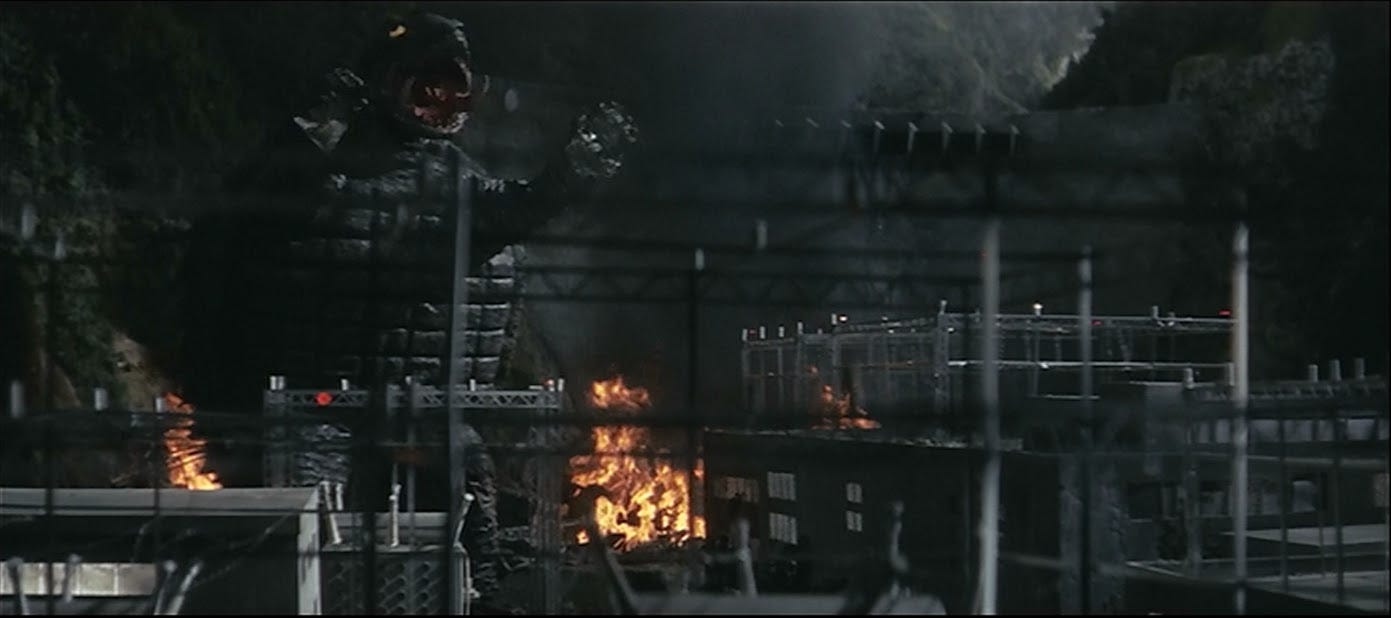
The movie opens with a short scene recapping the end of Gamera: in order to defeat the monster, the military sealed him in a space capsule and launched him out of the atmosphere toward Mars. Well, a meteor broke him out, and he’s back, and Daiei has a lot more money to spend this time around. We are treated to some wonderful composite shots and special effects as Gamera lays waste to a massive dam. Satisfied with his handiwork, Gamera flies offscreen to South America, where he will spend a questionably large part of the runtime of the movie. We’ve already seen about half of Gamera’s involvement in this movie– maybe he showed up to set drunk and they had to greatly reduce his role.
Meanwhile, our main character, Keisuke Hirata, resigns from his job as a pilot with the intention of starting his own travel company. Without enough money to do so, he invests his severance pay into his brother Ichiro’s get-rich-kinda-quick-twenty-years-later scheme. Ichiro, a WWII veteran, found a huge opal while fighting in the jungles of New Guinea during the war and stashed it in a cave before being sent to a prison camp. Now, he’s sending Keisuke, along with the excitable Kawajiri and menacing Onodera, to the island to retrieve the gem.
In a village in New Guinea, the trio ignore the warnings of the natives and set off to find the cave. Inside they discover the opal, an amber-colored gem about the size and shape of a football. Onodera, consumed by greed, allows a deadly scorpion to sting Kawajiri, killing him almost instantly, and lobs several grenades at Keisuke. Believing his two companions dead, he takes the opal and flees the cave. Some time later, Keisuke awakens under the care of Karen, one of the locals. When she learns that the opal was taken she is distraught. She and her father explain that the opal carries “the curse of the gods”. They ominously inform Keisuke that while it may look like a jewel, it’s something else entirely…
Meanwhile, Onodera is safely back on the boat admiring his prize, albeit with a case of malaria and athlete’s foot. To cure his fungal infection, the ship’s doctor provides him with an infrared lamp to point at his afflicted foot. The ship lands in Kobe, and Onodera inadvertently leaves the lamp pointed at the opal. The red light begins to heat up the gem. It glows and pulsates, then breaks open, releasing steam, slime, and a mucus-covered purple hatchling. The villagers were right. This is no opal… it’s an egg. The baby Barugon quickly grows in size thanks to the infrared radiation. It explodes the ship then begins to lay waste to Kobe, using its freezing breath to blanket the miniature sets with layers of ice crystals.
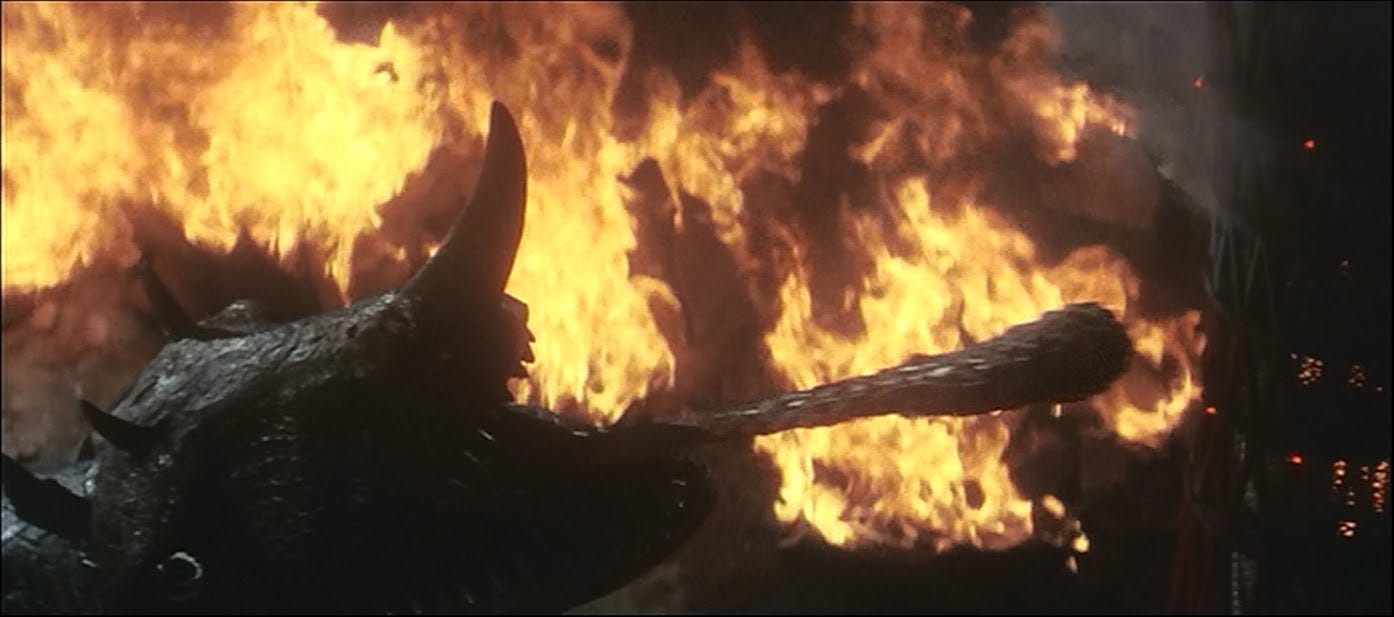
This is, in my opinion, one of the great setups of kaiju cinema. This first section of the plot functions somewhat like a mashup of Mothra vs. Godzilla and The Treasure of the Sierra Madre. Barugon, who on general details alone seems to lack conceptual cohesion, when slotted into this narrative becomes a metaphor for unchecked greed, a rubber-suited avatar of the jungle sending the despoilers of its homeland back to the Ice Age. Gamera vs. Barugon manages to stay on-theme for pretty much the entire runtime which is admirable and perhaps unlikely for a 1960s B-list kaiju movie. The throughline of greed that runs through the film is a serviceable catalyst for the action, and helps the viewer feel we’re seeing something a little more than “just” a vs. sequel.
Onodera is a great human villain too. After betraying his companions and escaping with Barugon’s egg he descends into a state of sweaty paranoia, presumably driven mad with avarice. He lies through his teeth to everybody that questions him, and he’s a really bad liar, and whenever anybody calls him on his bullshit he instantly flies into a spastic rage and tries to kill them using whatever furniture is in the room. Upon learning that the military is using an ‘infrared-enhanced’ diamond to lure Barugon to a watery grave (yup) he attempts to steal the diamond for himself. Rest assured that he meets a fitting and grisly comeuppance. He presents a good foil to Keisuke, who only wanted the opal in the first place to secure enough funds to escape the salaried ennui of his job, and who remarks “We’ve done a terrible thing” when he learns he is at least partially responsible for the destruction of Kobe and Osaka. I love the story of Gamera vs. Barugon because it presents such a down-to-earth scenario where a single lapse in judgement from a well-meaning everyman could summon a beast from Hell and kill thousands. While it doesn’t ever truly reckon with the emotional weight that implies, it’s a fresh and intriguing angle that keeps you engaged with the characters even when they’re trudging through a perfunctory military boardroom scene.
I may be biased just because it is a Japanese monster movie, but I find Gamera vs. Barugon to be a breeze even as it nears two hours (which can sometimes be a death sentence for a campy genre flick). It’s the first color outing for Gamera and they don’t let you forget it. The lighting is great and comes in many vibrant hues. In most of its scenes, Barugon is lit only dimly, illuminated by huge tongues of flame or military flares or neon billboards. The movie is also full of vapor, fog, steam, and clouds of dust kicked up by the monsters’ footfalls, which all look incredible when filmed overcranked and help tie together the miniature sets. We get great wide shots of the two monsters facing each other down when they do fight. Gamera spends most of the movie offscreen in South America, and then offscreen frozen completely solid, but I don’t find his presence dearly missed. Barugon is able to carry the weight.
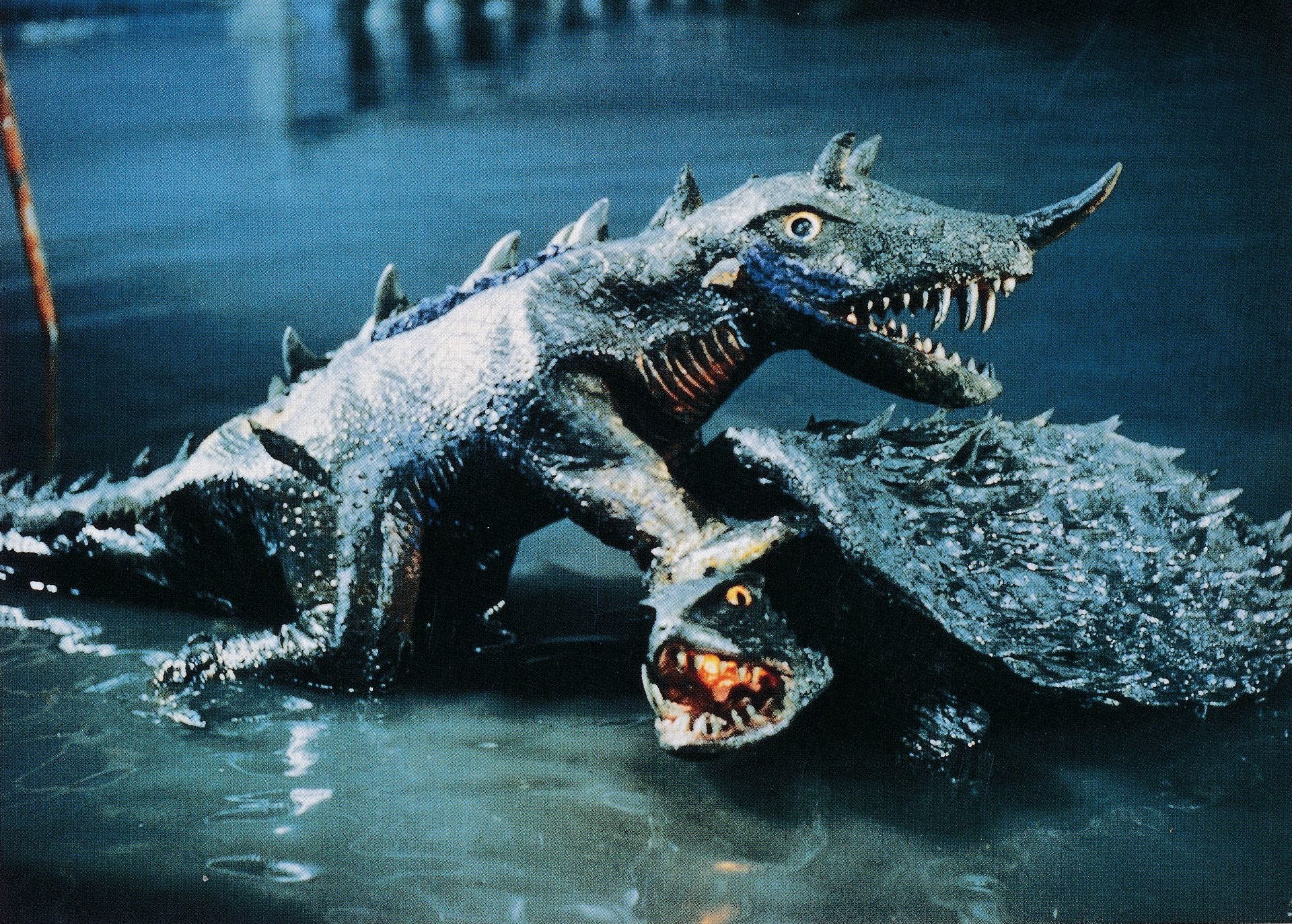
Let’s get into Barugon (not to be confused with Toho’s Baragon, who tangled with Frankenstein the previous year). It resembles a Jackson’s chameleon, the classic three-horned reptile that we all know and love from The Magic School Bus. It has dark reddish-brown skin, a row of spines down its tail and back (seven of which glow), and big glassy eyes with fully opaque nictitating membranes. One little detail I like is the front teeth in its long snout are shorter than the rest, seemingly to create a gap its long tongue can shoot out of. The tail is long and whips around a lot. When Barugon is injured, as it is grievously a few times in the movie, it bleeds gross purple blood that gushes and foams everywhere. If you, like me, enjoy seeing a rubber-suit monster sprout throbbing boils, you should stick around to witness Barugon’s final fate at the hands of the military and righteous Gamera.
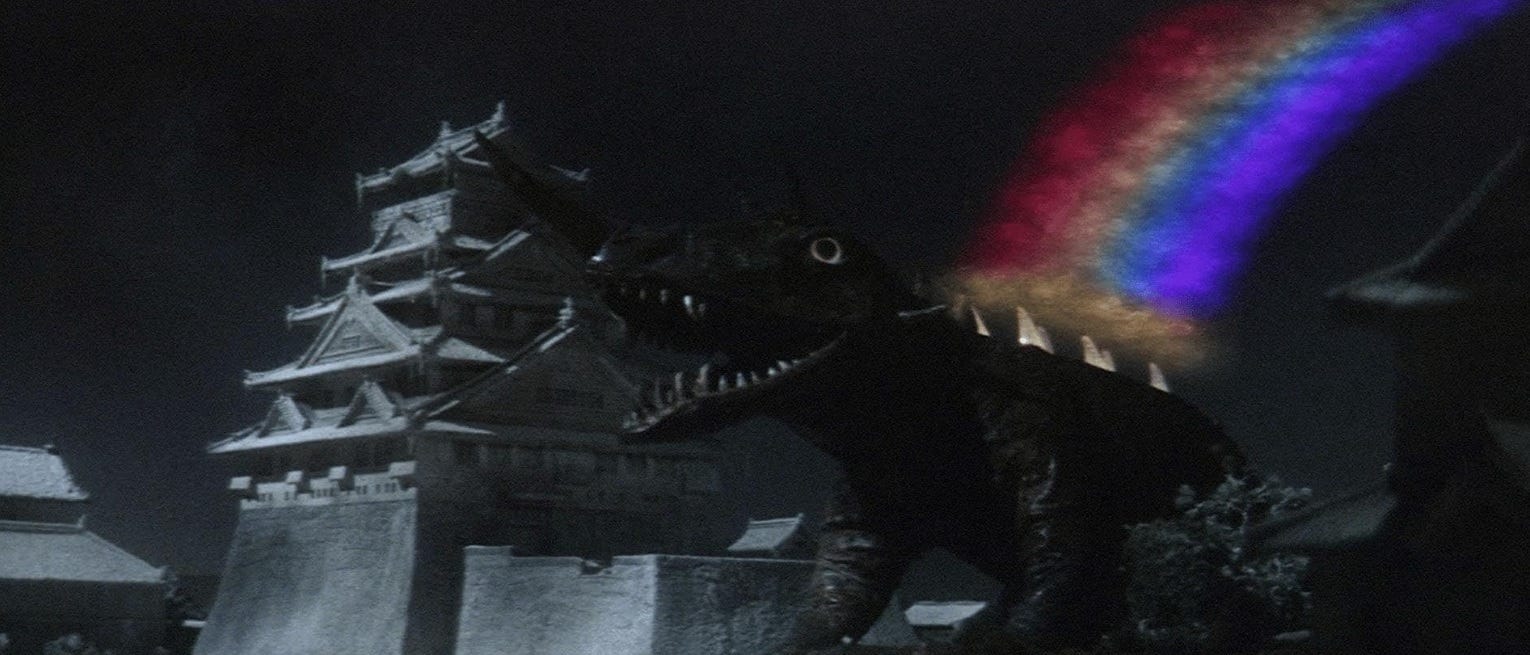
Barugon has two special abilities, both pretty bizarre. It is able to spray freezing vapor from the bulbous tip of its retractable tongue. The clouds being produced not from its actual breath but from the end of its tongue is so weird and I’ve never quite understood why they did it that way, but it does look cool. The tongue is also used to punch over a tower, so it’s got some physical strength too. Barugon’s second, more deadly, power is its death ray, which takes the form of a rainbow emanating from the spines on its back that destroys anything it touches. “Breathing” “ice” makes sense for the first foe of firebreathing Gamera, and a rainbow tracks as thematically in line with a chameleon-esque monster, but the two abilities don’t really make much sense together until you learn that Gamera vs. Barugon was originally developed as Gamera vs. the Ice Giants, featuring a race of Jötunn-inspired ice aliens that wanted to terraform the Earth. The rainbow death ray was clearly inspired by the Bifrost, a rainbow bridge between worlds from Norse mythology. Why these ice giant powers were carried over into a gigantic jungle chameleon I don’t know, but they make for a pretty unique monster. Barugon is one of a few Gamera foes who have not received a modern redesign (nor even a second appearance aside from stock footage). It’s hard to imagine exactly how they’d do it, but if it involves sheepishly downplaying the rainbow, I hope they never do.
Barugon has the quality I always find charming in old-school kaiju, where its visual design is fairly basic and doesn’t really reflect its abilities. Early kaiju suits are absent of the bells and whistles we’ve grown accustomed to in monster design. They are not sleek or cohesive and they don’t wear their purpose on their sleeve. Many of the design choices are made simply to make the suit bearable to wear for long periods of time, or to mask the human form within, or due to the limitations of the materials.
Four-legged kaiju portrayed by suitmation often crawl on hands and knees or, in the case of Barugon, lumber around with conspicuously bent rear legs. It’s a distinctive look that arises not from an intentional choice but a necessity, and one that is sorely lacking from modern monster design. CGI and the desires for biological accuracy or comic-book sleekness have extirpated the hands-and-knees quadruped, and to what end? For more A Quiet Place not-Clovers and Jurassic World Rebirth shrinkwrapped bags of bones? Body plans like Pestar or Zigra or Guilala are long gone, superseded by post-Xenomorph Unreal Engine Marketplace tulpas, mass-produced by consensus, “Does my monster look cool/scary/spiky enough, r/3Dmodeling?”, lithe and menacing, shaved down to the beetle-back luster of monomania by Occam’s razor. I am a monster and this is what (all) I do. Teeth, claws, a stomach, and just enough skin to cover it. Do I even need eyes? It’s like evolution in reverse, the plump toddling turkey slowly becoming the dromaeosaur with talons like kitchen knives and a compulsion to use them.
And sure, there are a decent amount of monsters nowadays that do not succumb to the velociraptorification of modern design sensibilities. But those are exceptions to a mainstream that seems determined to eternally pump out pseudo-demogorgons that all vocalize like a sound effect library was running a special on chitters and bellows. Can you believe there was a time when the Metaluna Mutant was it? When King Ghidorah enthralled the nation? Sure, these things live on, but they’ve been kitsched, niched, or utterly Disneyfied. I don’t accept nostalgia as an explanation for why I think the monsters of the 50s and 60s were so special, because I wasn’t around back then, and when I was growing up the creature du jour was the fast zombie, which I feel no affinity for. In the same way many science fiction premises were dealt a mortal blow when we learned the moon has no atmosphere, a font of creativity seems to have gone dry the day science decided bipedal dinosaurs held their tails out behind them for balance. If I was being extra dramatic I would say that the point when movie monsters no longer had to obfuscate the human form was the point when they lost their humanity. But I’ll save that for another rant.
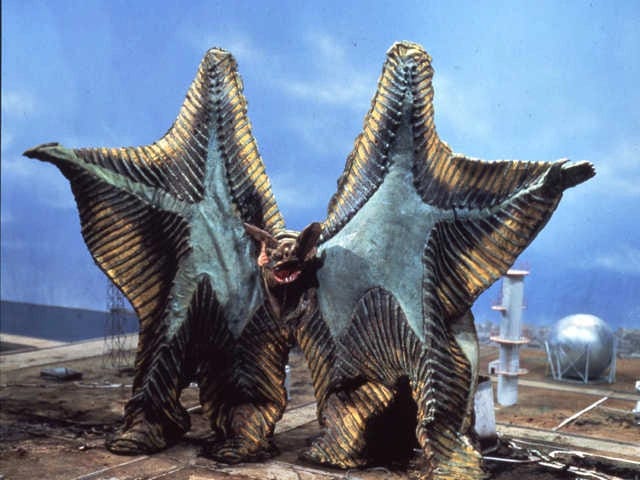
Of course I can appreciate the joy of a laser-focused monster design. It’s what makes things like Alien or even Pokémon so endlessly captivating. There is nothing like an artist’s touch. The experts who make the monsters we love today are clever and talented and know what they’re doing. Sometimes, though, I don’t want a monster that’s been intelligently designed. I want something that plopped straight out of the primordial ooze, all wrinkled rubber and reinforced plastic. Visual clarity of purpose is an admirable achievement but it renders its bearer an open book. The xenomorph is a perfect monster design: every extremity is tinged with sexual terror and twisted anatomy. But the work is done for you. The symbol is so obvious it is hard to look past. Barugon and many of his suitmated brothers refuse to disclose their intentions. They choose instead to confound us with their droopy jaws and walleyed stares and bunched-up joints. While some may find that antiquated, I think it’s magical.
I don’t want to go back, because the ship has sailed. I can accept that we just can’t make movies or monsters like they did in the Showa era. We have revenue targets, safety regulations, and a modern context that means that even if we did “go back” it’d be for different reasons and produce different results. I just feel so strongly about the transcendent beauty of early daikaiju eiga. When I see the blue skies and miniature power plants of a Showa Godzilla movie I want to fall to my knees. It is sublime and spiritual and it provokes the closest thing to Stendhal syndrome I can imagine experiencing. I know that world is gone, but thank God it’s been preserved on film, and thank God we can live there for hours at a time, and how is the entire planet not head over heels for rubber monsters like me?
Gamera vs Barugon evokes that religious feeling in me, not because it’s anything special, but because it’s not. I recommend it highly, not because I think you will like it, but because I think you should.
Is this the type of thing you want? Let me know.
Comments
Nothing yet. Say the first thing.
Sign in to join the conversation.