
Part of the reason I wanted to start a blog like this was to have a home for slightly longer and more collected writing about movies I like. I kept thinking it would be nice to be able to compose my thoughts outside of the crampedness of Letterboxd. For this inaugural post I wanted to throw together a few words about a movie that, while I wouldn’t call it unknown, deserves a whole lot more love.
Larry Cohen is one of my favorite directors. He was a genius B-movie filmmaker with several genre classics under his belt– he directed The Stuff and It’s Alive, and wrote Maniac Cop and Phone Booth, among many many others. In my opinion, almost everything the guy touched was gold. You can’t go wrong.
Q, sometimes subtitled The Winged Serpent, but come on, you gotta just call it Q, is Larry Cohen’s foray into the giant monster genre. It was released in 1982, during a time when monster movies looked more like Jaws and Alien, and a whole lot less like Reptilicus. The zeitgeist seemed to belong to terrors like Michael Myers and Regan MacNeil– monsters steeped in realism, not the gargantuan stompers of yesteryear. Godzilla’s reputation in the US hadn’t recovered from a disastrously bad dub of 1973’s Godzilla vs Megalon that tanked public opinion and condemned Big G to the world of camp. The 1976 remake of King Kong, while it was a modest success at the box office, was written off as a flop on release. Did that stop Larry Cohen? Hell no. He wasn’t making a blockbuster. He had a million dollars, a week to write a shooting script, and a vision.
In the very first scene of Q, a pervy window washer cleaning an upper window of the Empire State Building is decapitated by an unseen shrieking creature. His body slumps forward and his neck stump presses against the filthy window, pumping blood onto the glass as the woman inside screams in terror. Not even five minutes later we’re seeing a beef-jerky-esque flayed body on a hotel bed. Larry Cohen wants you to know– this may be a stop-motion monster movie, but I’m doing it my way.
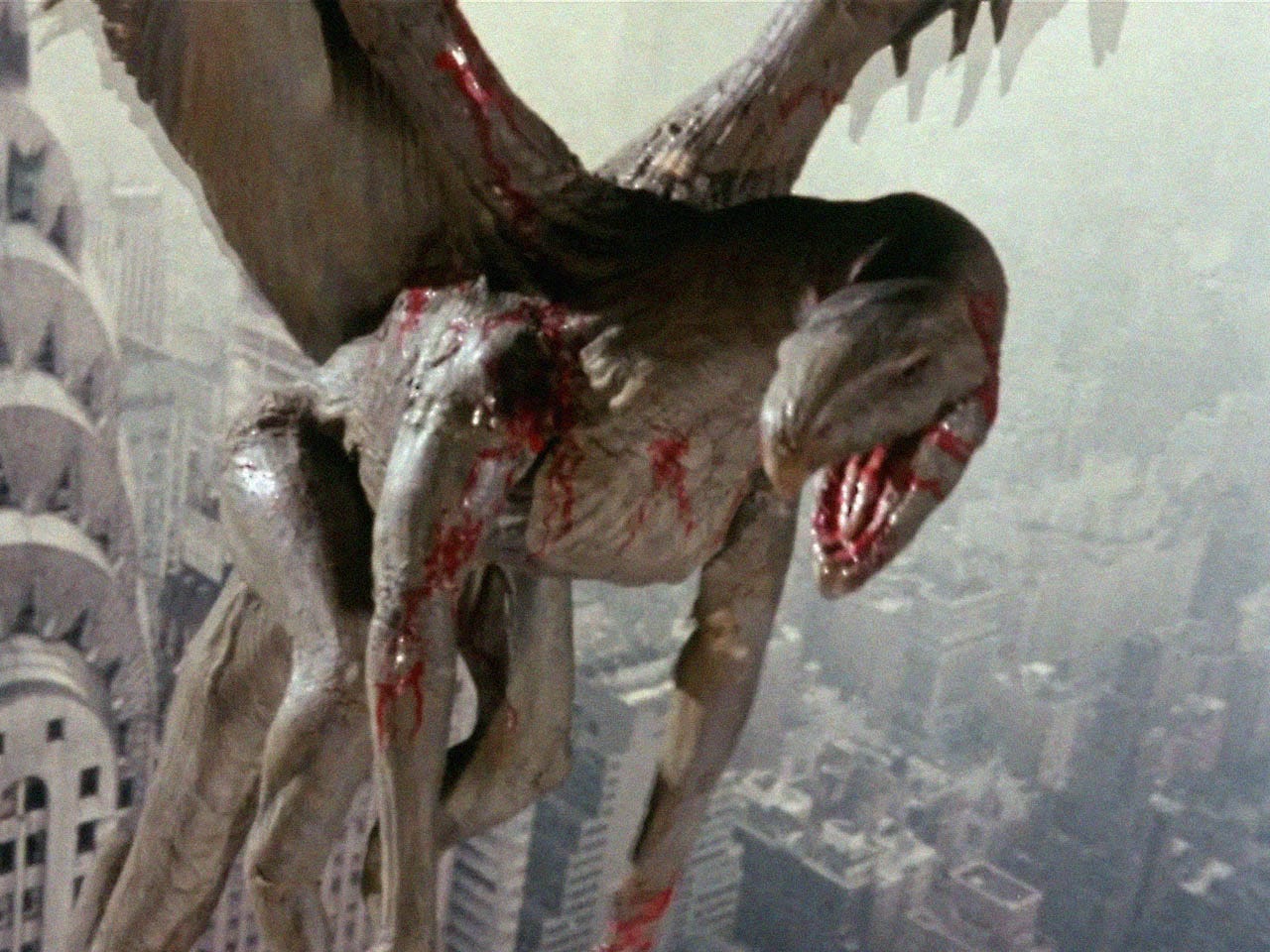
The plot of the movie centers around a ‘bird’ monster (it’s really more of a lizard with wings) terrorizing the skies of Manhattan and plucking victims off the roofs of high-rises. Meanwhile, on the ground below, a series of brutal ritual murders are baffling the NYPD. These two plotlines run parallel throughout the movie, and threaten to converge at various points without ever fully doing so. The police procedural thread follows Mr. Kung Fu himself, David Carradine, as a detective named Shepard, as he gradually acclimates to the idea that this series of mysterious human sacrifices may be linked to the ancient Aztec god Quetzalcoatl, who in turn may be linked to the strange skyscraper deaths. He is complemented by the more fiery Powell, played by Richard Roundtree.
Shepard seems fairly unbothered by the goings-on, and it doesn’t take much to convince him that a relictual serpent-god is preying on the populace of New York City. At first you raise an eyebrow– would this guy really swallow such an outlandish story so easily?– but then he delivers a wonderful line while in bed with his wife: “This wouldn’t be the first time in history a monster was mistaken as a god.” Okay, man. I guess you’re completely Spooky Mulder.
If I had anything negative to say about this movie it would probably be that this spate of occult killings feels vestigial to the overall narrative. It barely provides any context to the monster, nor does it ever really affect the plot. I wouldn’t say it feels shoehorned in, but rather like it was originally the scaffolding the script was built upon until the monster plotline ballooned in importance and took over the movie. There’s some nice low budget gore and insert shots of high priests flaying their surprisingly chill victims, but the real meat of Q is elsewhere.
Quetzalcoatl, as we’re obliquely informed the winged serpent is named, doesn’t have too much screentime. When it is onscreen, it’s hard for a monster fan not to smile. It’s a great stop-motion creature, with a wrinkly turtly head on a sinuous neck, and big bat wings that connect all the way back to the hind legs with long flaps of skin. There are only a couple true hero shots of the monster, but they don’t disappoint. The stop motion in these shots is smooth and lifelike, the few peeks we snag at the thing’s whole body don’t disappoint. It’s pretty much impossible for me to dislike a Harryhausen homage, and this is a good one even with its fleeting screentime. It’s leathery and wiggly and has those classic stop-motion dinosaur “body jowls” as I’m deciding to call them right now. As Shepard says at one point, “just a good old-fashioned monster.”
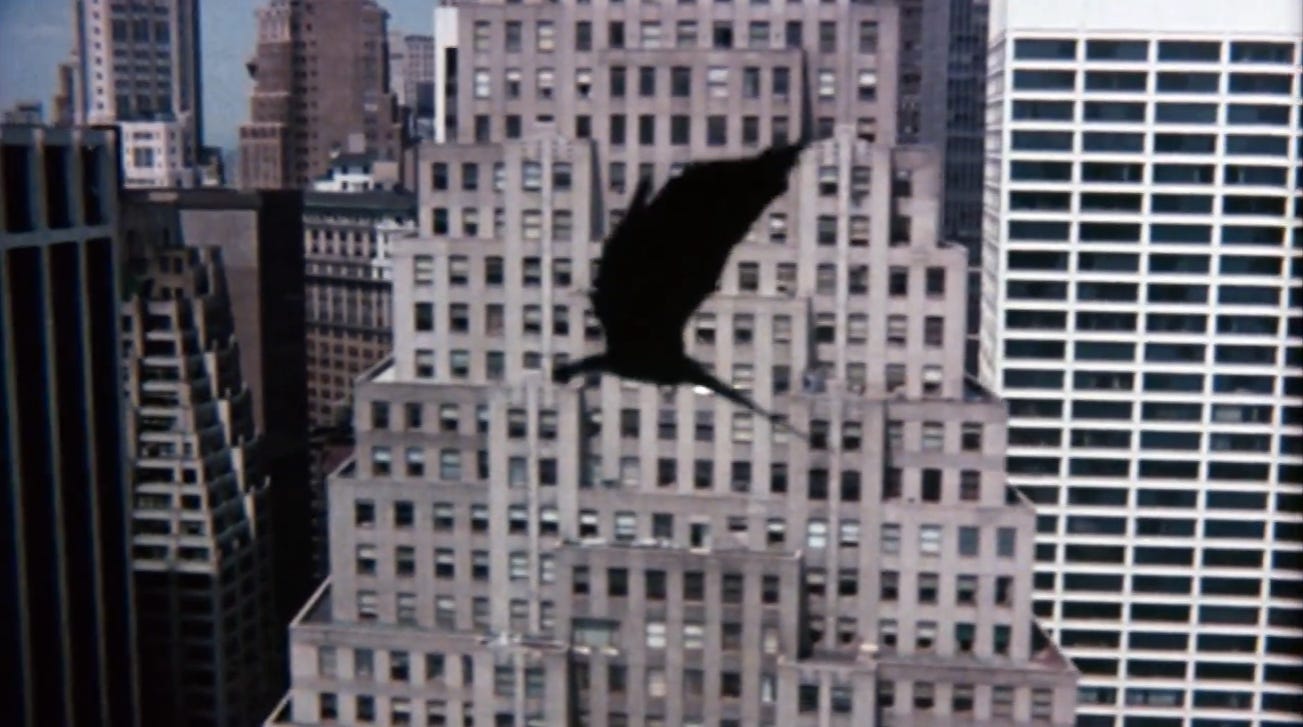
Most of the scenes involving Quetzalcoatl, though, don’t show the monster very much. We’re usually wheeling through the sky with frantic aerial photography from the serpent’s perspective, or catching glimpses of its animated shadow or fragments of its grey body darting through the frame. The attacks are a bit repetitive in concept, but always fun to watch– a hapless New Yorker is for some reason on the roof of a skyscraper, blithely going about their business without ever once looking up into the sky above, until– SCREE!!– they are pulled into the clutches of Quetzalcoatl and either decapitated or eaten alive. Sometimes we see their headless body thud to the ground, other times we see a huge clawed talon grabbing people by the midsection and hauling them up into the air, with a life-size claw prop that recalls Vermithrax Pejorative from Dragonslayer.
What makes the monster carnage really sing is Larry Cohen’s trademark guerrilla filming technique. Cohen famously eschewed permits and shot scenes in public locations without warning bystanders. There’s something not just real and raw about setting scenes in the ‘real world’, but playful and satisfying as well on a practical filmmaking level. Cohen’s 1976 sci-fi thriller God Told Me To features Andy Kaufman (in his film debut) attempting to shoot up a real New York City police parade and getting tackled by a throng of cops. In Black Caesar, Cohen has a cab driver actually drive a taxi up onto a Harlem sidewalk– a maneuver as unconscionably reckless as it is jaw-dropping. Staging these high-tension action scenes in public spaces with unwitting pedestrians is unbelievably gutsy, but it pays off in spades. Watching real people in a crosswalk dive for cover from a supposed rooftop sniper conjures a sense of gritty truth that might otherwise be lacking from your typical science-fiction-inflected police procedural.
Q’s guerrilla-filmed sequences are maybe less in-your-face than the ones mentioned above, but they’re just as effective, and make up some of my favorite moments in the movie. Early in the film, we’re treated to a short montage of pedestrians being splattered with blood falling seemingly sourcelessly from the sky. Cohen’s actors flail and scream, flecked with red goop, and you can watch the real people around them clock the craziness and try to ignore it in true New York fashion. A tangle of people fight to escape a crosswalk where a severed foot has just fallen from heaven. As planted actors and unwitting extras alike search the sky for the culprit, Q cuts to shots of the sun’s glare obscuring the sky, and flocks of birds taking flight. In a much later scene, actors fire real machine guns loaded with blanks, which supposedly led to mass panic not captured on film– that could be a post-release embellishment, but I wouldn’t put it past Larry Cohen. Even if you didn’t know how he operated, these scenes would stand out– they ooze authenticity. It’s sequences like these that help him consistently punch above his B-movie weight.
After describing all that creaturey goodness, though, I have to come clean– the monster is barely featured in the movie. And it’s not even the reason Q is so good.
As a lifelong Godzilla fan, I’ve heard one thing over and over: “Yeah, it’s a fun monster flick, but the human story is just boring.” It’s a mantra for fans and cynics alike, and seems to be the conventional wisdom about monster movies in general. I don’t always disagree, but I’d be lying if I said that sentiment didn’t irk me. So, for everyone who thinks they haven’t made a giant monster movie with a good human story yet– or for those who think Godzilla Minus One was the first of its kind– it’s time to do your homework. Q is one of many monster movies with a compelling “people-level” plotline, but it may be one of the few that I think is better when the monster isn’t onscreen. And for me, that’s saying something.
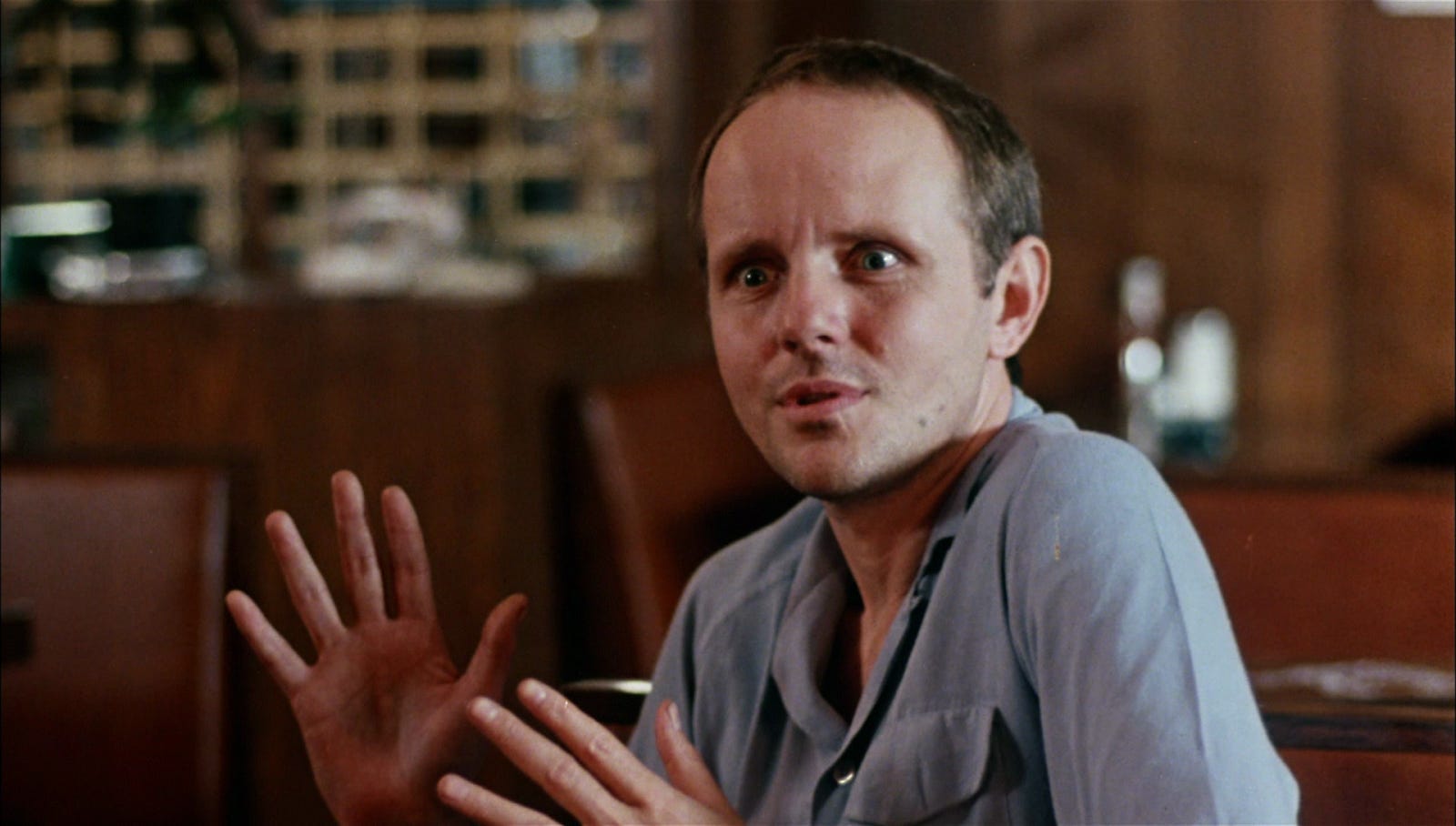
The real star of the show is Michael Moriarty. He was not an actor I was familiar with before watching the work of Larry Cohen. Perhaps best known for his TV work on Law and Order and the miniseries Holocaust, as well as an acclaimed appearance in The Last Detail, he’s receded from the public eye due to poor health and maybe being a little bit crazy. I couldn’t believe what I was seeing when I was finally exposed to him. I’m not exaggerating at all when I say Moriarty’s role in Q is maybe my favorite acting performance of all time.
Michael Moriarty plays Jimmy Quinn, a perennially down-on-his-luck ex-junkie ex-con loser who vacillates his way through life in a state of perpetual freakout. In the hands of another actor, that description might produce a strung-out sweaty paranoiac, but Moriarty imbues Quinn with a totally unique goofball energy that makes him as laugh-out-loud funny as he is painfully real. Flailing arms and dinner-plate eyes accompany each of his sentences, which are usually woe-is-me complaints or declarations of bizarre neurotic hangups. Whether he’s playing the piano so badly he makes a dog growl or climbing a ladder and then crowing self-satisfiedly that he may be afraid of everything but he’s never been afraid of heights, Michael Moriarty steals every millisecond he’s on the screen.
Everybody who meets Jimmy Quinn instinctively understands his purpose in the universe is to be beaten up on. The mobsters he enters ‘business’ with make fun of him to his face. Richard Roundtree’s character, upon meeting Quinn for the first time, palms his head like a basketball for quite a long time. Even Quinn’s girlfriend, the one person in the entire world who pities him, eventually turns on him. There is hardly a line delivered by Jimmy Quinn in this movie that doesn’t result in two other characters in the scene sharing a smirking glance. The movie literally spends half the runtime setting up just how pathetic of a fuckup this character is.
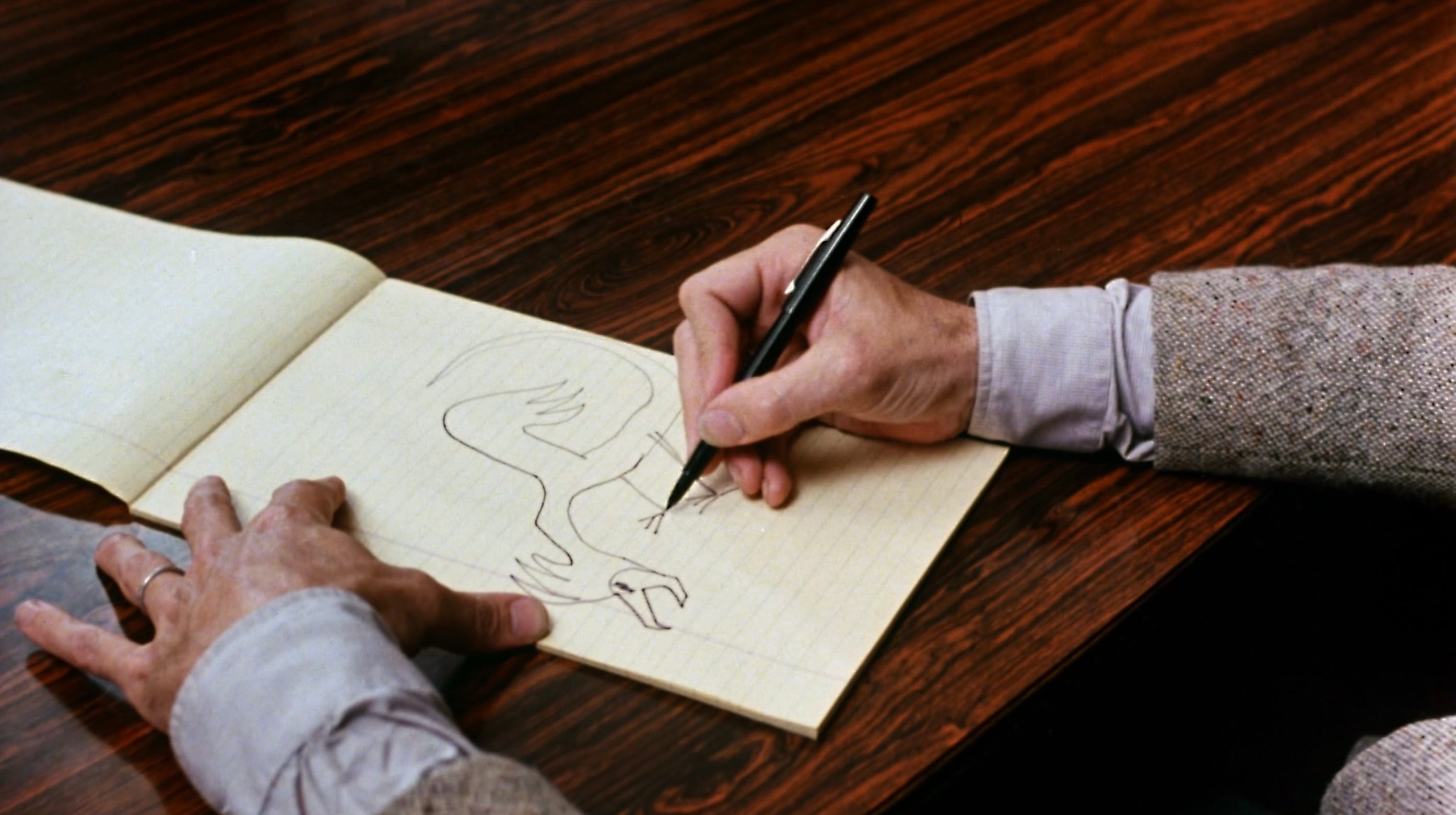
Then, when Quinn is left holding the bag after a diamond heist gone bad, he flees to the top of the Chrysler building where he happens upon Quetzalcoatl’s nest. Being the only guy in the city who knows where to find the giant ‘bird’ instantly corrupts him, and leads to my favorite scene in the entire movie. Quinn knows the police are desperately trying to solve the skyscraper murders, so he offers his information in a boardroom negotiation, for a price, of course. Quinn demands a million dollars from the police commissioner, tax-free (“I have never paid my taxes and I’m not going to start now!”), while Shepard doodles an elementary-school-level rendering of the winged serpent. In another movie this character may have been relegated to a comic relief role, but in Q he’s front and center. I’m not going to call this movie a ‘character study’, but it is definitely more interested in “What if the biggest loser in the world finally got some leverage?” than it is in “What if an ancient Aztec god terrorized New York City?”, and that’s what makes it so special.
Of course, if you’re a monster freak like me, there’s still more than enough for you to sink your teeth into– from heart extractions, to sunbathers going topless and headless, to an action climax that, in a beautiful inversion of King Kong, features machine gun toting police officers firing outward from the top of the Chrysler building at a circling monster, it’s all here for you. We even get an absolutely perfect Rodan-esque Baby Q poking its swollen face out of a gargantuan egg and then getting pumped full of hot lead. But you can get that stuff anywhere– only in Q are you going to watch a scat-singing freak suddenly become the most important man in New York City.
So look, it’s October, you need a monster movie to watch. Make it Q. And then run through the rest of Larry Cohen’s stuff– you’re not going to regret it. There’s a lot more Michael Moriarty waiting for you in those too. Like I said before. You can’t go wrong.
No posts
Comments
Nothing yet. Say the first thing.
Sign in to join the conversation.