
Some people might consider the original 1974 The Texas Chain Saw Massacre to be a slasher movie, but I think the consensus is that it’s more of a ‘proto-slasher’, whatever that means. The slasher genre is strictly formulaic yet nebulous, with a family tree that’s diverse and diffuse. But each slasher ‘subtype’ can typically be traced back to a single watershed movie– you’ve got Halloween-likes, Friday the 13th-likes, Scream-likes, et cetera… Then, of course, there’s Chain Saw-likes.
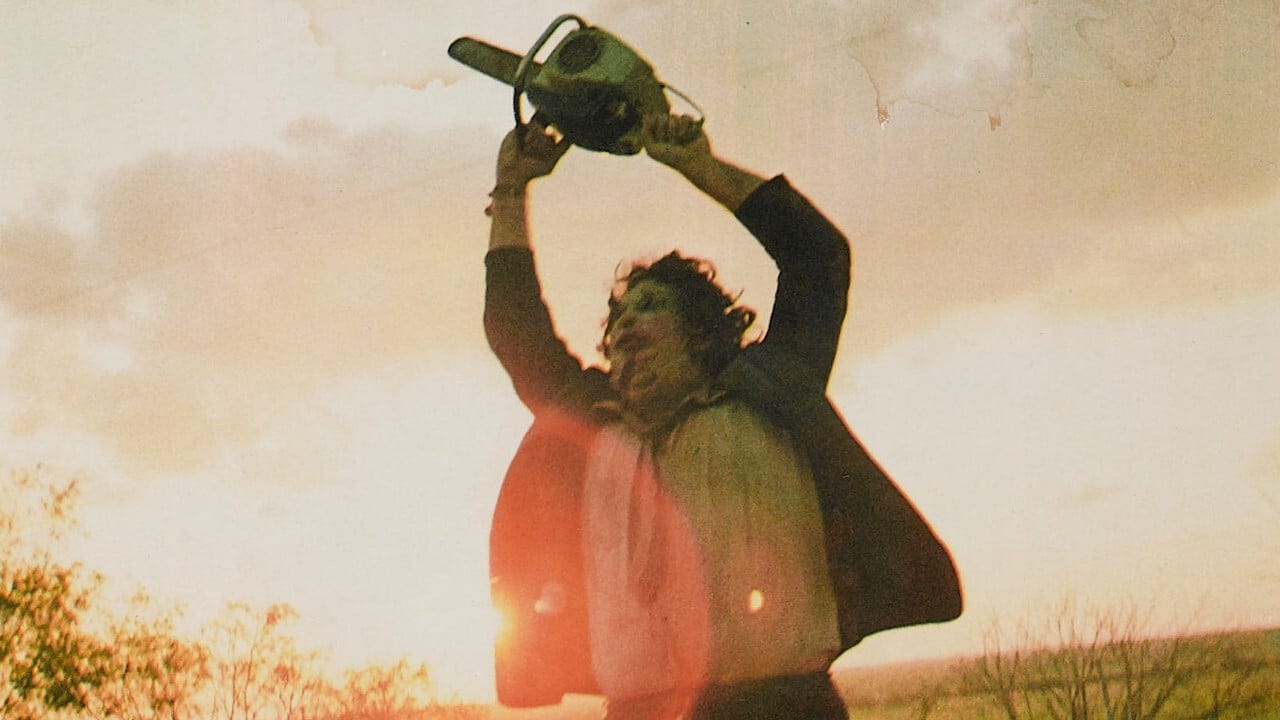
Much akin to the inbred mistakes of nature they depict, the clade of Texas Chain Saw homages has twisted and mutated over time, preserving some of those characteristics that once distinguished Tobe Hooper’s seminal masterpiece while also evolving new, strange features of their own. The reconfiguration of TCM is, in my opinion, something of an alchemy. You want to preserve enough of the trappings and signifiers without hewing too close to the primogenitor. Failure to innovate results in sterility; Wrong Turn or The Hills Have Eyes may not be bad movies, but they’re doing nothing truly generative with the formula they so desperately cling to. I’ve seen enough disfigured families that slaughter and eat tourists. And on top of that, I’ve seen The Texas Chain Saw Massacre, the absolute best to ever do it. You are never going to beat it on its own merits– so show me something new.
Hooper did it on his own, with perhaps the best example– 1986’s The Texas Chainsaw Massacre Part 2. Most horror fans know this decade-later sequel is much more than a ‘Part 2’. Where the original movie invokes true nightmare on film with sunbleached hyperreality, Part 2 smashes headlong through the looking glass into an altered world of color, gaudiness, and theme-park uncanniness.
1974’s Chain Saw takes a bleak look at the parts of America we’d rather pretend don’t exist. Our metropolitan lives are fueled by the industrial grinding-down of suffering animals, severed heads boiling in their own fluids, and the hegemonized people that oversee and conduct the abattoirs. Hippies who put their faith in cosmic forces beyond the firmament will suffer a cruel awakening when their faces are pushed against the filthy butchery floor of reality, their sex-addled drug-dampened worldviews dismantled piece by piece as their flesh is stripped away and they are processed into the very meat they so blithely take for granted. Pockets of violence and True American Horror exist out there in the Places We Don’t Go, and all you have to do is run out of gas to experience the brutal consequences.
In the sequel, the tumor has metastasized. Part 2 understands that when you peel back the skin of our seemingly-civilized country, what originally appeared to be isolated spots of Evil are revealed to be just the parts we were able to see; the true rot is all-consuming and underpins everything. The Sawyers now operate beyond the confines of their little microcosm, and it was never really a microcosm at all, was it? I don’t need to spare any words to convince the reader that a post-Vietnam (hell– let’s say post-settlement) America seethes with violence and hate just beneath the surface. The Sawyers’ lair is no longer a barren little stretch of sunburnt Texas highway; it’s a massive underground complex beneath an amusement park festooned with animal parts, skeletons, and carnival lighting. It’s as literal a statement as it gets: The amusements and luxuries of America are built on bones, corpses, and inbred murderers. Despite the ostentation and vastly different tone of the sequel, it is still fully compatible with the original’s arid minimalism. In 1974 we stumbled into the outpost, but in 1986 we bore witness to the kingdom.
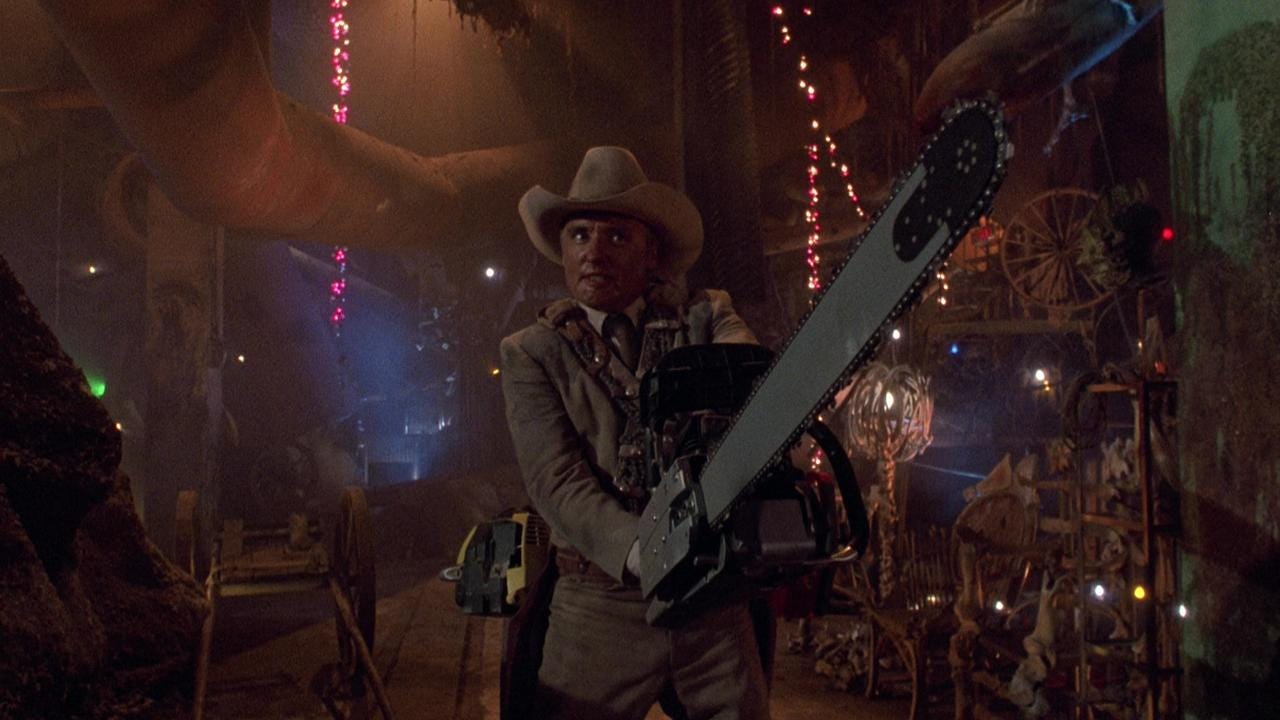
One of the defining characteristics of the Chain Saw-like is the intrusion of the victim on the world of the killer, as opposed to the converse usually seen in other slashers. This probably stems directly from Psycho and Deliverance (and maybe even Two Thousand Maniacs!), but on a longer timeline I believe it’s an inherited trait from Gothic horror. America doesn’t have spooky castles like Europe, so the remnants of a savage and alien past American Gothic protagonists find themselves stranded in are instead crumbling hotels, ramshackle estates, or forgotten roadside museums. The sick family secrets and transgressions are not illegitimate heirs locked away or erudite scientists gone mad, but incestuous throngs of ‘simple’ people. The Texas Chain Saw Massacre repackages the Gothic for an ignoble age.
So, like its Gothic forebears, Chain Saw focuses on place. The hapless protagonists must step into an altered world, where reality and reason are superseded by emotion, isolation, and brutality. This is why we see such an obsession with the House in Chain Saw-inspired movies. How many hillbilly murder movies have you seen where a group of people looking for help with their car hesitantly step across a decrepit threshold into a foreboding, decomposing house of horrors? That’s right, pretty much all of them. The entry into the house is so important because it’s how we know our heroes have entered the dream– by trespassing on this territory they have marked themselves for execution. We the audience, safe in our theater seats, now permit gruesome dismemberment to take place, because the characters have unknowingly (but we know they know, deep down) stepped into a PvP zone. Other slashers seek revenge for being wronged, and so their movies focus on the day they meted out retribution: Halloween, Friday the 13th, Prom Night. But Leatherface-likes are defined by the places in which they lurk: House of 1000 Corpses, Tourist Trap, Motel Hell, The Texas Chain Saw Massacre.
The protagonists of Texas Chain Saw stumble into a nightmare, but it’s a nightmare we’re shown you can wake up from. As bittersweet as her escape is, we see Sally Hardesty speed away from Leatherface in the back of a pickup truck, presumably shuttled back to society, traumatized but physically safe. The Sawyers only really claim dominion over a little stretch of highway. So what happens when you can’t wake up? When you can’t get away? When that nightmare universe won’t let you go? These are the questions posed by one of my favorite takes on the Texas Chain Saw formula, Gabe Bartalos’s 2004 directorial debut Skinned Deep.
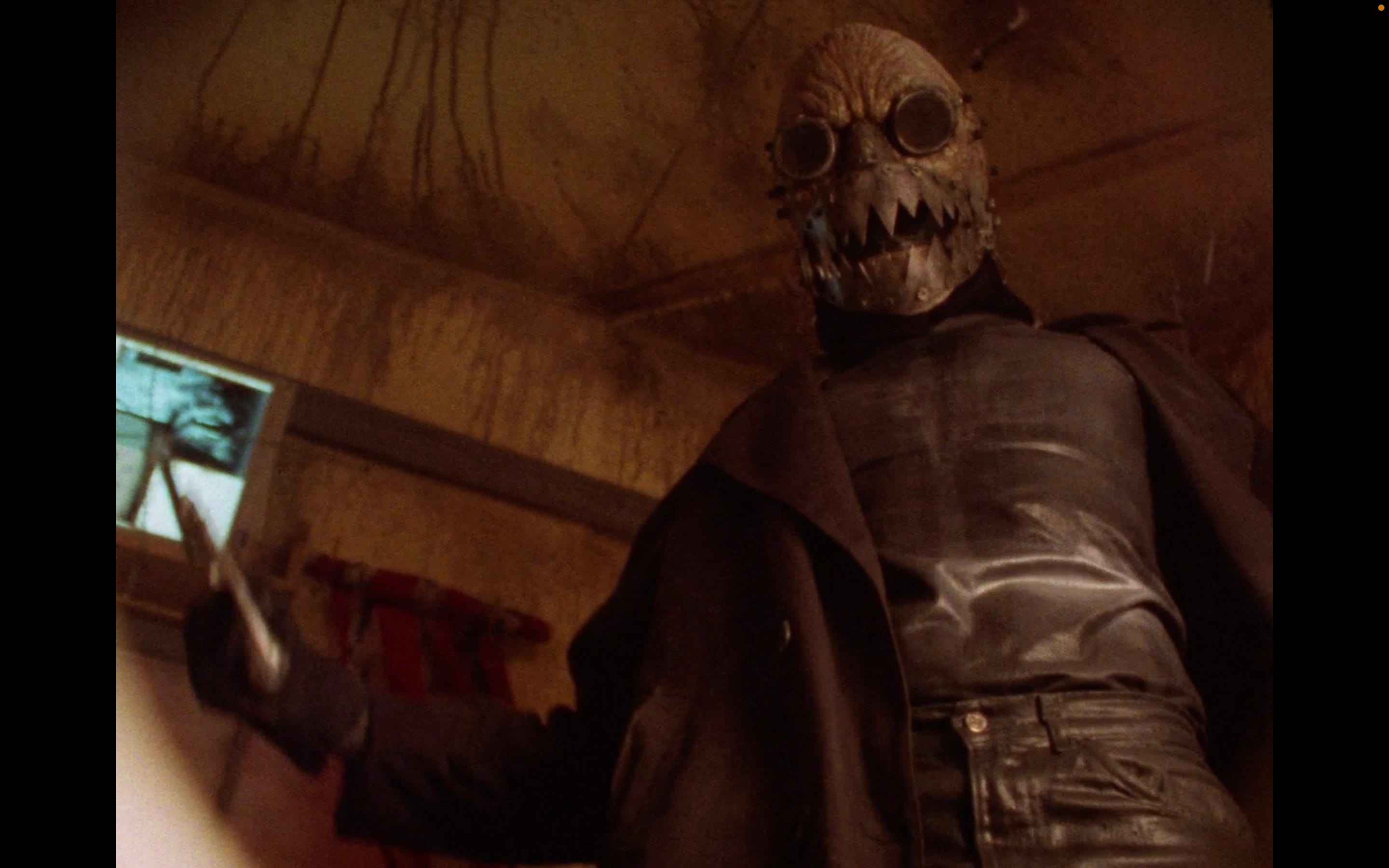
The first time I watched Skinned Deep, I found it on some foreign language Facebook page and sat down to watch it on my laptop, headphones in, all the Facebook video player overlay stuff popping up. The first thing onscreen is somebody actually scarifying the letters ‘SD’ onto their skin with a red-hot blade. Uh oh, I thought. This might be a little too much for me. The conditions of my original watch gave it a little more of a snuff film feeling than I think the movie really has. Yes, it is ‘too much’, but not in the way I initially feared, and in a way that most movies can only dream of achieving.
Skinned Deep takes the Texas Chain Saw Massacre formula and pushes it to its absolute limit, stuffing the familiar story to the gills with idiosyncratic characters, bizarre details, and over-the-top special effects. It’s as gonzo a take on the backcountry murder family genre as you’re ever going to see. It’s really something special. Before I even finished watching it on that scary Facebook page, I had opened a second tab to Ebay and ordered a DVD, something I don’t usually do. I’m hoping to induce the same effect in you.
After the opening credits, Skinned Deep kicks off with a familiar setup. A doofy family is taking a road trip through the American desert, filming their travels with a video camera. In the words of the dad, they want to “learn a lot about history and what made this country great.” Their car blows a tire on a spiky contraption that is quickly retracted by an unseen hand, the dad goes for help at a nearby general store, and an unsettlingly chipper old lady tells him to bring his family across the street to her house, where her son will help fix the car.
The family walks into the house, and they’re confronted with the most incredible murder lair I have ever seen. The typical Chain Saw-like cribs heavily from Hooper’s original production design to signify its Gothic nightmare reality– chicken feathers and bones and old creaky rocking chairs. Even some of the more strung-out takes like House of 1000 Corpses or The Millennium Bug tend to lean on classic haunted-house theming. But with Skinned Deep, Gabe Bartalos ‘understood the assignment’, so to speak. This murder house is truly something out of a dream.
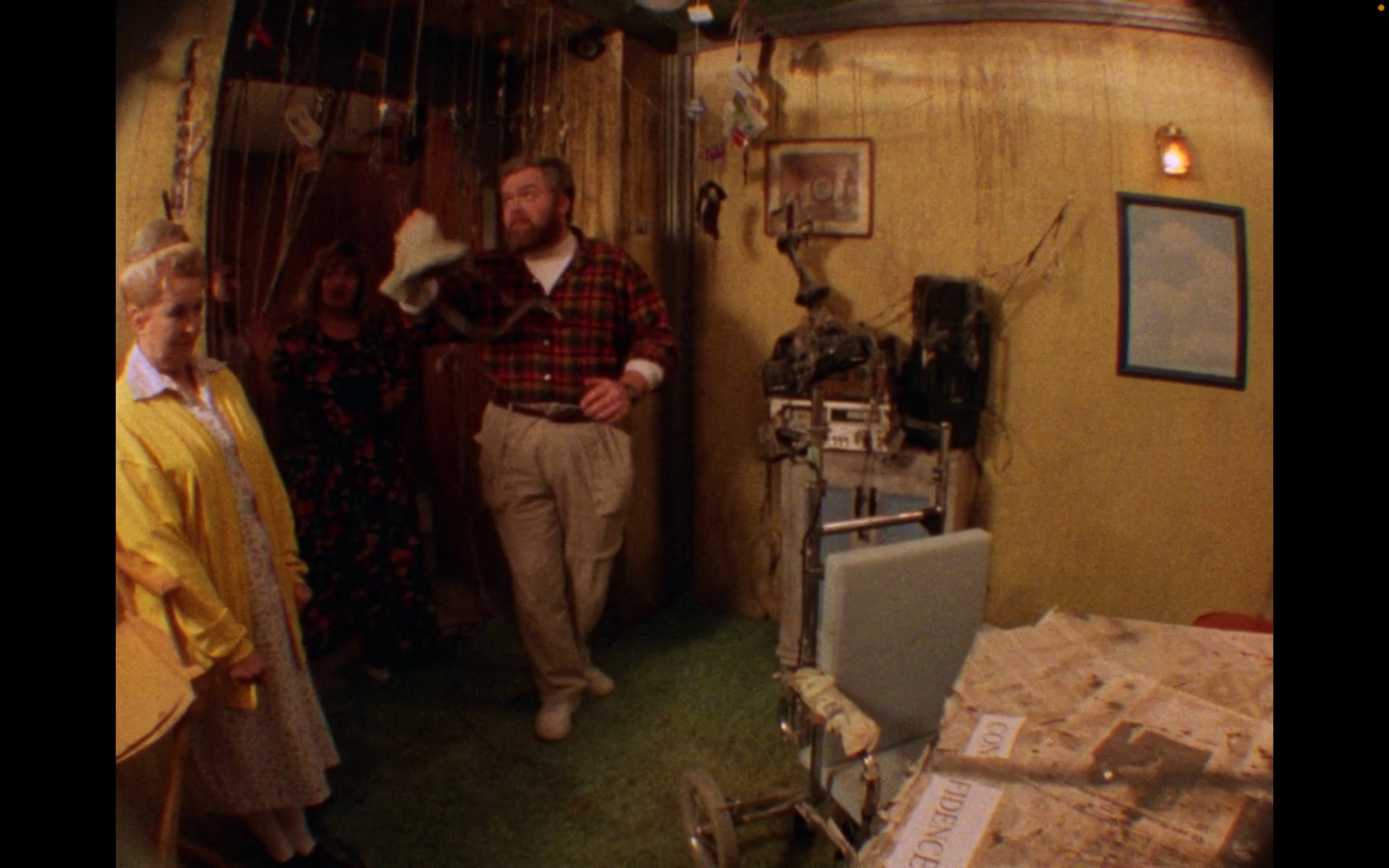
Instead of bones and weapons, we have innumerable model airplanes hanging from the ceiling, doll parts on springs, wood paneling, strings of beads and house keys, old technology, paper money and credit cards on wires, jars full of watches… This doesn’t look like Ed Gein’s house– it looks like a house from another universe. Skinned Deep shows its hand here, and then never stops showing it. Every scene is bursting with detail and creativity. You can tell the people behind it came into every shot thinking, How can we make this crazy?
The dad ushers the family on through the nightmare, insisting “Come on kids, it’s just a normal house.” From here, we’re properly introduced to the murder family of Skinned Deep. There’s the matron who we met in the general store, an elderly lady whose lines are all unsettlingly dubbed over. We have Plates, played by Warwick Davis, who has a holster on his back filled with plates (he throws them). There’s Brain, whose head is, well, a giant brain. The final main member of the family, the poster child for the movie, is the Surgeon General, a hulking cyborg who wields a huge blade and looks like a member of Mushroomhead.
The Surgeon General and Plates start killing the family. A robotic arm with two cameras descends from a panel in the ceiling and starts whirling around while snapping pictures as the mother and father are gorily dispatched. The kids flee, and the killers follow. The General slices the younger brother completely in half, leaving only Tina, the surly teenage daughter, alive. We’ve just run through the entire Texas Chain Saw playbook of plot beats and are already at final girl phase. And it’s only been 20 minutes.
Brain begs his mother to ‘keep’ Tina, which she acquiesces to. And then the movie begins in earnest. I’m not going to narrate the rest of the things that happen in the movie because I think one of its greatest pleasures is having no idea what’s about to happen next. Just know that there’s always something creative and insane lurking around every corner. Detractors will cite a lack of plot; I think that ‘lack’ (which I kind of disagree with anyway) is what helps Skinned Deep rank among the best takes on Chain Saw. TCM builds a space that is dreamlike, but physical and causal. Skinned Deep takes the Gothic otherworld and runs with it, dropping narrative to the wayside and trapping Tina in a phantasmagorical prison.
The Gothic nightmare has run its course already, but the sleeper is still comatose. The dream warps and changes, becoming feverish and unstable. Tina is stranded in an unreality that refuses to let go, with elderly biker gangs, desiccated corpses watching her own family’s home videos, and Madmaxian (adjective I’m trying to start) vehicle-to-vehicle combat with hooting drunk drivers who are projecting vintage porno onto the side of the road as they speed through the desert. In some ways, I’m almost reminded of a movie like Labyrinth. If I was playing it loose, I might call Skinned Deep a fantasy take on Chain Saw.
Bartalos is one of the few directors I’ve seen capture the surreality of Texas Chain Saw in a novel way. The Texas Chain Saw Massacre is a nightmare, but Skinned Deep is a nightmare with a brain bleed. It takes Texas Chain Saw’s interrogation of the violence underpinning America’s comfort and twists it into something truly bizarre, much as Texas Chainsaw Part 2 once did. Its true strength is its creativity. There is no worry about verisimilitude, pacing, narrative, acting… just as long as each scene can be a vessel for a genius special effects artist to show us one of his cool ideas. At the end of the day, that’s all I really want to see. As the headless musclebound Creator says just before he births the slimy green Octobaby (you’ll see), “I am progress. I am inertia. I am strength. Behold creation.”
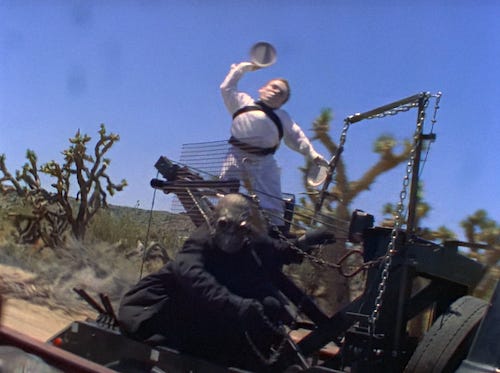
Where most Texas Chain Saw riffs want you to behold grim reality (or their conception of it), Skinned Deep eschews reality almost entirely and asks you to, indeed, behold creation. It’s a breath of fresh air for someone who’s seen a lot of these types of movies, and just as thrilling for someone who hasn’t. It somehow takes the most basic tenets of Chain Saw– the Highway, the House, the Family, the Dinner– and transfigures them into something hallucinogenic, absurd, and utterly new. It’s a nightmare you can’t wake up from, but you won’t want to.
No posts
Comments
Nothing yet. Say the first thing.
Sign in to join the conversation.