
Every time I’m asked to preach, it’s a bit of a dream come true. It’s not just that I love doing it—it’s that I like to think it’s in my blood. My grandfather was a Presbyterian minister for over 40 years. He wrote over 750 sermons and preached over 3,000 times. Lucky for me, he kept every single text, all meticulously filed.

When I was asked to preach for the America Media Preach podcast, covering this coming Sunday in the lectionary, I wanted to turn to my grandfather’s wisdom. And I asked my dad to help.
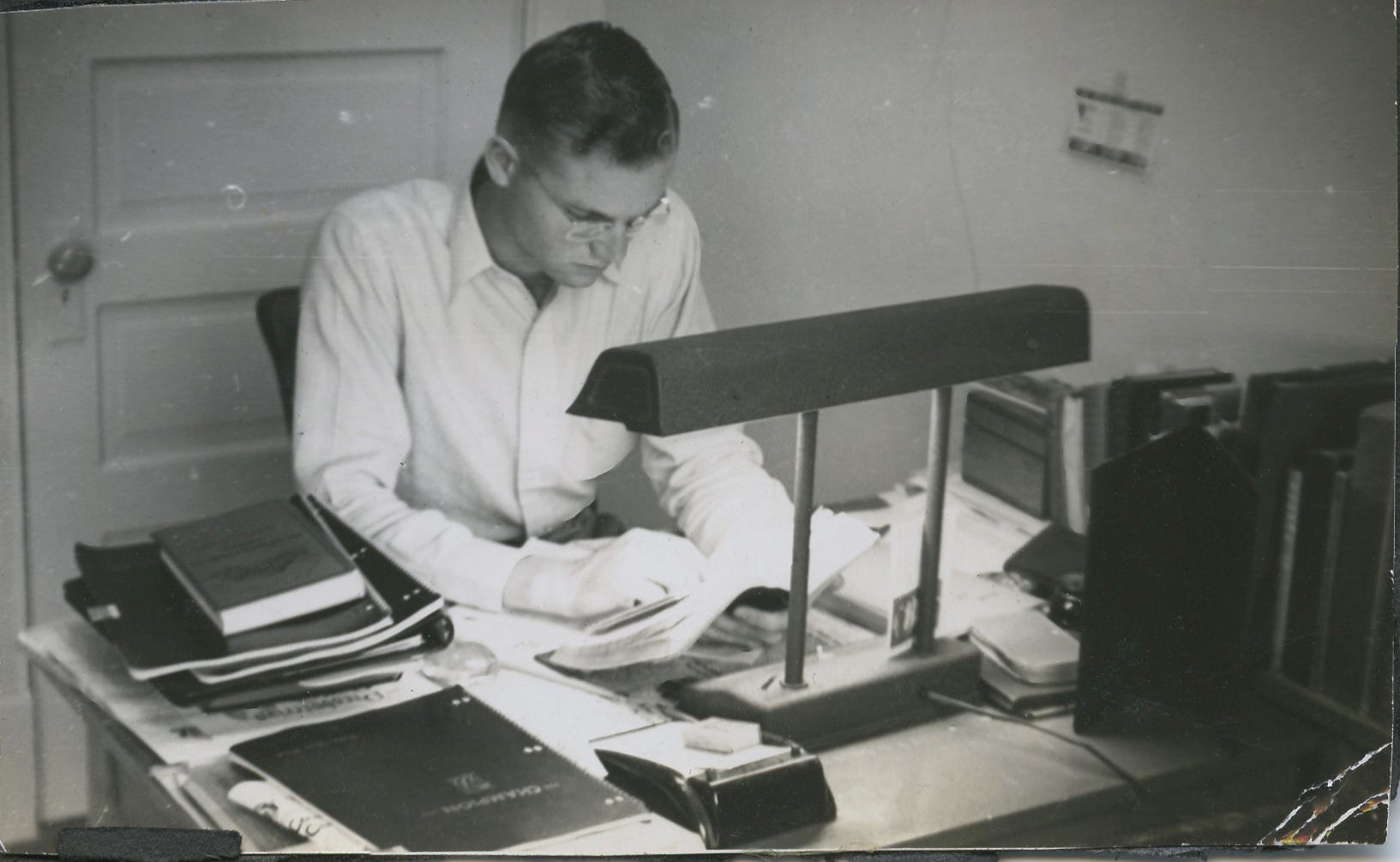
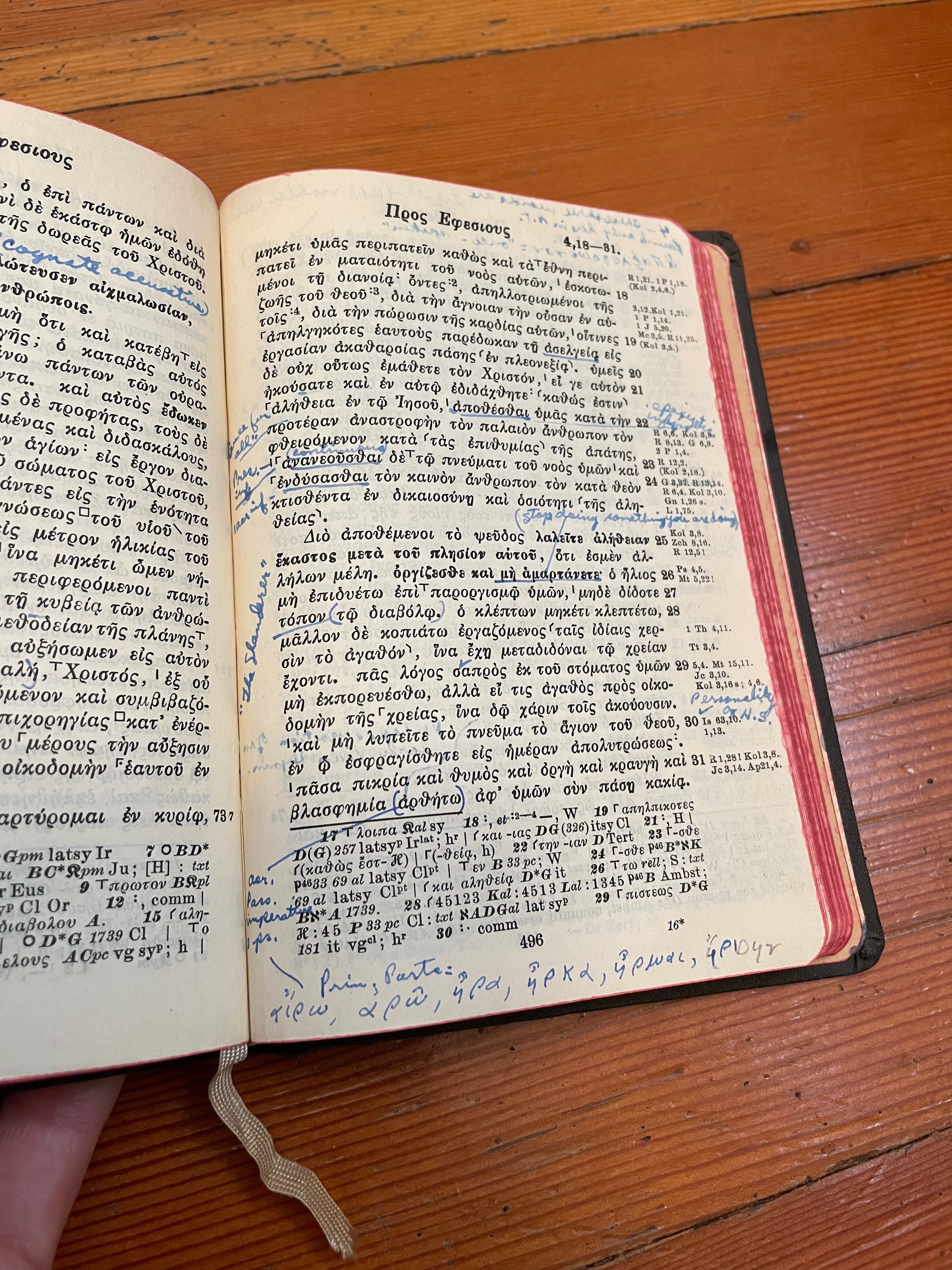
My dad and I spent the summer emailing files and photos back and forth, and I took comfort in knowing that the sacred stories we share bind us together across generations. It has been my dad’s spiritual practice for years to read one of my grandfather’s sermons every Sunday morning, a special moment of connection just between the two of them. But I got to bring my grandfather’s words, preached on the same gospel reading, into my homily for this Sunday, and I can’t tell you how much that meant to me.

The Preach podcast features a homily and also a conversation about how and why we preach, and I got to talk with Ricardo da Silva, SJ, about all my favorite things: Russian literature, the magic of etymology, St. Óscar Romero, and Etty Hillesum, to name a few. Moreover, the Preach podcast is supported by the Lilly Endowment’s Compelling Preaching Initiative, which is an incredible thing to be even loosely associated with.
In sum, it was a joy and an honor. You can listen to the podcast here or watch the video on Youtube if you are interested in seeing me talking with my hands a lot! And if you’d ever like me to guest preach, just drop me a line. Maybe someday I’ll even get to preach at Montreat, where my grandfather took the family every year for conferences—a wild dream!

Here’s my homily for the 29th Sunday in Ordinary Time, Year C, on the parable of the persistent widow and the unjust judge in Luke 18:1-8.
Parables need some unpacking for me. The minute I hear the word, I imagine sandaled feet and long tunics, trekking their way through ancient dust. The world of these stories feels impossibly far away to my modern ear. But I have to remind myself that the stories Jesus told were full of contemporary immediacy for his listeners.
The literal meaning of the word parable is to place something alongside something else. The name implies its function: we are invited to hear the story and then call to mind our own lives, looking for points of contact. Parables always ask us a question: how are we called to respond? Every story can be a parable. Maybe every story should be a parable, no matter how ancient or how modern.
Years ago, when I started working on my PhD in Russian literature, a friend from the sciences asked me for my personal take on the humanities. “Why read stories?” he asked, with respectful curiosity. “We study the particular to get at the general,” I answered. “Every story, even a fictional one, sheds a unique and particular light on what it means to be human.”
I think this is something Jesus understood intimately, given how often he answered questions with stories. Rarely did he give a simple yes or a no, but instead he created a space for human relationality, a space for wrestling with meaning. He offered parables to allow his listeners to draw their own conclusions, to place a short narrative alongside the flesh and bones of their own lives. Stories are so human, so undeniably incarnational. It is in stories, I think, that we find ourselves, stories in which we live and move and have our being.
It helps to remember, too, that we are part of a long and uninterrupted chain of people making sense of our lives by the light of parables. One of the first places I look when turning the lectionary over in my heart and mind is to St. Óscar Romero, whose homilies, the beating heart and conscience of an El Salvador gripped by overwhelming violence, have been lovingly recorded and translated.
When Romero preached on these readings almost fifty years ago in October 1977, disappearances, torture, and killings were everyday occurrences. What Romero understood about our faith, though, is that the liturgy is always a present reality, that Christ is crucified every moment, Christ is resurrected every moment, and every parable he told is taking place all around us. Right here. Right now. Replace those dusty sandals and tunics with jeans and sneakers. The gospel lives and breathes among us. That’s why Romero always included the week’s news and events in his homilies. He knew that the gospel was the lens we needed to interpret them.
That lens is also very personal to me—my grandfather was a preacher, a Presbyterian minister for over 40 years. He first preached on this parable in 1964, and he and his congregation are part of my own unbroken chain of people holding their lives up to the light of the gospel.
What can we make of this particular parable of the unjust judge and the persistent widow? It’s a bit of an unusual one, in that Luke tells us on the front end what its meaning is: that we should pray without growing weary. But I don’t think we should stop there. I think the meaning expands out in concentric circles from the story.
I hope to do as Romero and my grandfather did, and excavate the layers of what this story has meant to people throughout history. We start with the immediate context, which is the scandal of this judge’s lack of care for a widow. Widows and orphans are singled out for special treatment throughout the Hebrew Scriptures. As people without financial resources or protection, they are vulnerable to those who would take advantage of them, and unable to provide for their own needs. They should be the first people we enfold in our embrace.
My grandfather pointed out to his listeners that Roman court cases were often handled with bribes or pressure, but of course, this widow had no money to offer, no power to exert upon the judge. No wonder he turned her away.
But not forever. She kept knocking, asking, beseeching. And, Luke tells us, that’s what we should take from this parable: we are the widow. We must keep praying and not fear being turned away, for God is so much kinder than this judge.
That’s a good read on the parable. But it’s not the only one. Because, like it or not, we are also the judge. There are also people knocking, asking, seeking our help. Will we, like God, answer the door?
I was talking to a friend recently about what it would mean to be like God. My answer was quick: to be so wildly, extravagantly merciful, loving, and forgiving, that it confuses and infuriates people. That’s pretty much what Jesus did, after all. Many people found his radical inclusivity and shattering of social norms in service of mercy simply intolerable. Isn’t that, in fact, the ideal we should be striving to meet?
After Jesus tells this story, he says to the disciples, “Pay attention to what the unjust judge says.” I don’t know about you, but when Jesus says to pay attention, I sit up straight. The word he uses here, though, akouo, actually means to listen, to hear. I have been thinking intensively about attention for the last five years, as I’ve been working on a book about attention and prayer in the lives and work of twentieth-century mystics, artists, and writers.
When I read this word, akouo, I can’t help but think of one of them. Etty Hillesum was a young Jewish woman living in Amsterdam during the Nazi occupation. In a time of terror and dehumanization, Etty made a radical choice not to give in to fear and hatred. It was an unlikely time for a deep spiritual awakening, but that’s exactly what Etty experienced.
She described her prayer process with the German word hineinhorchen. Though it is often translated as “to hearken,” its literal meaning is “to listen in.” This is what Etty did—she listened in to God, listened in to the suffering of others, even during her time in the unspeakable conditions of a transit camp and until her death at Auschwitz.
She believed until the end that we have the capacity to act like God in the world. “There is a really deep well inside me,” she wrote, “and in it dwells God. Sometimes I am there, too. But more often stones and grit block the well, and God is buried beneath. Then He must be dug out again.” Is this not the work of our lives, to bring forth the goodness of God that dwells within us, that we might share it with the world?
My grandfather thought so. “Prayer is not an alternative to work and effort,” he preached. “God would have us to cooperate with him. […] Prayer is an accompaniment of effort in order that we not give over to despair—that we do not faint or lose heart.”
Romero, thirteen years later, also urged his people, and the church as a whole, to persevere in their collaboration with God. “You can rest assured,” he proclaimed, “that the church will always stand for justice for the poor and those who suffer, but she will also raise her voice when there are abuses. The church throws light on these realities from the perspective of God.”
Years ago, I was leading a sharing circle at a retreat, and we passed a small stone from person to person as each one of us spoke. Every one of us was stunned as we made our way around the room at how warm the stone was. That’s how I like to think about the way these parables are passed down to us by the communities that came before us, and the ones who will come after us. We are all just warming the stones for each other, passing our wisdom along, helping each other to see the living parables in our midst, to excavate the goodness of God within us, and to release it into the world around us.
When I take the stone of this parable in my hands, I feel called to listen in, to pay attention, to look for the places where it is made flesh in this moment. Who are the persistent widows in this time, in this place? Who is vulnerable, stripped of their rights, and in need of mercy and justice? Every time we pick up the newspaper or scroll through our phones, we can be looking and listening. Stories don’t just offer us entertainment—they offer us a challenge, an invitation to self-examination. Right now, in October 2025, people are knocking at our door. Will we answer them?
When I ask that question, I remember the words of 4th-century St. Basil the Great: “When we furnish the destitute with any necessity, we render them what is theirs, not bestow on them what is ours; we pay the debt of justice rather than perform the works of mercy.” This justice is not optional. It is something we owe to one another, something to which we must dedicate our hearts and our lives.
How we do that? Óscar Romero has advice. Responding to this parable, he said, “Only by sinking into the heart of God can we understand God’s plans for history. Only by sinking into moments of intimate prayer with the Lord can we learn to see the image of God in the face of men and women—especially those who suffer most, the poorest, the most ragged—and thus carry on God’s work. Only by prayerful contemplation can we perceive the power of the Spirit weaving itself into history.”
Let us sink down together into the heart of God. Let us listen in to Divine prompting and to the needs of those around us. Let us hear anew the stories passed down from generation to generation. And let us find in them our own place in the great and endlessly good work of God.
Holding the stories with you,
Cameron
No posts
Comments
Nothing yet. Say the first thing.
Sign in to join the conversation.