
I’d really meant to get this out to you sooner, but every span of time has its own flavor, and the flavor of this most recent span in our family was…covid. To the best of our knowledge, this was the first time any of us had ever had it in the past five years. It swooped right in a few weeks ago to knock out two work trips for my husband and set off some general reconfiguration of our daily lives. But it was a good run, dodging it as long as we did!
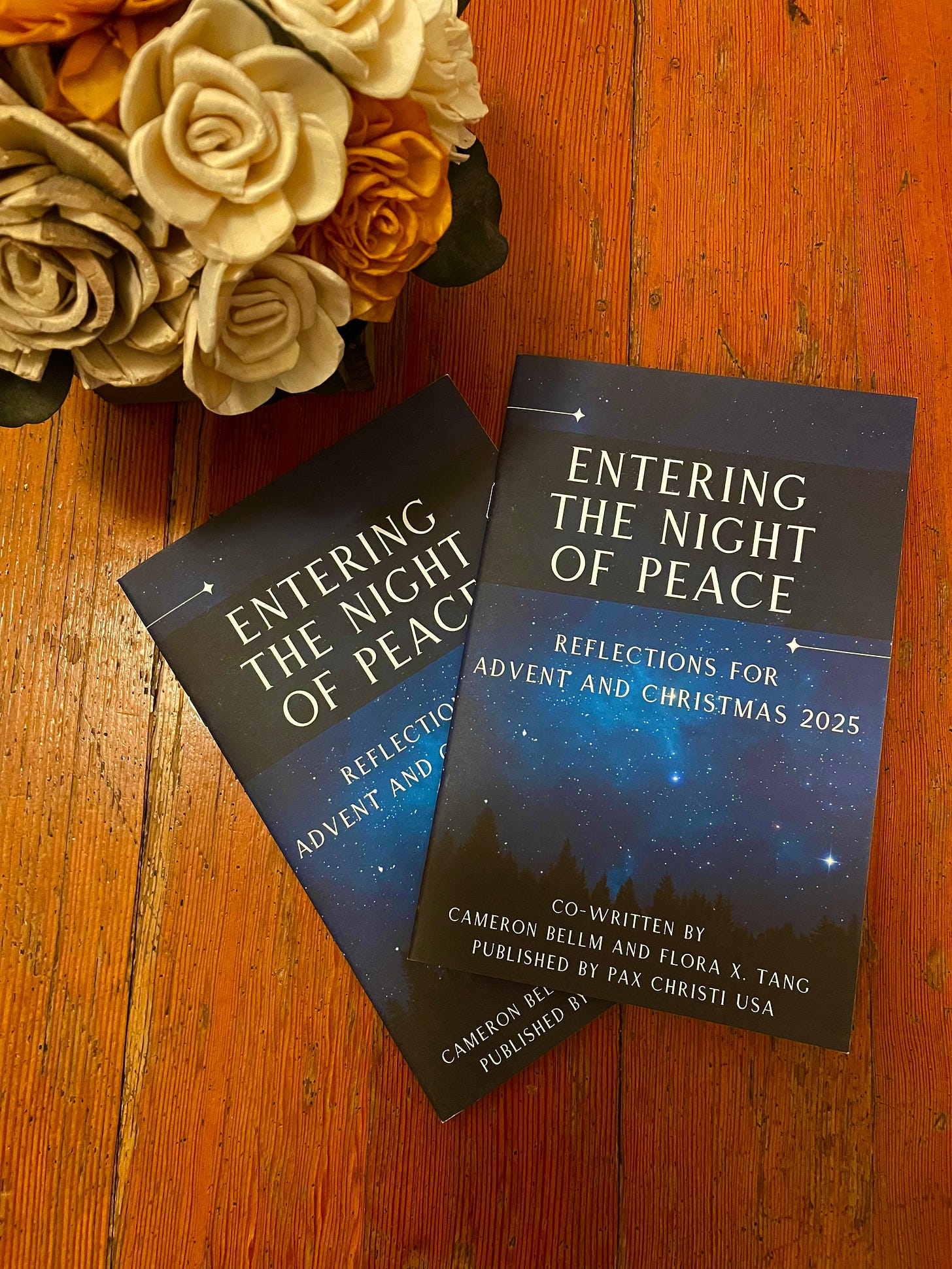
Now that we’re all recovered and life is approaching normalcy again, I am realizing that Advent starts in two weeks and that now is the time to tell you about a new Advent devotional! I was honored to co-write this year’s Pax Christi Advent and Christmas devotional with the brilliant theologian and activist Flora X. Tang (whom many of you know!). Many of you are likewise already familiar with the good work of Pax Christi, the Catholic peace movement—they do advocacy and activism rooted in the enduring hope that we can birth a better world into being. They are one of many organizations that keep me going, inspiring me to press on. (Is that a nod to the Ignatian Family Teach-In for Justice? Indeed, it is!)
If you’re longing for the peace that only justice can bring, Entering the Night of Peace is the devotional for you. Flora and I have written reflections on the lectionary readings for each day of Advent, and also for Christmas, the Feast of the Holy Family, the Solemnity of Mary, Mother of God, and Epiphany. I love that we get to walk into that season with you, concluding with the gifts of the magi and a star brilliant enough to light up our every night.
Entering the Night of Peace is available for sale now (for only $5!) on the Pax Christi website, and Flora and I are both running giveaways on Instagram here and here. It was Flora’s idea that we join in what Howard Thurman calls “the work of Christmas” by donating to our local food banks as part of the giveaway entry, and I love this idea!
Here in Seattle, we’re giving to Northwest Harvest, Food Lifeline, and our local chapter of the St. Vincent de Paul Society. I love imagining us lighting up the map with love and care for our neighbors, especially during this time of upheaval with the government shutdown and SNAP benefits interrupted.
In case you’re not familiar with it, here is Howard Thurman’s poem “The Work of Christmas.” It’s a perennial favorite, and I’d like to adopt it as my personal Christmas motto.
“The Work of Christmas”
When the song of the angels is stilled,
When the star in the sky is gone,
When the kings and princes are home,
When the shepherds are back with their flock,
The work of Christmas begins:
To find the lost,
To heal the broken,
To feed the hungry,
To release the prisoner,
To rebuild the nations,
To bring peace among others,
To make music in the heart.
—Howard Thurman
Worth returning to, again and again, isn’t it?
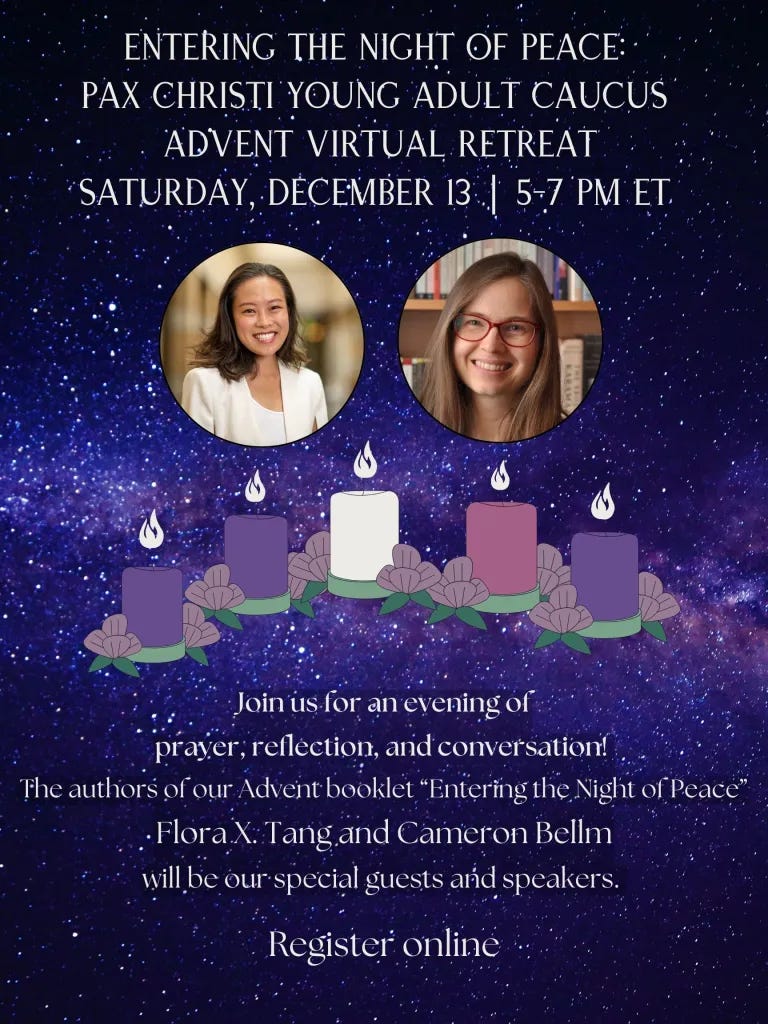
Flora and I will also be preaching at the Pax Christi Young Adult Caucus Advent retreat on Saturday December 13th at 5pm Eastern. It’s virtual, so if you’re a sprightly age 20-39, please do join us! You can sign up here—it’s free.
****
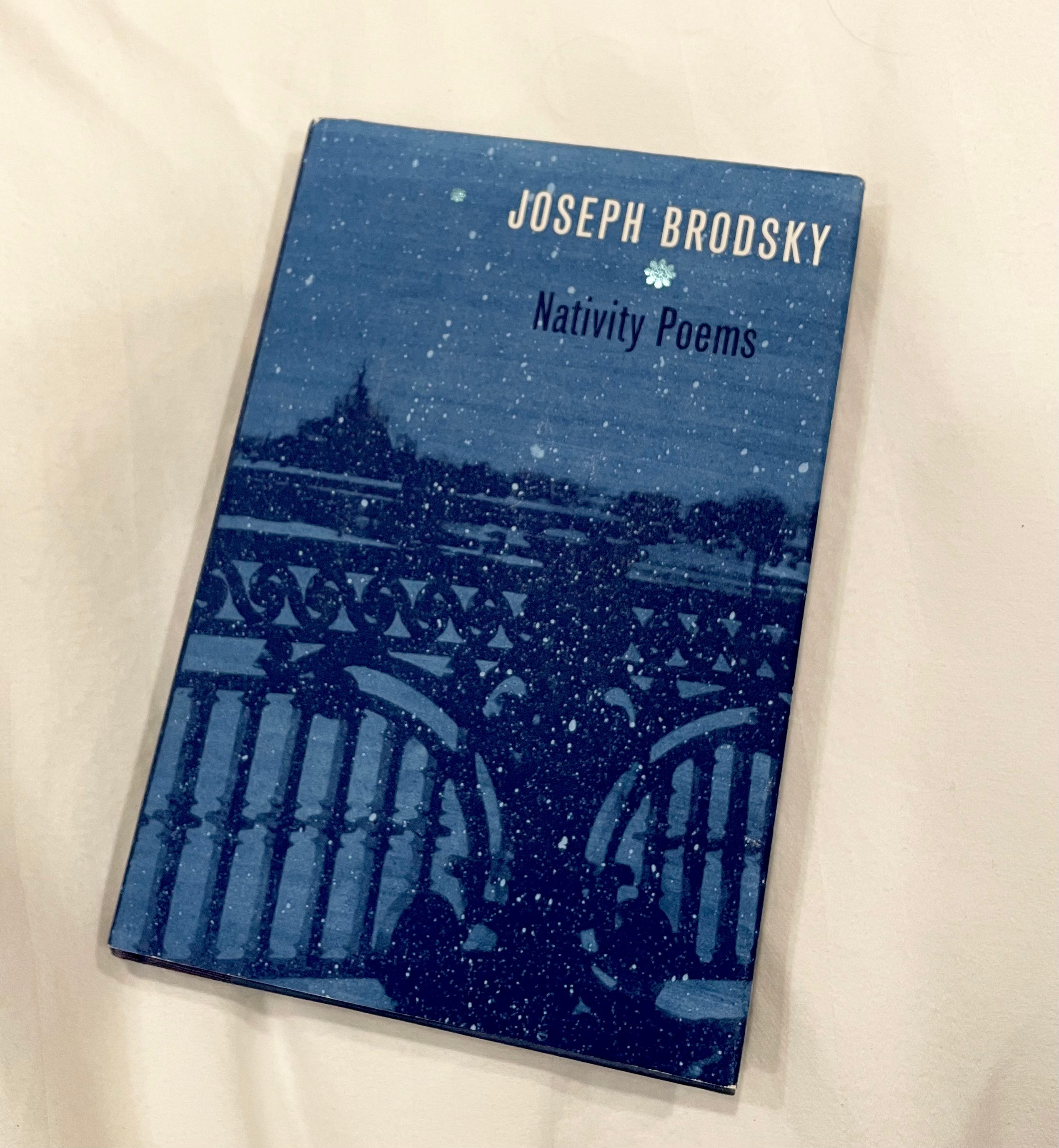
Speaking of time and Christmas, I’m in a reading and discussion group that meets weekly, each of us taking turns choosing the texts. When my turn comes in December, I’m planning to lead us through several of Joseph Brodsky’s beautiful Christmas poems, but I’m going to have a hard time choosing. I’d forgotten, until I pulled my copy of Nativity Poems off the shelf, that Brodsky wrote a poem to mark Christmas every year.
Brodsky is a bit of an unlikely candidate for Christmas poet. Of Jewish descent, he grew up in the atheist Soviet Union, where his dedication to non-regime-friendly poetry led to his denunciation, imprisonment in a mental institution, and trial as a social parasite. After being expelled from the Soviet Union, he lived the rest of his life in exile in the United States.
Brodsky was once asked by an interviewer why he kept returning to the Christmas story, and his answer was illuminating. “Above all, this is a temporal holiday, linked to a particular reality, to the movement of time. In the final analysis, what is the Nativity? The birthday of God-made-man. And it’s no less natural for humans to celebrate it than for them to celebrate their own.” Brodsky explained his annual Christmas poems as a kind of birthday greeting, one that I imagine was addressed to all of humanity.
The interviewer pegged Brodsky as more interested in time than space, and who could argue with him? Space is a limited entity. But time? Time is a trickster, always folding over on itself, always making accessible to us things we thought had been lost.
Sure, there’s chronos, the ordinary timescape in which we live our everyday lives. But I think what Brodsky was grasping for was another type of time—kairos, which is the result of God crashing into our numbered days in ways so significant that time stretches, broadens, and is reshaped by mystery and mercy.
Memory and imagination are the two realms of our spirit that cannot be chained, imprisoned or exiled. Brodsky wasn’t a religious person, strictly speaking, but every Christmas, those two faculties allowed him to build spaces in his poetry that geography couldn’t touch, places where faith was granted some breathing room, some license to expand. In these poems, I feel like I can reach out and touch kairos; I can sense its shadow tucked between the lines of text.
My friend Zach introduced me to this poem eons ago in grad school, and I’ve treasured it ever since:
“January 1, 1965”
The kings will lose your old address.
No star will flare up to impress.
The ear may yield, under duress,
to blizzards’ nagging roar.
The shadows falling off your back,
you’d snuff the candle, hit the sack,
for calendars more nights can pack
than there are candles for.What is this? Sadness? Yes, perhaps.
A little tune that never stops.
One knows by heart its downs and ups.
May it be played on par
with things to come, with one’s eclipse,
as gratefulness of eyes and lips
for what occasionally keeps
them trained on something far.And staring up where no cloud drifts
because your sock’s devoid of gifts
you’ll understand this thrift: it fits
your age; it’s not a slight.
It is too late for some breakthrough,
for miracles, for Santa’s crew.
And suddenly you’ll realize that you
yourself are a gift outright.
—Translated by the author
Wow. If you have a moment, I’d really recommend listening to him read it in the original Russian because Russian poetry recitation never fails to bring me to tears. It shares more of a kinship with singing than reading.
All of this is to say: here we find ourselves. Advent dawns anew. Ancient and fresh all at once. Trickster time, folded over on itself. Kairos bursting into our ordered calendars. May we all find our place in it, once more.
Setting out for the work of Christmas with you,
Cameron
No posts
Comments
Nothing yet. Say the first thing.
Sign in to join the conversation.