

A few months ago, my 5th grader asked me to speak to their class about technology as part of an SEL lesson related to digital literacy.
I’ve spent years thinking about this topic—as a former educator, and now through my work at the California Partners Project, where we focus on how technology shapes kids’ lives and well-being.
I know the research, and I have a pretty good handle on the kids and tech landscape. I’ve led conversations with parents and young people across the state. I also talk openly with my own kids about screens, devices, and the media they consume. And yet, I still wasn’t sure what might make the most sense for this group of students to learn more about.
So I did something simple: I asked their teachers to collect anonymous questions.
And what I received in return was both surprising and encouraging.
“Why are apps so addictive—and how do they make them that way?”
“Why do parents go on their phones, but yell at us when we are on ours?”
“If I don’t want to be in a group chat but people keep adding me. What should I do?”
“If you have a favorite YouTuber that does not post anything bad or toxic, is that still not ideal?”
“For social media, what happens if an unknown person texts you and you accidentally text them?”
“How do I stop hangouts becoming another time to use screens?”
These weren’t surface-level questions. They were thoughtful, vulnerable, and observant.
And they revealed something I don’t think we talk about enough: Kids are really grappling with growing up in a digital world. They’re aware of some of the harms, and they’re trying to make sense of how to manage them.
I took their questions and built a presentation around them. The goal wasn’t just to share information. It was also to spark conversation.
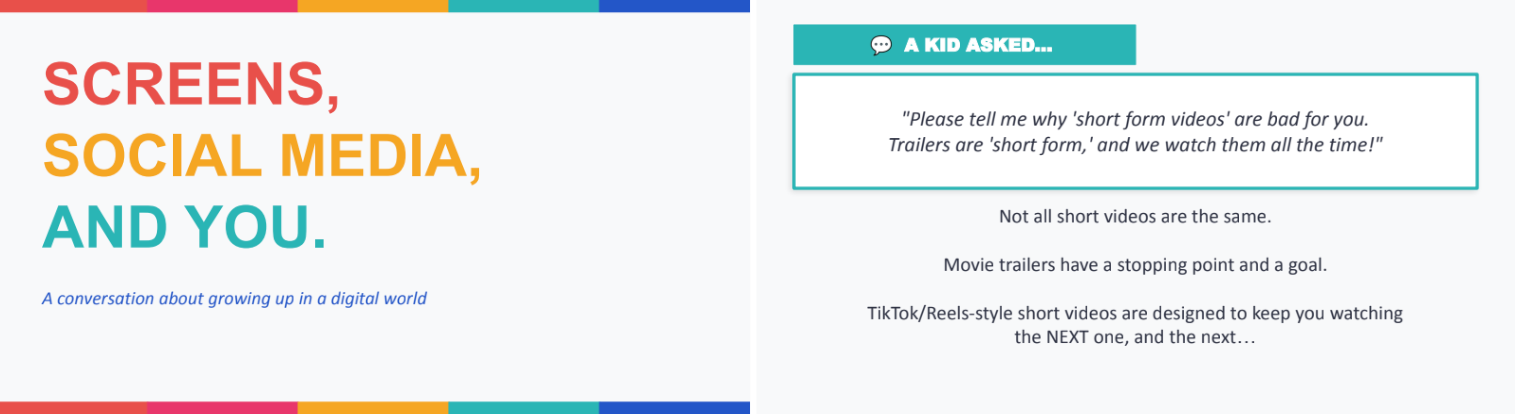
And that’s exactly what our time together did. What was supposed to be a one-hour assembly stretched into two. The kids were fidgety from sitting too long, but they stayed engaged, sometimes waiting (impatiently) for their turn to share a personal story.
Yes, they asked about the “right” age for this and the “right” time for that. But what stood out most wasn’t a search for age-based rules—it was a desire to understand.
I’ve spent a lot of time thinking about how we support kids in a digital world. And if I’m honest, we sometimes overcomplicate it.
If you want to have this kind of conversation with your kids—or in a classroom—you don’t need to be an expert. You don’t need a perfect script. You just need to be willing to listen.
Start with curiosity and let them lead.
Because the most compelling questions weren’t really about devices. They were about control, trust, belonging, friendship, privacy, and whether adults are being fair or clear with them.
Our job as adults is to help kids understand the world they’re growing up in—and give them tools to navigate it with awareness and confidence.
Reply or comment if this presentation and the corresponding handout would be helpful for your family or school community. We’ll send it over.
—Jennifer Heifferon, Child Well-Being Program Director, California Partners Project
Your Turn!
If you’re a parent, caregiver, or educator and you want to have this kind of conversation with kids, here are a few places to start inspired by Jennifer Heifferon’s experience speaking to a 5th grade class:
Start with their questions, not yours.
Make space for curiosity.
Create a way for them to ask anonymously.
Focus less on how much time they spend on screens and more on what their screen use is revealing about their needs, fears, and friendships.
If you are looking for more ways to start conversations with young people about technology and the digital world, start here:
If you want kids to trust you with tough questions:
– Shafia Zaloom on consent, connection, and being an “askable parent”
If you want to support a child that’s struggling in the moment:
- Katia Martha on screentime, boredom, and why Gen Z is getting crafty
If you are looking for the right time to talk to kids about tech:
- Logan Shallow on food, pressure, and talking to your kids about life online
Comments
Nothing yet. Say the first thing.
Sign in to join the conversation.