
From the day we are born, our brains are learning. As babies, we focus on blurry shapes and then familiar faces; as children, we develop through relationships, observation, and play.
By adolescence, the brain becomes especially tuned for exploration and discovery so that we can figure out who we are and who we want to become. These superpowers make the teenage brain a powerful complement to the adult brain, which is more practiced at planning, regulating emotions, and drawing on past experiences.
And yet teenagers and adults are notorious for clashing. How can we better facilitate a meeting of the minds?
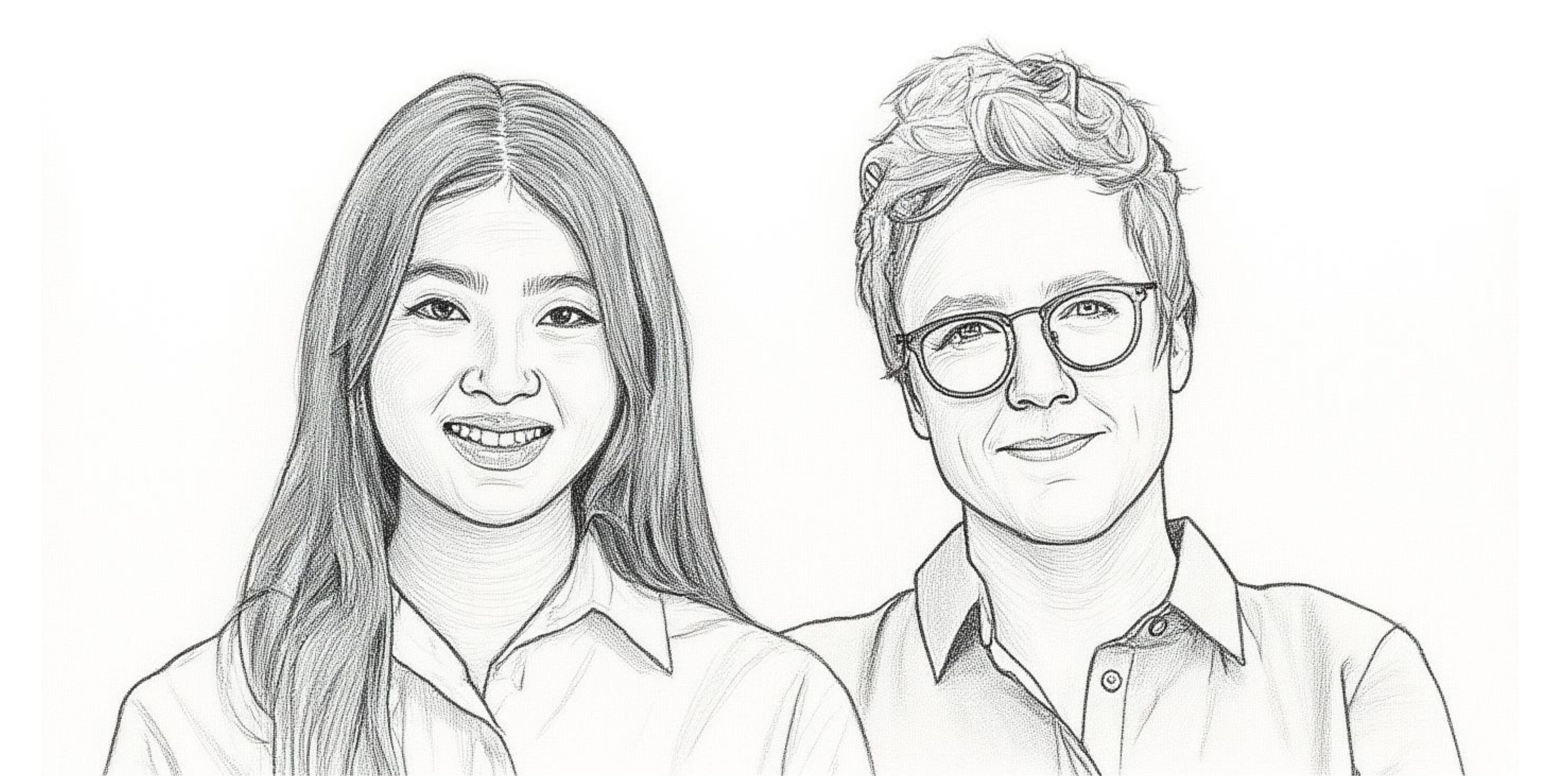
As the co-founder of the Spark & Stitch Institute, Erin Walsh has dedicated her work to answering that question. Drawing on brain science and focusing on digital technologies, Spark & Stitch translates research into practical strategies that support young people and strengthen connections across generations.
It’s an approach that resonated with student Karina Yue, a youth co-designer with the California Partners Project who is passionate about media literacy and amplifying young people’s voices. In this conversation, they discuss generational differences in navigating the opportunities and challenges of the digital age—and how we might bridge the divide.
Karina Yue: Discussions about teens and technology often happen between young people rather than with them, and as a youth co-designer with the California Partners Project, I spend a lot of time thinking about how adults and teens understand the digital world differently. Can you tell me a little bit about what Spark & Stitch Institute does?
Erin Walsh: We use brain science, research, and child and adolescent development to spark understanding of what’s going on inside the brain—this miracle [that’s] perched on top of young people’s shoulders and perched up on adults’ shoulders. And then we stitch that science to practical strategies.
The power of connection and belonging is really at the core of our work. We translate research and hope to make it meaningful for young people and the people who care about them as they navigate a changing world.
KY: Did you imagine you’d end up doing this work when you were my age?
EW: Definitely not! My parents started one of the first education and advocacy organizations focused on media’s impact on child health and development. As a young person, my relationship with my parents’ life work was arguments about why I had to do my homework before I played video games. [I was] sort of exasperated by my parents’ consistent invitations to think critically about the things that I was seeing on screens! Of course I am grateful for all of that now.
When I was graduating from college, I started working with youth, and I realized that we couldn’t really have a meaningful set of conversations about what it meant to thrive or flourish without taking into account the powerful role that screens have. It took me longer than you to figure out that this was something that I wanted to dedicate my career to.
KY: My generation is often described as either thriving because of technology or struggling because of it. Most of the people I know would probably say it’s both. What do you think adults get wrong about what it is actually like to be a teenager right now?
EW: The simple story is that tech plus teens equals inevitable bad outcomes. This leads to a lot of rigid and one-sized-fits-all solutions. The dominant narrative is that we can understand teenagers simply by how many hours they spend in front of a screen. How do we replace that with [a] more nuanced story? There is a big difference between scrolling all night through content that doesn’t make me feel very good and using that tool to connect,collaborate, and participate in conversations that matter to me. It’s the same device, just used in really different ways. The real story about tech and teens is a lot more complicated.
The other simple story is that teens are just risks to be managed. This could not be farther from the truth.
“We actually know that the teenage brain is built for discovery. It’s built for purposeful exploration and learning. It’s a time of incredible transformational growth. So rather than just being a window of risk, it’s actually a window of opportunity.” —Erin Walsh
KY: Is there anything that surprised you about teens, like something you expected to hear, and it turned out to be totally different?
EW: There used to be the strong narrative that adults wanted to take phones out of kids’ hands, and teenagers were just thoughtlessly clinging to them.
I’m impressed and always honored to hear from young people just how many thoughtful strategies they already have; how much awareness they often have about tech design. Many young people have really strong opinions about tech companies, and are asking important questions about how to take back power and agency. They are asking, “How do I use this device rather than letting the device use me?”
KY: Do you think being a teenager today is harder than it used to be, or maybe just different?
EW: Every generation has a unique set of challenges and opportunities, and I think that it is common for adults to look at this current generation of teens and ascribe a lot of challenges to it and to glamorize the “good old days.”
This is the first generation that’s grown up with so much access to the world through technology, both [its] joys and challenges. A lot of today’s challenges and opportunities are amplified and transformed by tech in a way that can be pretty intense. We have portals to the world’s pain and its beauty. I do think we should take the unique transformational power of technology seriously for this generation, not just for young people, but for adults, too.
KY: One thing I appreciate about your work is that you spend time listening to both sides. What’s the number one thing parents ask you about over and over again?
EW: Parents ask about what age young people should get their first device, and how much screen time should my kids have. Those are the most common questions, likely because those are simple and measurable metrics.
There are so many things that parents are worried about, and it makes sense that we are eager for these simple solutions. Of course, even those questions don’t always have simple answers. We have some guidance and general recommendations from science. But what we know is that screen time alone is not necessarily the best predictor of outcomes, except in the extremes. Outcomes are really driven by who teens are, what they are doing online, and what is going on around them.
I have found that once we have an opportunity to have a conversation, caregivers are ready to move beyond just one-size-fits-all solutions. We start with simple questions, but parents are also willing to engage with the complexity. Most parents do want to show up meaningfully for kids as their digital world expands, and they’re just eager to know what’s the best way to do that.

KY: What’s something you wish more teens understood about their parents?
EW: As you get older, there’s more opportunity for parents to move [on] from just delivering rules into the role of a coach and a mentor. Of course, parents are still going to have purposeful boundaries, and hopefully those boundaries are designed to help protect safety and health. But within those boundaries is so much more room for collaborative problem-solving between young people and the adults who care about them.
For example, teens and adults can have conversations about their priorities. How are we still going to hang out with people face-to-face? How are we going to sleep? How are we going to get our schoolwork done? How are we going to move our bodies outside? These priorities are actually shared among most teenagers and their parents.
One of the superpowers of the human brain is our ability to take the perspective of someone else. It really is about us trying to work together to figure out: how do we move towards our goals? When we can step into that collaborative mode, we tend to just communicate better and come up with better solutions to our problems.
KY: Teens, parents, connections come together in your new book. Can you give us an overview of what the book is about and who you wrote it for?
EW: The new book is called It’s Their World: Teens, Screens, and the Science of Adolescence, and it really is a book specifically written for parents or caregivers—adults who care for and about young people.
I really wanted to write a book that wasn’t organized just around digital risks and harms, but around the latest science of adolescence. The teen brain is built to explore questions like “Who am I?” “Where do I belong?” and “How can I contribute?” Once we understand that the teen brain is built to discover and to explore these questions, then we can bring those developmental tasks into conversations with the research on tech. And instead of it being about “is tech good or bad for kids,” we can ask a more interesting set of questions. When does tech help young people stay connected, find belonging, and explore their purpose? When does it get in the way?
This approach points to a more nuanced set of strategies for adults. It positions adults not just as “on-off regulators”—like our job is just to turn devices off or rip devices out of kids’ hands—but to really consider, how do I support healthy development? What’s the role of a parent in helping a young person find connection and keep connection? Of exploring their purpose and figuring out who they want to be in the world? This invites us to listen more to our teenagers, like what do they think? Do they think that this is helping or hurting?
[The book] really was meant to be kind of a love letter to the science of adolescence and the extraordinary adolescent brain. It has so many superpowers. And once we better understand that, I think it creates a more powerful roadmap for adults on how to show up meaningfully for adolescence that isn’t just about screen time or turning devices off, but really turning on possibilities.

KY: If you had to pick one big idea you want readers to walk away with, what would it be?
EW: Get curious. I think that if we can start with a mindset of curiosity, that gets us very far. The only way that we’re really going to understand how to show up meaningfully—not just for national data sets or national averages—but for the young person living in our home or sitting in our classroom, is to turn towards them and to get curious about what’s going on in their lives. What are they thinking about? What are they overwhelmed by? What are they energized by?
That’s the first step, because the rest of the strategies might not meet the young person’s needs, if we haven’t taken the opportunity to ask them what they’re experiencing.
KY: Is there anything you’re curious to ask me, or something you’d want to know from my perspective as a teen?
EW: I’m curious, is there anything you wish adults better understood about your relationship with technology?
KY: I wish adults better understood that the solution isn’t a complete ban on technology. Instead, we should focus on improving regulation and providing guidance. Technology is a huge part of our lives. We rely on it for communication with our friends and family, for staying informed about what’s happening in the world. What teenagers really need are healthy boundaries and good habits.
EW: That’s so insightful, and it’s helpful to hear you say, “We do need limits sometime,” just like adults need limits. I hear this from young people all the time: our goal is not to scroll through TikTok 24 hours a day. There are things we want in this world! We need caring adults to set purposeful boundaries. But then what I’m hearing from you, is within those boundaries, you also want people to listen to [what] you’re facing to help you problem solve.
Have you ever had an experience where you felt like an adult started a conversation with you around tech that you felt was meaningful, [where] you felt heard or listened to, and what was that like? Was there anything different that they did?
KY: Throughout my journey founding Youth for Narrative Justice, a storytelling organization dedicated to transforming personal narratives into meaningful advocacy, I have met so many amazing mentors and leaders. One of those mentors is Chelsey Goodan. When we had discussions about media literacy and the impacts of social media on girls’ wellbeing, she always showed genuine interest. She asked insightful questions and most importantly, treated my perspective as valuable.
KY: What’s the one thing you hope changes about how parents and teens talk to each other?
EW: When adults get scared, oftentimes they reach for things like control and restriction. Now, control and restriction are not the same thing as purposeful boundaries. Control and restriction tend to be rigid, reactive, and unresponsive. This is not a great fit for the teenage brain.
The teenage brain is organized around agency, autonomy and exploration. My hope is that when parents and teens talk to each other, we can approach these conversations around tech [by] respecting the way the teenage brain is built and the gifts that young people have.
“Collaborative problem solving is a much better fit for the teenage brain—where we replace control and restriction with things like boundaries, listening, communication, skill building, reflection, problem solving. It’s not only a better fit for the teenage brain, but it actually better prepares both adults and young people to navigate the risks and rewards of a really complicated digital world.” —Erin Walsh
KY: I definitely understand that: making sure that we're working together and achieving impactful change. Are you excited for how technology is going to evolve?
EW: It depends upon the day, Karina. It depends on the day!
I feel as mixed about the future as I do about the present. And I think that reflects the complexity of being a human today. I am amazed by today’s youth-led movements for digital well-being and tech accountability. We have increased awareness about mental health and well-being. At the same time, technology is moving very, very quickly. Historically, we have been more reactive than proactive when it comes to creating systems solutions for online safety and digital flourishing.
But I have hope! If we turn towards each other and we keep working together—and we have opportunities to co-design and to co-create solutions—that does make me very hopeful.
KY: I'm glad to hear that. Thank you so much for sharing your insights with me today.
EW: Thank you so much for the thoughtful questions [and] for sharing some of your insights.
The teenage and adult brain each have their own superpowers—and they work best together. Teens are built for exploration and discovery; adults bring experience, perspective, and long-term thinking.
Inspired by this conversation with Erin Walsh and Karina Yue, here are a few questions to help shift conversations from rigid rules to curiosity and collaborative problem solving:
What feels good about technology for you right now? What feels stressful?
Do you think your technology habits are helping you reach your goals—or getting in the way?
What boundaries actually help you feel healthy and successful?’
When do you feel most heard by adults? What makes those conversations different?
What do you wish adults better understood about your relationship with technology?
For more ideas about how to talk with teens, check out the Tech/Life Balance series, free, bilingual resources from the California Partners Project.
Looking for more intergenerational conversations about technology and well-being? Start here:
Katia Martha on Gen Z swapping digital habits for IRL hobbies
- “It’s easier to add in good things than take out ‘bad’ ones.”
No posts
Comments
Nothing yet. Say the first thing.
Sign in to join the conversation.