
Before we get into this week’s learnings on Mickey + Konrad, we’re so excited to share a podcast episode our founder, Fassa Sar, was most recently on. Last month she sat down with Manager of Entertainment at Accenture and podcast host, Minds in Motion, Charles Fautnbi.
In this episode, they took a deep dive into:
The core mission of Callo: turn as many Creators into Studios by providing a platform to find collaborators, manage project lifecycles, and commercialize media projects.
The differences between being a Gen Z executive at Sony Pictures and founding a company for a new generation of Hollywood.
The lost art of having taste and how her background led her to fight for the underdog.
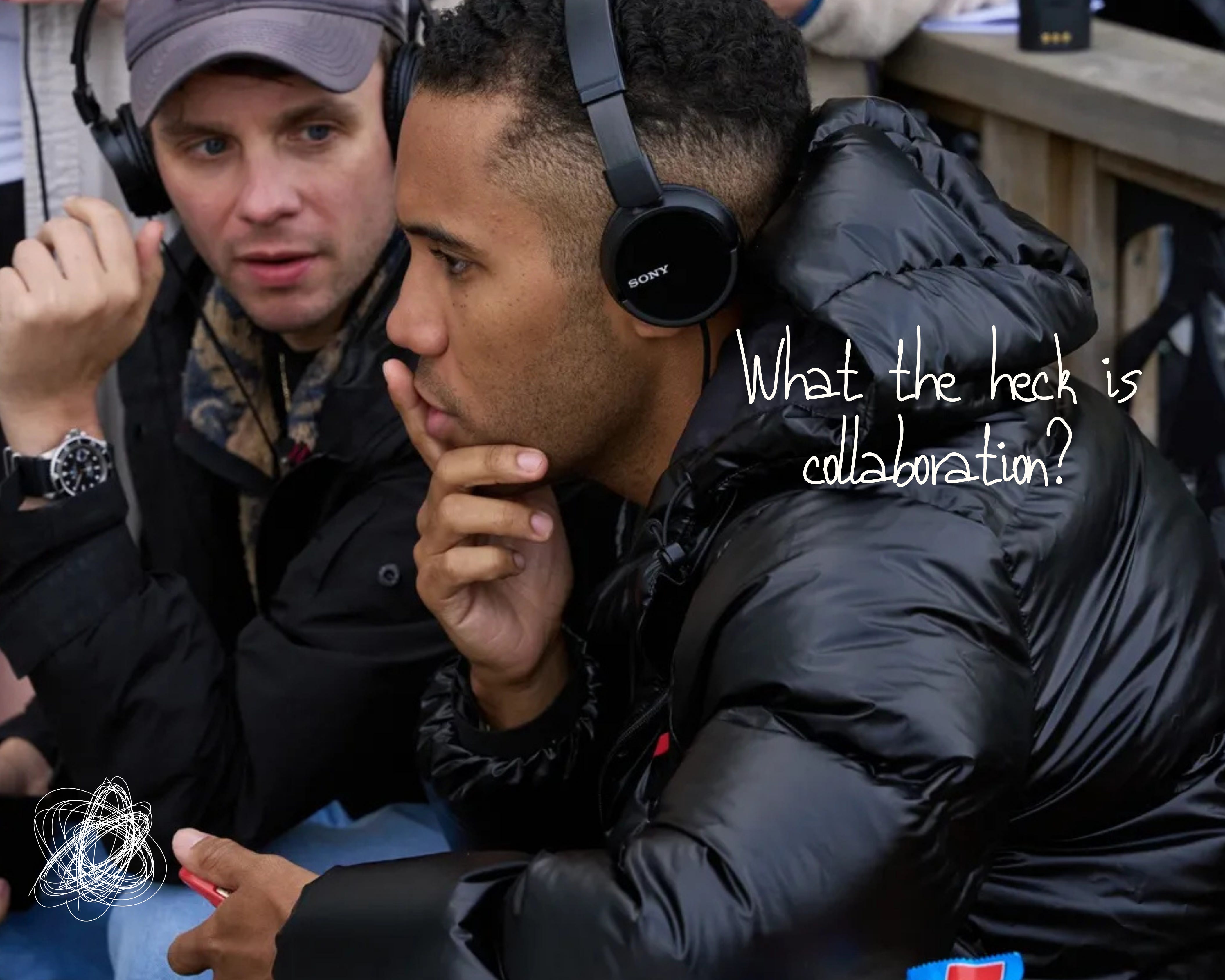
We’re going to start at the end of what is a well-documented tension for most filmmakers: how to collaborate.
Three choices typically stand between you and a project getting made and distributed. They want in. Not because it's the right call. Not because anyone has sat down and run the numbers. They choose it because it is, in the moment, the least catastrophic-feeling option available.
So now you have one choice to make:
Door 1 – Creative purity
Say yes to powerful collaborators who make it fundable, even though they push the project in a direction that doesn’t feel like the finished project you had in your head.Door 2 – Authorship vs money
Take EPs and capital that strengthen and expand the IP, while letting them shape characters and world in ways even when it might feel sometimes feel like they’re taking over your project.Door 3 – Existence or nothing
Protect your idea or the project, even if it never leaves development.
Here is how showrunners Mickey Down and Konrad Kay, creators of the hit HBO/BBC show Industry adapted early on to tradeoffs that go down in HBO history. A partial excerpt from Gentlemen’s Journal.
Mickey Down had recently left his job in banking and just sold something to NBC. He wanted his best friend Konrad Kay, friends since high school to understand that a career in film and television might actually be viable for both of them. In their mid-thirties, Down approached Kay with a wild idea.
“What would it take for us to go away for a weekend and try to develop some big thing on the back of this?”
For Mickey Down and Konrad Kay – creators of the hit HBO/BBC show Industry, they placed the world of banking under a microscope for 20-somethings. Both had been literally pushed out of the finance industry after being fired.
As a duo, they went to work writing scripts. Staging plays. Making low-budget short films. A low-budget feature. Working on other people’s shows in London. “We had an attitude,” Kay says, “especially at the start, which was we had to literally say yes to everything, develop anything, take any job.”
They received their first check about a year in. Not much money, but enough to sustain the delusion.
In retrospect, it felt like we’d F****, not won an Oscar, but if someone was paying us to do something,” Kay recalls, “it felt like an enormous win.”
The commitment to the idea of this kind of life as writing partners, paid off.
In March 2016, Down received the first email stating HBO’s real interest in the project that would become Industry—a bottom-up view of high finance, centered, at least at first, on a class of recent university graduates. Kay joined to flesh out the series.
By November 2020, Industry hit like a syringe of adrenaline to the heart.
By 2024, the third season of the show slid into HBO’s historically coveted 9 p.m. ET slot (The Sopranos, Game of Thrones) .
Industry had emerged suddenly and without fanfare on HBO Max, during COVID. without recognizable stars, and a world of written-ness with it’s own language.
The show follows an ensemble of first-years through the competition for full-time jobs. This is the engine of the season.
It opens with scenes from the recruiting interviews of the incoming class of analysts at the fictional Pierpoint Co. Fresh faced graduates from the best universities made their case for why they should be allowed to lend their big brains to the sales force of a trading desk. Gus, a graduate of Eton and Oxford and the son of a Ghanaian ambassador, explains:
“I play third fiddle to two figures in my mother’s life: Jesus Christ and Margaret Thatcher.” And where do you stand on them? a recruiter asks. “One’s the reason we’re all here. And the other’s a carpenter.”
This was London. This was kids. Talent that was new and fresh with a soundtrack behind the script that defines the show for so many fans five seasons later.

“Most people don’t work for a bank because they want to work for a bank–but because they want to be a banker.” This is the kind of subtle differences that the duo exploit in the shows writing.
Working for a bank is hard, and tends to involve either utter boredom or near constant terror, and usually a mingling of both, often before 5.30am. Being a banker, on the other hand, is simple. Understood. Straightforward, despite its complexity. Impressive, even as it sliding towards global default and taking people’s savings, homes, and possessions with it, hence the 2007-2008 banking crisis. People know what a banker is at a dinner party, even if they don’t quite approve.
Your friends won’t mock you for going into finance in the same way that they might if you followed your actual dreams, like stand-up comedy, or filmmaking. The show picks up on the 1980s fashion scene, back when being a grown up actually sounded fun. The deciding factor of being a banker was the clothes. “I had visions of Hermès ties and nice suits,” says Down, who worked in M&A (Mergers & Acquisitions).
The duo had an insider view of young men with a particular taste level in British finance. “Aesthetics can be a great motivator,” Down says. “Everyone in finance wore ties and really nice suits, and had very shiny shoes. Even if you go out and it’s two in the morning, bankers are still wearing suits and ties.”
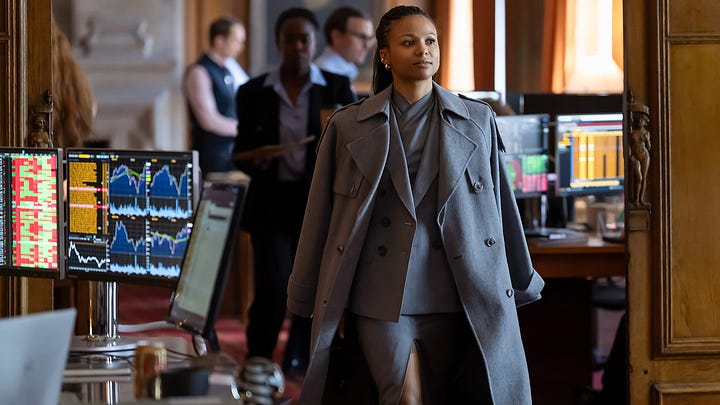

Industry could only have been made by two people who appreciate these nuances…
While at Bad Wolf, it was a producer that told Kay she had always wanted to make a show about the banking industry, so he wrote a soft treatment. A pitch was put together for HBO with an old spec script and the pair were commissioned to write two episodes and a detailed roadmap. They burned through about 70 drafts of the opening episode.
Those two episodes were not random. It’s typically a pilot and one other—often episode 3 or 4—to show range. The pilot establishes world, character, and tone. The second episode proves you can sustain it, if you know how to write television, or do you just have a good idea?
The roadmap—sometimes called a series bible or a season document was the argument for the whole show. It included character arcs across the season, episode breakdowns, themes, and where they thought the story would go in the long-term.
“Actually, I wish we’d had more of an impostor’s syndrome in season one,” says Down. “If we had realised that we didn’t know what we were doing, we probably would have asked for some more help and mentorship.”
“Yeah. Turns out you need a story for eight hours of TV,” says Kay. “You need stuff that isn’t just Konrad and me trying to make each other laugh,” adds Down. “You need more than vibe and good music, basically” which meant by Season 3, every episode needed a very clear plot proposition within the first 5–10 minutes, something they describe as a very strong HBO note/rule. That’s a big shift from the looser, more ambient feel of the early “slice of life, young person show” they initially made.
From vibes and ambiguity to more plot and explanation
Season 1 began as a small, textured, slice‑of‑life show about young people in finance, with a lot of density and implied backstory.Plot and character explanation
To prove they could deliver a fully structured eight‑hour story for Season 2 they leaned hard into now described as an “overcorrection” that made the season heavier and more somber than they wanted. This is where they traded ambiguity and tonal looseness for clarity and structure to satisfy the demands of HBO.
From purely character‑driven messiness to theme‑driven swings
In the first two seasons they say they were “hesitant to delve into more significant themes” and hadn’t understood the full scope of what the show could be. They were still learning in real-time and didn’t understand how to push further into themes. By Season 3 they “threw everything at the wall,” explicitly exploring how the bank interacts with media and politics, which shifted the show closer to a high‑concept, thematic drama than just an intimate character study. The trade‑off is that the show’s world and story began to create macro‑themes, not just micro emotional beats.From instinctive storytelling to meeting HBO’s clarity rules
Over time the duo felt “more confident” and “professionalized” as writers, but that it meant even more guardrails including timing of reveals that some producers initially resisted, like parceling out Harper’s revelation across Season 2 rather than front‑loading it. They fought to keep some emotional choices like holding back certain reveals.But, the overall framework of front‑loaded propositions, cleaner arcs were driven by audience expectation that wasn’t part of their original scrappy, auteur‑ish fantasy of the show.
From closed authorship to collaboration with EPs and directors
Across later seasons, more directors (Michelle Savill, Luke Snellin) and writers like Joseph Charlton came in, and EPs such as Jane Tranter at Bad Wolf are credited as crucial to the show’s evolution. Down and Kay remain showrunners and direct some episodes, but the creative ecosystem is now a much larger process.
“In this way, maybe the narrative to date about Down and Kay has been exactly backwards. Industry isn’t really the incredible story of two bankers who somehow become makers of television. It’s really more the incredible story of how two budding television makers were somehow allowed to become bankers.”
GQ Magazine
Industry is often equated to Succession for all sorts of reasons, and a lot of it is down to the two shows’ clear sense of voice and style. Succession spawned the rise of ‘quiet luxury’ and ‘old-money dressing’ (even though its characters were distinctly new money and were often anything but quiet). Kay and Down have a laser eye for often what’s not said in its clothes, party scenes, locations. But Industry’s creators repeatedly chose Doors #1 and #2: they accepted structure, partners, and an expanding canvas in order to grow the show. They have joined the small, esteemed club of dramas that will run for five seasons on HBO.
Comments
Nothing yet. Say the first thing.
Sign in to join the conversation.