
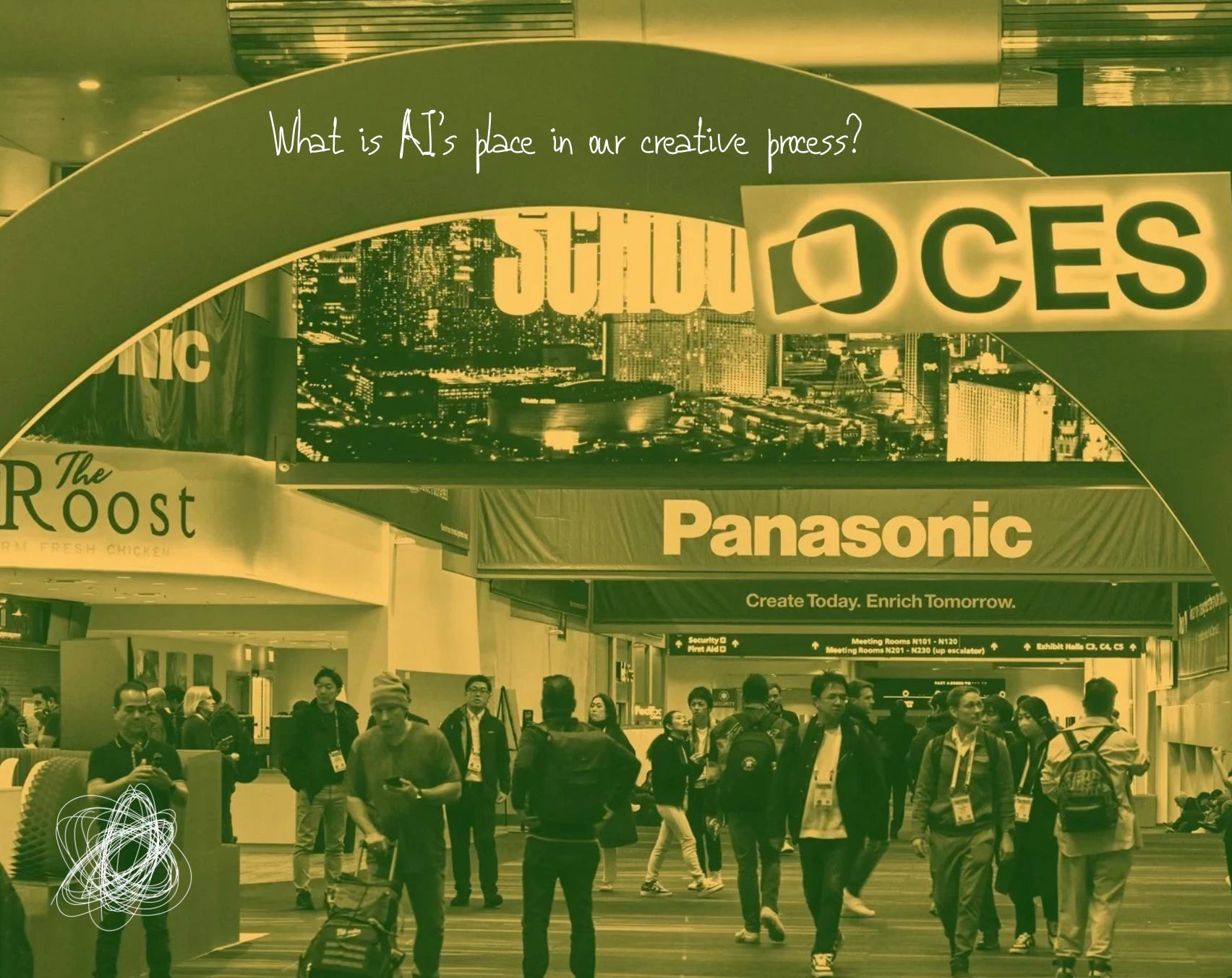
At this year’s Consumer Electronics Show, (CES), we were fascinated by how the conversation around AI in filmmaking has evolved so fast that it was taking center stage of the worlds largest entertainment and technology show.
Historically focused on technology that delivers products supporting the "director's intent," CES is where brands, broadcasters, streaming operators, and IP rights holders across advertising, entertainment, sports, gaming, and device manufacturing meet to determine who will deliver the future of entertainment—in living rooms, cinemas, and on the go—and which deals will get made.
So this year, it was particularly interesting that CES was like the cousin of Sundance with major agencies like UTA, and production companies such as Hello Sunshine. It seems we’ve leaped past the question of if AI has a place in our process to a much more interesting clarifying question: Is there a way to use AI that doesn't exploit creators' work without consent or compensation?
As a reminder, union talks are set to begin February 9, 2026, and we’re all processing some pretty significant shifts in the industry—like Disney’s recent partnership that turned OpenAI’s 800 million users into Disney’s perpetual unpaid content farm, with 200 characters (including props and costumes) for “expressive user-generated content” on Sora and ChatGPT.
It’s a lot to process.
At CES, “AI companies should not be forgiven for the content theft driven by the large language models that are trained on everything humans have put their time and energy and labor into without consent or compensation.”
He’s right. This resonates with creators everywhere, and it’s why we need to approach this moment with both eyes wide open.
Five years ago, AI in filmmaking was barely part of the conversation. Today, it’s attempting to reshape a $325 billion global content creation industry. To be clear, the software technology itself is neutral—what matters is how we choose to use it and who benefits.
The questions we need to keep asking:
How do we ensure consent or fair compensation is integral to the work that trains these systems?
How do we protect human artistic integrity and intellectual property?
How do we use these tools to create more access, not consolidate power?
How do we keep human wisdom and authentic storytelling at the center?
AI tools can empower independent creators, small production companies, and artists to build meaningful work without the need for legacy infrastructure or “old guards.”
At Callo, we see firsthand that the old development model isn’t serving us anymore (or nearly enough of us) to sustain the entertainment ethos. When talking about technology and data-driven approaches which is exactly what AI is, then the new infrastructure model should be consistent with being fair, collaborative, clear, human-centered, fast, and efficient for the future.
On Callo’s platform, members have multiple ways to connect, collaborate, build, and sell using AI and non-AI features—their preferences, not ours.
Our research on the intersection of collaboration and AI makes our current position more clear: it is difficult to imagine a project created entirely by AI having a long shelf life compared to human-led work.
Dylan Field, the founder of Figma, recently spoke about the relationship between AI and creation—a perspective that deeply resonates with how we view media creation:
“In the future, the probability of something generated entirely by AI will be inversely proportional to its intended lifespan… If you intend for an artifact to have a long lifespan (ex: software, a novel, a movie), then AI might still aid you in your creative process. But you will bring great intention to the work. You will think through many different approaches. You will care about the smallest of details. You will lean into the craft. Because if you don’t, it won’t be good enough to last. It won’t be noticed. It won’t be loved. It won’t matter.”
Short-lived things → very likely to be fully AI-generated
Long-lasting things → unlikely to be fully AI-generated
There is a profound link between craft and the time invested in creation. As humans, we have a natural bias toward work that is perceived as well-built with a considerable amount of time put in.
Ultimately, this impacts the business of creativity, particularly in the film and television industries. AI tools can be used to expand the upside. The time you have to focus on the “craft” of projects, to increase your return on investment and speed to market.
Here’s what the data is showing us: traditional TV and film now make up only 50% of total video viewership in the United States. Social content continues to gain ground, and the traditional 5-7 year development cycle for projects is not sustainable.
At Callo, we’ve seen our AI-integrated approaches accelerate development and packaging by as much as 80%. For independent creators, that kind of efficiency isn’t just convenient—it can literally be the accelerated difference between a project coming to life or dying.
We’ve also seen how conversational AI can remove some of the gatekeeping activities from finding collaborators, protecting IP and getting projects financed, produced, or sold. The new way radically rewires how fast that work gets developed and produced.
XTR is a production company that sits at the intersection of “old and new” in their Echo Park studio says the Oscar-nominated producer (Lifeboat, Body Team 12). “The neighborhood used to be called Edendale, and that’s where the first Hollywood studios were. Charlie Chaplin’s studio, the Keystone Studios, Mary Pickford, everybody was here. The first talkie was filmed probably a mile or so away. So there’s this history of making things here, which is really exciting.”
Mooser, through XTR, has spun up the AI animation group Asteria with a slate that includes projects from Natasha Lyonne (who is a co-founder of Asteria) and Toy Story 4 writer Will McCormack. XTR is leaning forward with original IP creation and training custom AI models so they can become an extension of the creative team’s hand—condensing the time it takes to create “storyboards or previs, animatics, backgrounds, whatever.” “Mooser agrees the indie industry may be facing its judgment day, but he doesn’t think it needs to be a Terminator-style event.” Mooser argues, the combination of ultra-fast rendering and custom models will make big projects cheaper and faster. His pitch is that the same combination, in the indie space, will make projects possible that would have been out of reach before.
The wave of companies touting themselves as the new studio tastemakers with Gen-AI has been impossible to keep track of. Most AI applications in the business of film and TV are currently focused on production quality creative output. But what’s really interesting is what’s happening as it relates to team-building, sales, research and market testing minimal viable projects to lessen the financial and time burden on filmmakers. Here are the tools we’re tracking:
AI workflow tools and platforms before creative and financial resources are committed:
Callo - Uses conversational AI to find specific collaborators globally, manage a creative studio, consent and sell creative IP faster. Used by Netflix, Widen+Kennedy and 13,000+ storytellers across 32 countries.
ScriptBook - Provides analytics and audience insights
Vault AI - Evaluates scripts for commercial potential and helps you understand your audience before you commit resources
Made by Humans, UK - Curated roster of AI artists with production support for concept testing. Used by TLC, Animal Planet & Discovery Networks International
Where data meets intuition in really beautiful ways:
Parrot Analytics - Measures audience demand across global markets—every major studio is using this to inform their decisions
Realeyes - Uses emotion AI for content testing and optimization including facial expressions and emotional responses to understand how audiences respond
Largo.ai - Predictive analytics that help you understand how your content might perform
Here’s where it gets really exciting—you can test concepts at about two-thirds the cost and 90% faster than traditional methods as part of the development process:
Wonder Dynamics - AI-powered VFX that’s actually being used on major productions—it’s transforming what’s possible
LTX Studio - Used by independent small studios and filmmakers on a budget for exploration of narrative concepts and character consistency testing. Used by Taika Waititi.
Runway- Used for prototype and visualizing concepts in hours instead of weeks. Used by Lionsgate, AMC, and UCLA's Film Department
Moonvalley - The first ethical AI Video Model generator trained entirely on licensed, commercially safe data, giving studios confidence in copyright compliance, cinematic-quality outputs and control over visuals.
Pika Labs - Text-to-Video Creativity - One of Callo’s favorites. Pika Labs is known for its easiest use and viral “Pikaffects,” for short-form, stylized video content and testing. Acts like a creative sandbox more than full professional suite, offering indie professionals the ability to “play” rather than to create production-ready outputs for cinematic storytelling.
Designed to expand what your writer’s room can do, not replace their voice:
Highland 2 - Created by screenwriter John August, it integrates AI thoughtfully
Speechify - This is the one Callo members swear by for script reads—Hear scripts in talent voices including Gwyneth Paltrow!
Mid to larger studios are really taking note of cost. What we’re hearing from producers is that “fix it in post” is now about “fixing it in pre” to shift anticipation up front and earlier in the process. It’s true, modern teams need to be part artists, part entrepreneurs to run fast, but you also must now be part experimental to envision the work to inform the pipeline.
Tell us about your experience with AI. What’s working, which tools or why you would never integrate it into your process. Share your thoughts in the comments—this conversation matters.
Comments
Nothing yet. Say the first thing.
Sign in to join the conversation.