
There’s a moment happening right now that most storytellers and producers are watching from the sidelines, treating it like industry noise when it is anything but. It is the biggest restructuring of creative rights since the studios invented the work-for-hire clause, and unlike that moment, this one is still live in the wild wild west, which is both the danger and, if you are paying attention, the opportunity.
(Disclaimer: This post is for informational purposes only and does not constitute legal advice. Our community should consult a qualified IP or entertainment attorney regarding their specific circumstances. Here’s who is part of Callo’s network)
The blueprint nobody followed
In 2024, three authors, Andrea Bartz, Charles Graeber, and Kirk Wallace Johnson, filed a class action against Anthropic, the company behind the Claude AI model, alleging that Anthropic had downloaded millions of copyrighted books from shadow libraries including LibGen and Pirate Library Mirror to train its AI without permission or payment.
The case produced two significant outcomes:
The first was a ruling that training AI on copyrighted books qualified as fair use because it was transformative in nature, which was a meaningful win for Anthropic and for the broader AI industry on the question of training data.
The second was a finding that Anthropic had wrongfully acquired that training data through pirate websites, and it was that finding, not the training itself, that drove a settlement of at least $1.5 billion to authors and publishers.
The industry lesson was specific and important: you may be able to train on copyrighted work, but you cannot steal it first. And crucially, the fair use question on training itself remains genuinely unsettled in the courts, which is exactly why the cases working their way through the system right now matter so much.
Instead of treating that settlement as the beginning of a more careful, consent-based relationship with creative work, the rest of the industry looked at that number and kept moving.
Here is what followed:
Getty Images sued Stability AI for scraping millions of its images without licenses or attribution.
Google allegedly scraped millions of books and images to train Gemini, with major publishers now moving to amplify the case.
Snap stands accused of ripping YouTubers’ videos to train its AI lens, adding a DMCA anti-circumvention claim that reframes the question from copying to something closer to breaking and entering.
According to the nonprofit Copyright Alliance, over 70 copyright infringement cases have now been filed against AI companies.
The training data buffet, as far as most of the industry was concerned, just kept going.
The two cases that might actually change things
Two lawsuits currently working their way through the courts are worth watching closely, not because AI copyright cases are new, but because of who is standing behind them and how much institutional weight they are carrying.
The class action against Google’s Gemini is no longer driven by individual illustrators and writers alone. Major publishers including Hachette and Cengage are moving to step in as class representatives, which changes the resource equation entirely and signals that the creative establishment is treating this as a fight worth financing properly.
The class action against Snap for scraping YouTube content adds something legally distinct: a DMCA Section 1201 claim arguing that Snap didn’t merely copy the content but actively bypassed YouTube’s technical protections to reach it, which courts have historically treated as a separate and serious legal matter well beyond straightforward infringement.
Both cases matter for three reasons:
They are backed by powerful institutional players with the money and legal resources to go the distance.
They are testing the central question courts are still split on, namely whether using copyrighted work to train AI is fair use (meaning open to the public) or a taking that requires licensing compensation model (pay to use)
Regulatory signals are aligning with the plaintiffs. The U.S. Copyright Office and the U.K. House of Lords are both moving toward a license-first framework for AI training data, which makes the legal strategy being tested in these cases more politically and legally plausible by the month.
Disney, OpenAI, and the time-travel problem in IP law
This is where the story gets personal for the creative community, and genuinely strange as a matter of IP law.
Disney sued Midjourney in June 2025 for reproducing unauthorized AI-generated derivatives of its characters, a reasonable enough position for a studio that has spent decades and billions defending the integrity of its IP.
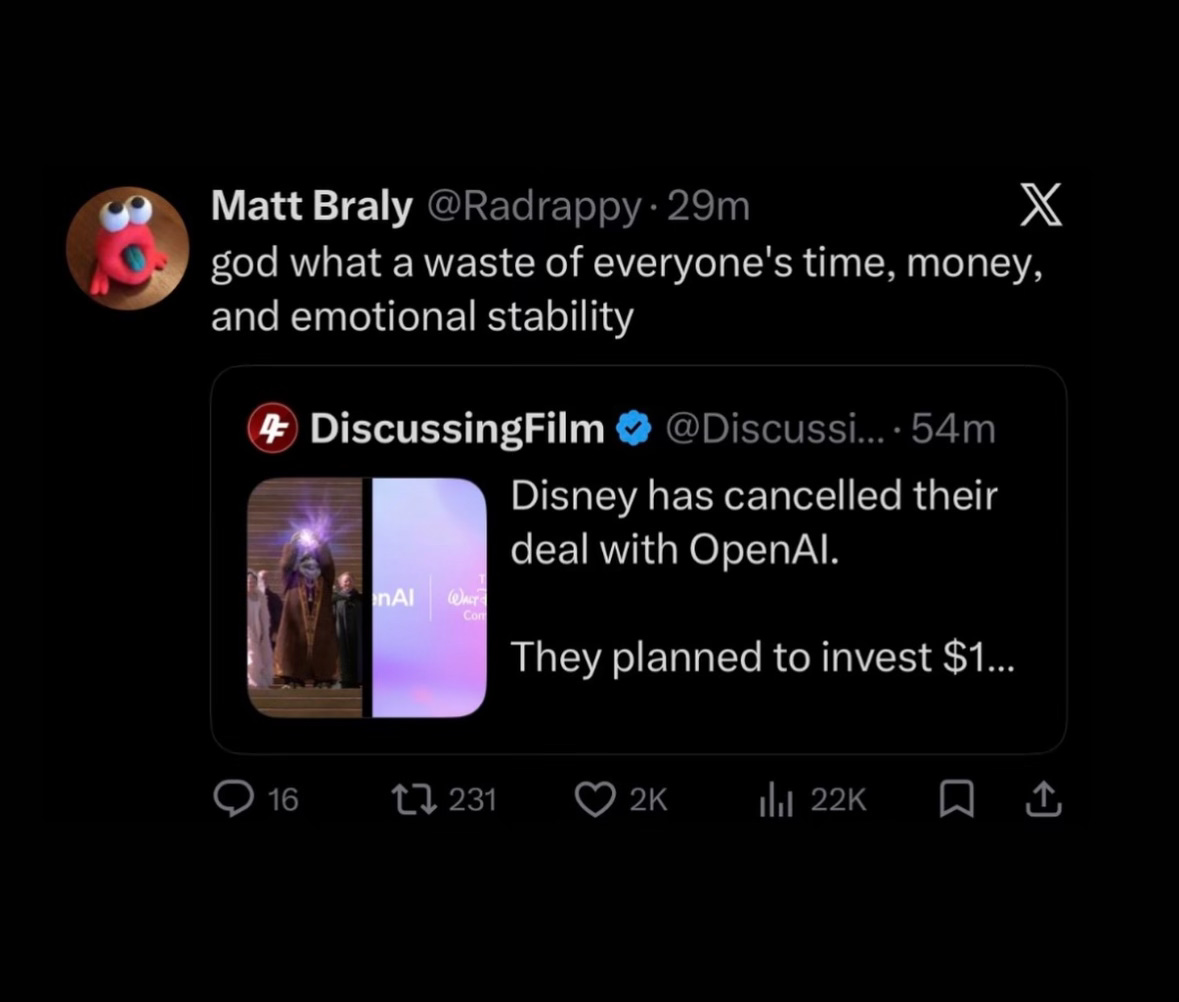
Then, by December of the same year, Disney had announced a three-year deal with OpenAI that would have allowed Sora and ChatGPT to do essentially the same thing, unlocking over 200 characters and costumes for user-generated AI video and derivative content at scale. We wrote about this in one of our first Substacks.
The creative community reacted with something between disbelief and fury. Then, this past week, both parties walked away from what had been framed as a landmark billion-dollar agreement, and the response split cleanly along predictable lines, with the creative world exhaling and the tech community treating it as a failure of imagination or commercial nerve.
But the deal’s collapse matters less than what it revealed underneath. Disney acquired and created those characters under contracts built entirely around a print-film-merch-broadcast world. Those contracts didn’t anticipate:
Deep learning models that can algorithmically morph a character across styles, genres, and contexts at scale.
Hundreds of millions of users remixing Mickey Mouse into a horror villain, a personalized birthday video, or something far darker, in seconds and at no cost.
A third-party AI platform being granted the effective right to let its entire user base freely alter and re-render those characters across every genre and context imaginable.
The original animators, writers, and composers who built those characters are not part of this deal and have no mechanism to participate in whatever AI-generated revenue their work would enable.
Disney isn’t doing anything technically illegal by attempting to monetize what it owns, BUT what it owns was built on creative labor compensated under a completely different set of assumptions about how those creations would ever be used. That gap between what was signed and what is now being attempted is the moral argument the creative community keeps returning to, because it is a real one, and it is not going away.
If either the Google or Snap case settles favorably for creators, the practical consequences could be wide-reaching such as …
Mandatory or default licensing schemes for training data, so that training on books, images, or videos requires negotiation or payment rather than unilateral scraping.
Stronger legal scrutiny of AI outputs that mimic specific artists, directors, or authors, because the underlying data practices are being formally challenged.
Real pressure on major studios to revisit how original creators participate in the AI-era revenue their work is generating, potentially including retroactive consideration for the artists behind the Disney characters at the center of that deal.
What this means if you are building outside the studio system
Everything described above is happening at the level of billion-dollar settlements, institutional class actions, and deals between the world’s largest entertainment company and the world’s most valuable AI startup.
It is easy, sitting with a script and a shoestring budget, to feel like a spectator to someone else’s fight. But the legal and regulatory frameworks being established right now will govern every storyteller, not just the ones with studio backing, and the independent creative community has the most to lose from frameworks written entirely around institutional interests.
This is the context in which we built Callo. We use AI, specifically LLMs, to help us recognize patterns faster. This helps independent filmmakers find the right collaborators and connect across genres and continents in ways that would otherwise take years of relationship-building and access that most people working outside the studio system simply don’t have. But we have been deliberate about the terms on which we do that, because we think the terms matter enormously right now.
Your projects, your IP, and your personal information never feed back into general models or get used to train on models, ever. Your data stays inside Callo, shaped and interpreted by a human curation team with real development experience, not exposed to the open web.
AI in entertainment works when entertainment professionals who genuinely love our industry are driving it. That is not a disclaimer for us, it is the founding principle.
We say all of this because the practical advice that follows is grounded in exactly that principle: the creative community’s best protection right now is clarity, documentation, and deliberate choices made before the rules get finalized without you.
What storytellers and producers should actually do right now
The macro picture matters, but the practical question is what you do with it while the rules are still being written. Here’s a playbook that has been crafted by our own Callo community through discussions and forums:
Own the human core of your project
Keep the story, structure, characters, and key creative decisions human-made before AI tools come in.
Document everything: keep logs, maintain asset histories, and be deliberate about showing the human hand in your creative process. AI-generated work on its own isn't copyrightable, and the more central AI is to the expressive elements of your film, the weaker your copyright claim becomes, which is precisely why documenting the human creative decisions throughout your process matters so much.
Build your paper trail now
Add a clear no-AI-training and no-commercial-use notice to your metadata on your personal website.
Register your works with the Copyright Office and explicitly disclaim any AI-generated portions, so your human authorship is on record before anyone challenges it.
Get the right legal coverage
Bring an IP or entertainment lawyer into the conversation early like our list of partners here, ideally before you have locked anything, to assess your errors and omissions path and ask specifically about coverage for AI-assisted content.
Your distributor’s E&O (Errors and Omissions insurance carrier) may have developed positions on AI-assisted work that you haven’t yet encountered, and it is far better to surface those conversations before they become urgent.
Put opt-out language in your agreements
If you want any real control over whether your work gets used to train AI models down the line, get that language into your contracts now, while the rules are still being negotiated.
An opt-out clause written into an agreement today is worth considerably more than a lawsuit three years from now when the precedents have already been set.
The creative industry’s copyright reckoning is unfolding in real time, in courtrooms in New York and California, in Parliament in London, in boardrooms at every major studio.
Independent filmmakers are not automatically at the table where those decisions are being made, but the window to get there is still open. The people who understand what is at stake and act on it now are the ones who will have shaped the terms when the dust finally settles.
If you are building projects in film, TV, or emerging media, Callo was made for this moment. Find the people you need, organize your slate, and get your work made. Join Callo.
Comments
Nothing yet. Say the first thing.
Sign in to join the conversation.