

The closing bells just rang across the major exchanges. While the retail crowd is staring at superficial numbers on their screens, celebrating speculative tech headlines, the structural shifts beneath the market floorboards are accelerating. If you spent your day insulated from the real macroeconomic wires, the perimeter has fundamentally moved.
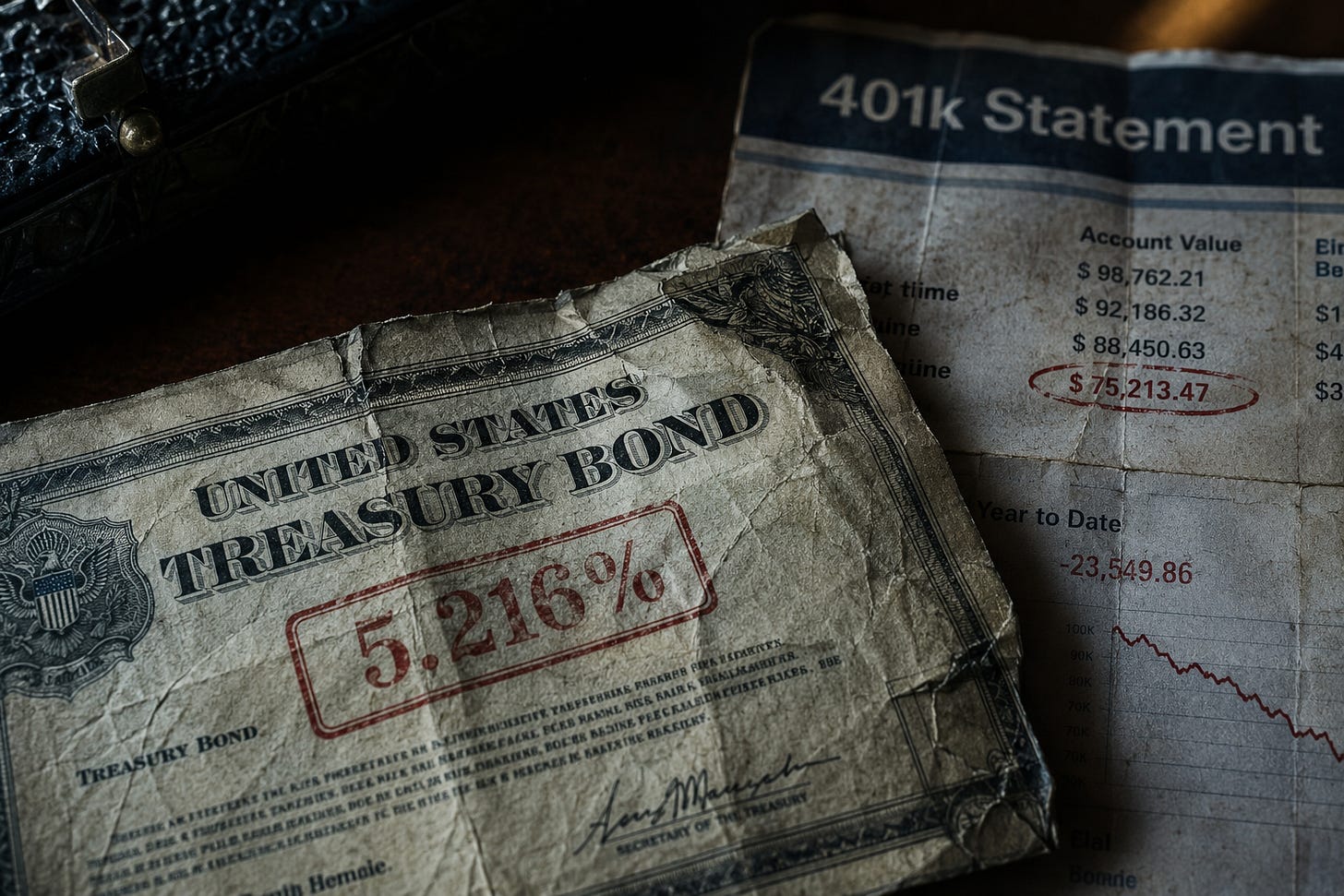
While financial media cycles through auction headlines and Fed commentary, the real story is in the mechanics nobody explains: a 30-year Treasury yield at a 25-year high doesn't just affect government finances — it reprices every leveraged dollar in the American economy simultaneously.
Mortgages. Auto loans. Business credit lines. And the bond allocation sitting inside your "conservative" retirement portfolio.
The bond market is not an abstraction. It is a pricing engine for all long-term capital. When the floor rate rises to 5.2%, the cost of every loan benchmarked against it adjusts upward — often quietly, often without any notice from your financial institution. F
or anyone between 50 and 65 with money in a target-date fund or a bond-heavy IRA, this week's auction data is a portfolio event, not just a news item.
(ad)
I remember when Roku went public. September 2017. $400 million in revenue, still losing money. They didn’t make TVs. They made software... an operating system that sat inside other companies’ TVs. You’d buy a TV and Roku was already on it. Every show watched, every ad served — Roku took a cut. The stock opened at $14. Four years later it hit $479 — a 3,300% return. $10,000 turned into more than $340,000. That’s Roku’s history — it doesn’t predict what any other stock will do. A small Chicago startup runs a similar playbook... an operating system for phones that sits inside the device and takes a cut of every ad that runs on it. And then shares that cut with the user. The difference is the market size. Roku had 270 million smart TVs to work with. This startup has 7 billion smartphones... Right now, shares are $0.52. The NASDAQ ticker is reserved. The SEC has qualified the offering. Anyone can invest. On August 14, the opportunity to invest at $0.52 closes — and this price disappears forever.
📈 30-Year U.S. Treasury Yield - 5.216% — 25-Year High
Long-term borrowing floor for mortgages and corporate debt. Every basis point rise adds cost across the entire credit stack.
🕳️ U.S. Federal Deficit (FY2024) - $1.83 Trillion
Primary structural driver of Treasury supply. More issuance required to fund the gap means ongoing upward pressure on long yields.
💸 U.S. Net Interest Payments (Annualized) - ~$1.1 Trillion
Now exceeds defense spending. As yields rise and existing debt rolls over at higher rates, this figure compounds automatically — without any new spending.
🏠 30-Year Fixed Mortgage Rate (Current Market) - ~7.1% National Average
Directly benchmarked against the 30-year Treasury. Rate refinance activity is near multi-decade lows. Existing homeowners are locked in — new buyers are priced out.
(ad)
Most financial advisors love to tell you to diversify. They want you spread across 50 different stocks, hoping for the best. According to Market Wizard Larry Benedict, Trillions of dollars are about to shift. And instead of scrambling to guess which sectors will win, Larry focuses on just This exact ticker previously helped his readers capture massive double and triple-digit gains during market shocks. Today, he’s giving the name of this ticker away completely free. No guesswork. No complicated charts. Just one symbol you can trade right from your phone in under 60 seconds.
Go here to get the ticker symbol and see the full 2026 playbook.
Investment-grade corporate bonds have started repricing wider relative to Treasuries as the risk-free rate floor rises. Companies planning refinancing rounds in 2025–2026 are facing materially higher coupon obligations than their current debt was priced at. Margin compression follows automatically.
Art’s Take: Every CFO rolling over debt in the next 18 months is looking at a 150–200 bps cost increase versus 2021 rates. That comes out of earnings, not Wall Street projections. Watch Q3 earnings calls for the language shift.
Several major 2030-vintage target-date funds — the default allocation for workers expecting retirement within 5 years — have posted negative or flat 12-month returns. The cause: their bond allocation, designed to reduce equity risk, is instead absorbing duration losses as the long end of the yield curve rises. The product description says “conservative.” The current math disagrees.
Art’s Take: Pull the fund fact sheet on your 401(k)’s target-date fund. Find the “effective duration” figure. Multiply it by the yield increase since you bought in. That product is the yield increase expressed as a percentage loss on your bond allocation. Most people have never been shown this calculation.
*Please read the offering circular and related risks at invest.modemobile.com. This is a paid advertisement for Mode Mobile’s Regulation A+ Offering.Mode Mobile recently received their ticker reservation with Nasdaq ($MODE), indicating an intent to IPO in the next 24 months. An intent to IPO is no guarantee that an actual IPO will occur.The Deloitte rankings are based on submitted applications and public company database research, with winners selected based on their fiscal-year revenue growth percentage over a three-year period.Pro forma revenue and EBITDA, includes full year numbers of the businesses acquired throughout 2025.
No posts
Comments
Nothing yet. Say the first thing.
Sign in to join the conversation.