
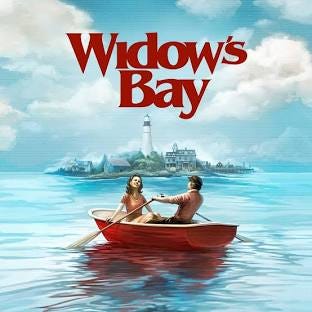
The best show of 2026 is a horror-comedy about a dying town. The strength of Widow’s Bay is that the show knows that fear and laughter aren’t opposites: they’re two angles on the same wound. In the Year of Our Lord 2026, we know that life is terrifying and absurd at the same time. Widow’s Bay plays this tension straight. It’s not a comedy dressed as a horror or vice versa. It’s a drama (albeit hilarious and terrifying) about ordinary people trying to make sense of a mystifying world.
That’s why I thought this strange hit from Apple TV as a good fit for The Gap. (If you’re here for education writing, the next article in the On Learning newsletter drops next week).
The premise is simple. Mayor Tom Loftis, played by Matthew Rhys, wants to drag a cursed island forty miles off the New England coast into the modern world. No Wi-Fi, spotty cell service, superstitious locals, the whole place a relic. He wants the next Martha’s Vineyard. He gets the tourists. He also gets the old ghost stories, the ones too ludicrous to be true. Widow’s Bay is like telling the story of Jaws from the mayor’s point of view. That mayor just wanted the beaches open, as the livelihood of the town depended on the tourists. The fear living in the water was just a distraction.
Tom begins the season in denial. The cursed lore of the island is nothing more than old wives’ tales, and the islanders insistence on believing the stories keeps the town anchored in the past. The biggest barrier to transforming the island into a tourist destination is the mindset of the townsfolk themselves.
The terror starts immediately. An ominous fog that turns men into zombies. A haunted inn. A sea hag who stalks her victims. Each episode plays like a “monster of the week,” while slowly chiseling away at the deeper lore of the island. The show has its share of scares.
But it’s also absurdly funny.
Widow’s Bay is the rare work that can make you scream and laugh in the same scene. That’s not an accident. Creator Katie Dippold built her career writing comedy: Parks and Recreation, The Heat, big broad studio laughs. Working with a horror premise, she doesn’t sand the comedy off. She points it at the same wound the horror was already circling. The jokes in Widow’s Bay aren’t relief from the dread. They’re the dread seen from a half-step to the left.
Pair Dippold with Hiro Murai behind the camera and you understand why the tone never wobbles. Murai spent years on Atlanta proving he can hold terror and absurdity in the same frame without either one blinking. Tonal whiplash is the hardest thing in television, and the conventional wisdom says pick a lane. Widow’s Bay drives the median line on purpose and somehow never crashes, in good part because the performances are so good. Rhys plays Tom’s grief as bedrock. Tom’s assistant Patricia (series standout Kate O’Flynn) has her own baggage that surfaces as terror and comedy. Wyck Crawford (played by the incomparable Stephen Root) is the town’s true believer, which initially sets him against Tom’s plan to bring tourists to the island, before the two form an uneasy alliance. There isn’t a weak link in the ensemble, and the entire cast plays their role with authenticity.
It would be easy for the show to read as a spoof, but it never does.
That’s why this thing lands with such different crowds. The horror fans show up for the dread and stay for the heart. The comedy fans show up for the jokes and get ambushed by the dread. The show is generous enough to leave both ways open.
What centers Widow’s Bay is its optimism, the way it claws for hope and humor amidst the despair. One of my favorite bits from the finale was this quote from Tennessee Williams, which showed up in an absurdly long cross-stitch from Tom’s 84-year-old secretary at a key moment:
“The world is violent and mercurial. It will have its way with you. We are saved by love—love for each other, and the love that we pour into the art we feel compelled to share. Being a parent, a writer; being a painter, being a friend; we live in a perpetually burning building, and what we must save from it all the time is love.”
Sometimes it feels like the house is always on fire, and we’re perpetually trying to save something from it. That anchors the show, in all of its absurd terror. Widow’s Bay is a love letter to storytelling, a product of the “love we pour into the art we feel compelled to share.” At a moment when art is referred to a content and quantity trumps quality, this show is a reminder of what good storytelling is meant to do: make us feel something.
No posts
Comments
Nothing yet. Say the first thing.
Sign in to join the conversation.