
The ogre of global inflation is real. Critical inputs to your business, including labour costs, are likely to remain elevated for the foreseeable future (as in years). 40% of inflation is composed of goods, 60% services (including housing).
The de-globalization trend, spurred by the now deemed endemic Covid-19, will likely play out over the coming decades. Autarky (self-reliance), near-shoring, on-shoring and US Treasury Secretary Janet Yellen’s latest gem “friend-shoring” are all decidedly inflationary. Friend-shoring is a cuddly term for a policy that would buttress free-market democracies against the authoritarian regimes of China and Russia. Supply chains re-engineered on this basis would arguably be more robust, but would cost more 10 times out of 10.
Taiwan Semi’s Morris Chang recently noted that the expense at their Oregon, USA semiconductor plant (WaferTech, based in Camas, OR) are 50% higher than in Taiwan. Apple, with assistance from the CHIPS and Science Act (2022) will undertake domestic chip production, but at a cost of +20-30% versus current facilities (Foxconn has 1.3 million employees). The US Inflation Reduction Act, “a historic down payment on deficit reduction to fight inflation” was clearly mis-named as all arrows point skyward. Are folks really this gullible? Debt is debt, not a down payment. All will rue the day that “buy-now-pay-later” devolves to our $1,200+ smart phone and eventually to dental floss.
ESG pressures have forced a significant redirection of capital investment from extractive industries to renewable projects. At least a decade of shortages in key base metals awaits. Rare earth metals will serve as a critical bottleneck soon. These “rare earth” metals exist all over the world, it is just that, until now, only China has the stomach for the caustic processing required. Inflationary, and fraught with NIMBY and ESG “conflicts”. Lithium remains a “hot” commodity as we transition from an ICE dominated automotive industry to an EV one. Mexico (Baa2 rated) nationalized their lithium industry last month and Chile has announced plans to do the same. Myanmar’s recent production halt for tin sent tin futures up > 10% in April 2023.
Geopolitical influences:
The shift in the global power structure from USA, often termed unipolar to multipolar is undeniable. USA vs. China is likely more accurate, bipolar, if you will. India just surpassed China as the country with the largest population at 1.42 billion (35x Canada’s 40 million for reference). China has issues. The real risk is that they get old before they get rich. Some see Russia’s invasion of Ukraine (lets call it the Ukrainian War) as a smoke screen for China’s invasion of Taiwan. Handicapping the timing is difficult, but likely before an IMF bail out (of China, to be clear) which some forecast by 2030. As an aside China’s net-zero commitment is 2060, a decade back of global peers who have committed to 2050.
USA (AAA/Aaa) Credit default swaps (CDS) are at record highs with 1 year CDS > 140bp (1.4%) and 5 years wrapped around 50bp (0.5%). The debt ceiling farce is in full swing once again. Can-kicking is the solution at hand with a $1.5tln patch in the works. US federal debt stands at US$31.7 trillion (36% of the $88tln total sovereign debt tally).
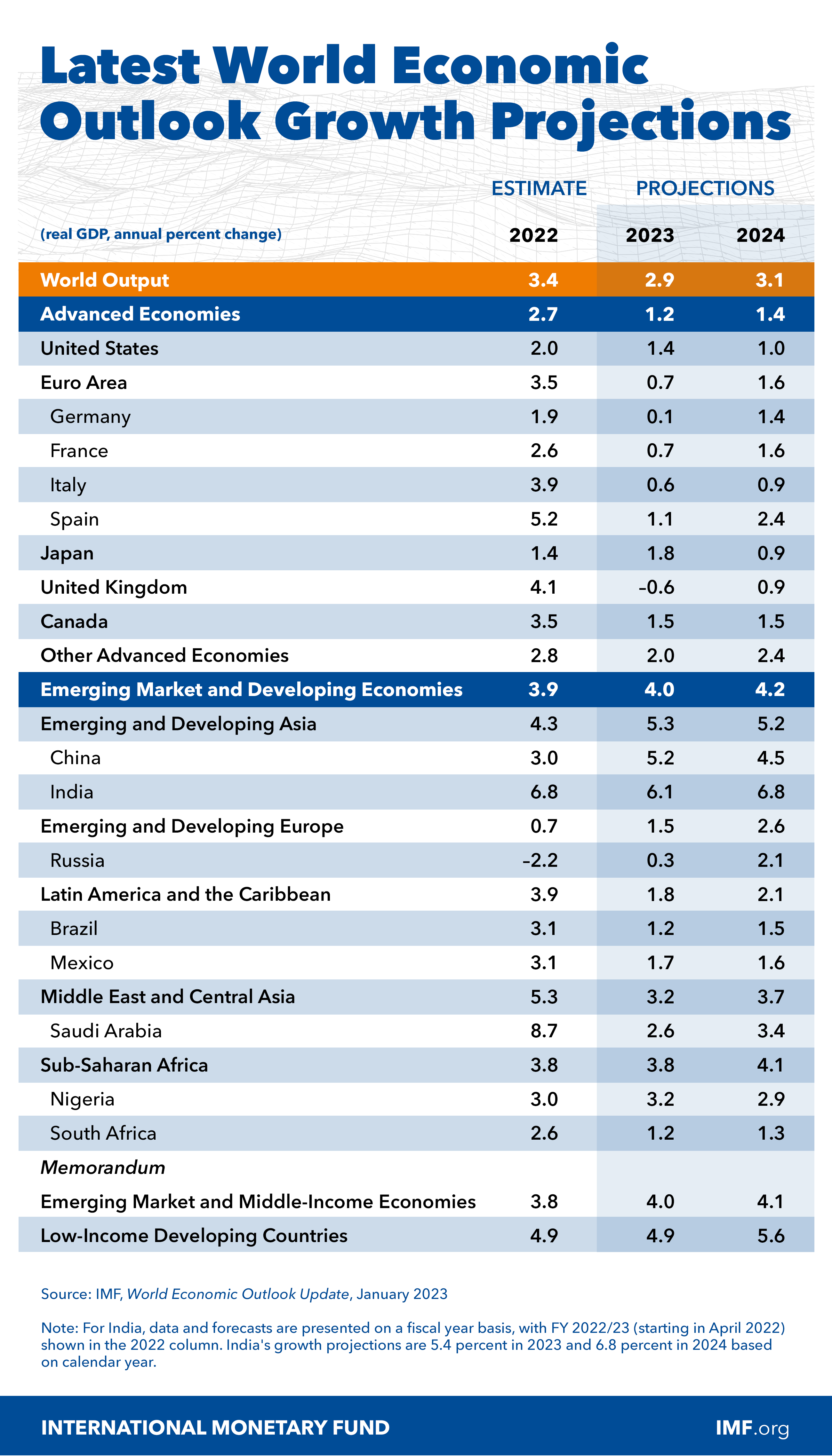
A deep and prolonged global recession would be one route to deflation (via outright demand destruction), or at least dis-inflation, but the global tea leaves tell a different near-term tale. China is slowly emerging from their Covid-19 induced hibernation. The IMF forecasts China growth in 2023 at 5.2% and some private forecasts are for >6%. India is pegged at 5.9%. There are scant signs of inflation in China’s domestic economy, so far. Folks are just glad to have their front doors un-welded, perhaps.
China and India will account for over 1/2 of global economic growth in 2023. The USA and Japan are treading water, with the IMF forecasting +1.6% for the US and +1.3% for Japan in 2023. The EU is at +0.8 and the UK at -0.3%. The UK is the only developed nation to acknowledge a recession is a near certainly. Current odds of recession are 80% for the UK and 65% for the USA (China and India zero % chance). The tug-of-war favours China and India, a thumb on the scale for the goods component of global inflation. When China is fully open the services component will be on full boil too.
Can central banks coordinate bringing inflation down without governments doing the same? Likely not. The US has not run a budget surplus since the year 2000. Direct federal debt stands at $31.7 trillion, as noted. Republican or Democrat, the red ink flows. The US deficit for 2023 will exceed $1.2 trillion (record receipts of $4.8tln vs. spending of > $6tln). Global central banks are using their significant balance sheets, built up over years of quantitative easing to throttle steer around potholes. The UK did it in September 2022 with a 1 trillion GBP QE targeting the long end of the gilt market to save the private pension market (Truss vs. lettuce). Japan has not even started. The USA was reducing their formidable $8.65 tln balance sheet by 95bln per month until the regional banking crisis hit and 6 months of QT was negated by the BTFP (Bank Term Funding Program).
The Bank of England has slowed their pace of rate hikes to 25bp (0.25%), as have the Fed in the USA, but headline inflation last printed > 10% in the UK! The UK’s Chief economist Pill (jagged little) says Britons need to accept they are poorer and that seeking pay increases will only push prices higher. Inflation globally is both broad and sticky. In the EU 80% of the components in the broad CPI basket are > 3%. Wages are running > 4%.
All eyes on Japan’s BoJ next week. Incoming Ueda is making noises and Japan is under increasing pressure to act. All are preparing for higher rates, which current stand at -10bp (-0.10). When QT (quantitative tightening) comes it will send global shock waves given the broad mandate the BoJ had on the ramp of their balance sheet to US$5tln + (JGB’s, corporate debt, equities, etc.). Japan’s CPI basket increased to 2.9% YoY in March 2023, up from 2.7% in February. These levels have not been seen for 40 years.
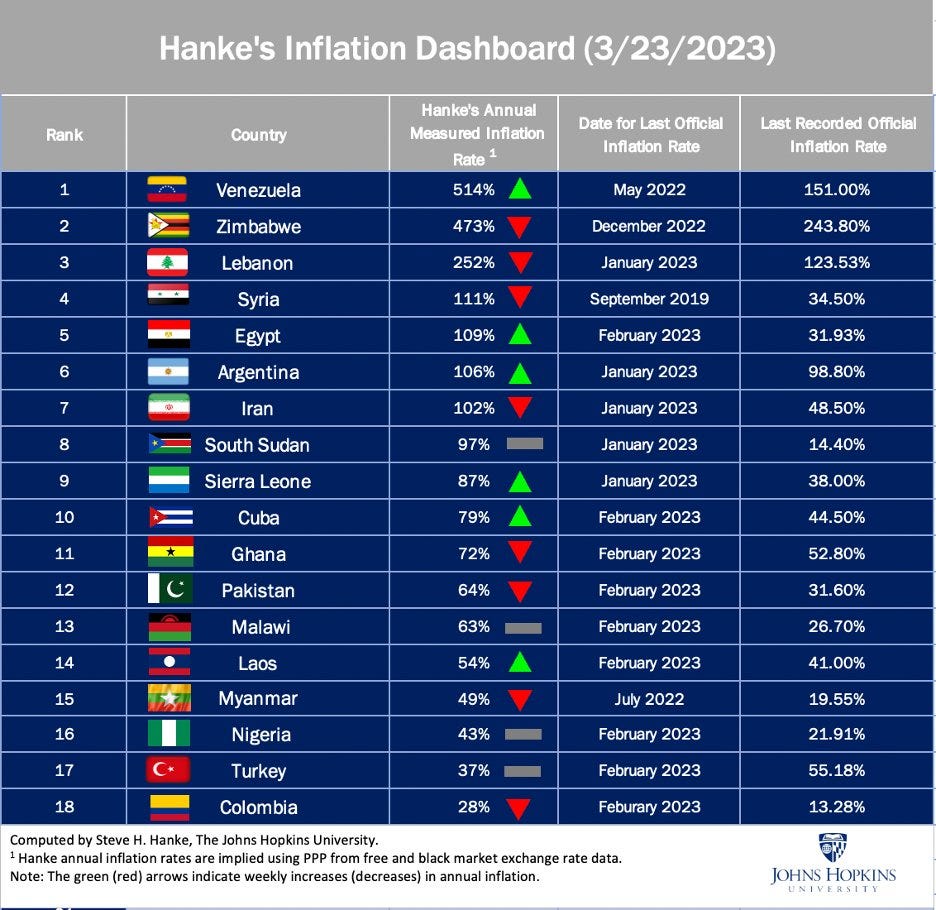
Emerging markets. As you might expect, messy. Argentina hikes rates by 3% to 81% after inflation hit 104% (not typos). Venezuela inflation hit 495% post $60bln debt default. Serial defaulters are lining up like dominoes. With the IMF have any porridge left if China succumbs?
Military spending. Worldwide military spending rose 3.7% in 2022 to $2.24 trillion (2.65% of global GDP of $88tln). The USA is the “big dog” with $877bln spent (39% of the total). China is #2 at $291bln (up 4.2% from 2021), followed by India at $66bln, Russia at $61bln (seems low), UK $55bln, Japan $48bln (defence only!), Germany $46bln, Italy $33bln, Canada $27bln, Brazil $20bln and Iran at $6bln. There is nothing green, productive or arguably sane in times of war. With an ongoing war in Ukraine, spending in Europe swelled 13% to $345bln, the fastest military spending clip since the end of the Cold War.
Risk assets (equities) have been whistling through the graveyard ytd 2023. Regional bank indigestion in the US may in fact be an ulcer. First Republic Corp dropped 50% after disclosing they lost $100bln in deposits thus far in 2023 (JP Morgan and others deposited $30bln in a sign of faith a mere month ago). Earnings from tech stalwarts impress thus far for Q1 2023, but chinks in the armour abound. UPS, a bell-weather, saw domestic volumes off by 5.4% with next day air and deferred -11% and -25% respectively (I see dead people), suggesting a precipitous fall in retail sales (ex. buy-now-pay-later). Global banking turmoil will lead to tighter credit conditions for businesses and households.
Shifting inflation dynamics could see the most aggressive tightening cycle in decades begin to unwind by the end of 2023.
Higher nominal rates have clear implication on valuation, as we have seen in spades with respect to banks HTM (held to maturity) and AFS (available for sale) securities portfolios with unrealized losses. Ditto to commercial real estate, perhaps the next shoe to drop? Investment grade debt has been selling like hot cakes, but the new issue equity and high yield markets are setting up for some rough comps as the deltas on recession tick higher.
From an exposure assessment perspective, many risk are 2-tailed by nature, greatly expanding ones hedging alternatives. Doteki’s team are well versed in the intricacies of these perilous markets (across rates, credit, commodities and foreign exchange markets) of setting a plan of action and executing.
No posts
Comments
Nothing yet. Say the first thing.
Sign in to join the conversation.