
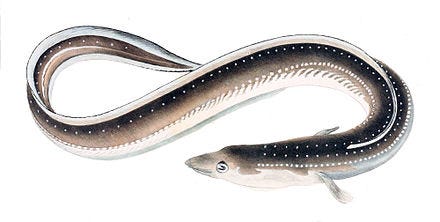
Japanese eel (Anguilla japonica) 1.9kg (4.2lbs.). Silver eel (full grown) pictured.
Japan has a love for Unagi (eel), consuming over 100 metric tons in 2020.
With all the fervour over the recent Fisheries and Oceans Canada (DFO) decision to effectively halt the glass eel harvest for 2023 in the Maritimes (45-day ban, likely to be extended), I decided to investigate this shrouded global fishery for baby eels, glass eels, aka elvers. The halt was a result of attacks on harvesters and evidence of widespread poaching of the endangered fish, a problem we see globally.
Glass eels are sold primarily to eel farmers in Taiwan and China who grow them to between 150g and several kg. for export to Japan, South Korea and Hong Kong.
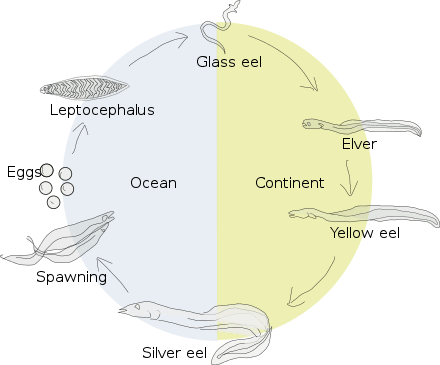
The glass eel fishery in the Maritimes is worth C$50 (US$37mm) million per annum with prices in 2022 reaching C$5,000 per kg., making glass eels the highest valued catch, by weight ($1 each, 0.002kg), in Canada.

American eel (Anguilla rostrata), 7.3kg (16.1lbs.)
European eel (Anguilla anguilla), 6.6kg (14.5lbs.)
日本鰻 nihon'unagi
Pimizi (Anishinaabemowin word for ‘eel’)
Japan is one of the largest consumers of eel in the world, it is a popular dish in Japanese cuisine. The traditional Japanese dish of grilled eel, called unaju, served in a lacquered box over Japanese rice. A thick sauce made from sake, soy and sugar is lathed on the eel fillets as they are being cooked. One can expect to pay JPY4,000 (C$40) for a 200 gram (7oz.) unaju meal. Prime cuts of the increasingly scarce Japanese eel can be as high as US$90/200g. No sushi here as raw eel is poisonous. Eel blood has toxins that are broken down from cooking it. Advertised in the 18th century Japan as building stamina for the hot summer months, eel has been in high demand for a long time.
A significant portion of the eel consumed in Japan is imported from other countries, particularly China and Taiwan, due to the decline in the wild eel populations in Japan. Eels can not be bred in captivity. Japanese glass eels can trade for in excess of US$10,000/kg. (C$13,600/kg.)
Roughly 1bln glass eels (Euopean eels) hit the shores of Europe in their migration each year and fetch upwards of €1 per eel.
The global glass eel trade is largely unregulated and often conducted illegally, making it difficult to obtain accurate information on global glass eel quotas. The Convention on International Trade in Endangered Species of Wild Fauna and Flora (CITES) regulates the trade of the European eel, which includes glass eels. Under this regulation, a quota system is in place for the export of European eels, including glass eels, from the European Union to other countries. The total annual quota for the EU is currently set at 3,200 kilograms (3.2 tons!), which is divided among individual member states based on historical catch records.
It is worth noting that the illegal trade of glass eels is thought to be many, many times larger than the legal trade, and there are concerns about the sustainability of the wild eel population due to overfishing and loss of habitat. As a result, many countries and regions have imposed their own regulations and bans on the trade of glass eels to protect the species from further decline.
Japan places eels on the “red list” of endangered species in 2013 after seeing the eel population shrink by 90% (over 3 decades). Japan’s largest harvest year was in 1965 when 140 metric tons were harvested.
For other types of seafood, farm-raised stocks remain relatively stable when wild catches fall off. But unagi, which hatch at sea but mature in freshwater, cannot be effectively bred in captivity, hence farm-raised stocks rely on baby eels, also known as glass eels, which are harvested in the wild, then raised to maturity at eel farms in China, Korea, and Japan. The penalties for fishing eel without a license were made more severe from 2015, up to 3 years in prison and a fine of JPY3mm (C$30,000 at current fx rates).
Japan consistently consumes >100,000 tons of eel, representing an estimated 75% of the global catch.
China’s role:
China is also a major consumer of eel and is one of the largest producers and exporters of eel in the world. Eel is a popular and traditional dish in many regions of China, and it is often served in various styles, including grilled, steamed, and braised.
According to the Food and Agriculture Organization (FAO) of the United Nations, China is the largest producer of farmed eel in the world, accounting for more than 80% of the global eel production. However, it is difficult to estimate the exact amount of eel consumed in China as data on domestic consumption is not widely available.
In terms of exports, China exported a total of 121,000 metric tons of live, fresh, or chilled eel worth $1.1 billion in 2020, according to the United Nations COMTRADE database. Most of these exports were destined for other Asian countries, such as Japan, South Korea, and Hong Kong.
China calls on all localities to further strengthen the export management of glass eel, strengthen law enforcement and supervision, strengthen industry self-discipline, and severely crack down on the smuggling of glass eel. The Yangtze River Estuary and the Yangtze River Basin are the most important producing areas of glass eel in China. The output of glass eel in the Yangtze River Estuary accounts for about 2 / 3 of the total output in China.
Indigenous fishers - International Law
The current international legal framework provides no specific rules or principles regarding the rights of indigenous peoples to salt sea fishing. As a result, Indigenous coastal fishing rights are derived from more general instruments. Since the establishment of the Universal Declaration of Human Rights, the cultures of indigenous peoples, including their use of the ocean, has been increasingly protected by the introduction of various international law instruments.
United Nations Declaration on the Rights of Indigenous Peoples
The above declaration contains several articles which provide protections for the rights of indigenous peoples to natural resources. For example, article 3 provides for a right of self-determination which includes the free pursuit of economic, social and cultural development. More specifically, article 26 provides for the protection of the rights of indigenous peoples to own, use and control resources, lands and territories they possess by traditional ownership, occupation or use.
It is important to note that this declaration is not a treaty, and thus does not have the binding effect of a treaty. Its adoption by the United Nations does, however, have considerable legal effect internationally.
Article 27 of the International Covenant on Civil and Political Rights
Article 27 provides for the right of ethnic minorities to enjoy their own culture by precluding any action of others which interferes with this enjoyment. The Human Rights Committee, in General comment 23 (1994), stated that the right includes traditional activities of indigenous peoples such as hunting and fishing.
A strict application of this article to indigenous fishing rights would suggest the existence of a preferred position for indigenous peoples compared to other citizens. Therefore, It may be argued that in order to preserve indigenous culture in particular regions, fishing quotas and other restrictions imposed by law must be relaxed or eliminated in their application. Further, in order to uphold the intention of the legislation, it may be required that fishing quotas and other restrictions must be tightened for non-indigenous fishers. This idea is further supported by the Committee’s explanation that article 27 imposes specific obligations on State parties to ensure the protection of these rights.
International Labour Organization (ILO) Convention concerning Indigenous and Tribal Peoples in Independent Countries (No. 169)
The ILO Convention includes numerous provisions which provide protections for indigenous rights to fishing. First, article 6 imposes a duty on governments to consult with its peoples to establish means by which they can freely participate in, and fully develop, their own institutions and initiatives. More specific to fishing rights is article 15, which supports the protection of material bases of indigenous peoples’ culture by safeguarding their right to the natural resources of their lands. Article 13 provides that the term “lands” is to be given a wide meaning to include all “areas which the peoples concerned occupy or otherwise use”.
Indigenous fishers - Canadian law
The Origin of the Right: Peace and Friendship
From 1725 to 1780, the British Crown entered into and renewed “Peace and Friendship Treaties” with Indigenous Peoples, including with Mi’kmaw, Wolastoqey and Peskotomuhkati Indigenous communities in Atlantic Canada. These treaties set out mutual obligations between the Crown and those Indigenous peoples. Treaty Rights, including those confirmed in the Peace and Friendship Treaties, are constitutionally protected by section 35 of the Canadian Constitution Act, 1982, which recognizes and affirms the Aboriginal and Treaty Rights of Indigenous peoples. Like Aboriginal Rights, Treaty Rights are collective rights and communal in nature. While individuals may enjoy the benefits of these Rights, such as hunting and fishing, the Rights themselves belong to the community.
The Right Defined: R v. Marshall
The Supreme Court of Canada considered whether the Peace and Friendship Treaties granted a Treaty Right to hunt and fish in the 1999 landmark case of R. v. Marshall.
Issue. Donald Marshall Jr., a Mi’kmaw person from Membertou First Nation, was charged under the Fisheries Act for catching, possessing and selling eels without a licence and doing so outside of the prescribed fishing season. In his defence, Mr. Marshall argued that the Peace and Friendship Treaties enshrined his inherent right to sell the catch of his hunting and fishing, irrespective of modern regulations that may restrict or limit such hunting and fishing.
Amazing that such a pivotal case was decided on this exact harvest, glass eels and with Donald Marshall Jr., a judicial trailblazer versus the Crown! Wrongly convicted of murder in Sydney, NS decades prior, Donald Marshall Jr. served 11 years in prison before his eventual release. Perhaps the CBC put it best, “The name Donald Marshall is almost synonymous with ‘wrongful conviction’ and the fight for native justice in Canada.”
Moderate Livelihood. The Court decided the Peace and Friendship Treaties of 1760-1761 confirmed the right of the Mi’kmaw people to provide for their own sustenance by taking the products of their hunting, fishing and other gathering activities, and trading for what in 1760 was termed “necessaries”. The Court found that the concept of “necessaries” is equivalent in current times to the concept of a “moderate livelihood”, and a moderate livelihood includes such basics as “food, clothing and housing, supplemented by a few amenities”. It does not, however, extend to the open-ended accumulation of wealth.
With only 9 commercial licenses and individual indigenous elver harvesters of between 100 and 150 (estimated 2023), it would appear that all involved in glass eel have outsized gains! If 70% of the market was retained by commercial license holders and they all harvested an equal share that would leave C$3,900,000 per holder. If 30% was eventually split between 150 First Nations harvesters that would be C$100,000 each. Whether this sum constitutes a “moderate livelihood” is open to question. What is the appropriate threshold? The current average household income in Canada is C$75,452, for reference.
Constitutional Right. Accordingly, the Court affirmed the Mi’kmaq of Nova Scotia’s Treaty Right to fish for a moderate livelihood is validated and protected by the Canadian Constitution. The regulatory prohibitions against fishing and selling eels without a licence infringed Marshall’s constitutional rights and were inoperative, unless the Crown could justify them – which it could not in this case.
The Scope & Limit of the Right: Marshall II
The R. v. Marshall decision caused considerable uncertainty, an escalation in tensions and, in some locales, even violence. On the one hand, the Court unequivocally recognized a Treaty Right to pursue a moderate livelihood. On the other, a lack of clarity remained as to how the exercise of this Treaty Right would impact stocks and interact with existing regulatory regimes. In the days following the R. v. Marshall decision, some Indigenous groups put traps in the water regardless of existing regulations on the basis they didn’t constrain the newly confirmed Treaty Right. This led to conflict between Indigenous and non-Indigenous fishers similar to those in 2020. Two months after its decision in R. v. Marshall, and in response to the growing tensions, the Supreme Court of Canada issued a subsequent decision in R. v. Marshall, known as Marshall II, to clarify the scope and implementation of the Treaty Rights in question.
Local Rights. Marshall II clarified that the treaties, and the benefits granted under them, were local in nature and limited to the area traditionally used by the local community with which the treaty was made.
Regulation. The Court determined that although treaty rights could be infringed, the government must produce sufficient evidence demonstrating that the regulation in question is necessary for conservation or other grounds of public importance. Although the Court in Marshall II found that the regulations purporting to limit the Treaty Right by imposing a discretionary licensing system and closed season (on eel fishing specifically) were not justified in that context, it left open the possibility that the government could regulate such Rights in the future.
Justification. The Supreme Court of Canada in the R. v. Marshall and Marshall II decisions was clear that although the federal government has the right to regulate Aboriginal and treaty rights, such regulation must be justified. The burden for proving a justified infringement rests solely with the government. Accordingly, the federal government cannot impose whatever regulation it sees fit.
The Clarification of the Right: The Missing Piece
There have been some steps taken since the R. v. Marshall and Marshall II decisions, but significant progress is still needed to ensure a peaceful and mutually acceptable resolution.
Post-Marshall. In 1999, the Department of Fisheries and Oceans (DFO) launched the Marshall Response Initiative, which aimed to increase participation of Indigenous communities in commercial fisheries by providing assets and training. In 2007, DFO implemented the Atlantic Integrated Commercial Fisheries Initiative, which provides funding to Indigenous communities to build the capacity of their communal commercial fishing enterprises. And in 2019, DFO reached 10-year interim agreements with a few Indigenous communities throughout the region to guide implementation of their Treaty Rights. Criticism, however, has persisted among Indigenous communities that there has been insufficient effort by DFO to ensure the Treaty Rights the Court affirmed in the Marshall decisions can be integrated and respected within current regulatory regimes. As a result, Indigenous communities, like the Sipekne’katik First Nation in Nova Scotia, have moved forward with their own self-regulated fisheries. In response, there has again been tension and even violence.
Post-Sipekne’katik. Almost one year after the events involving Sipekne’katik, there have been both signs of progress toward certainty and resolution, and some setbacks.
On November 29, 2020, the office of the federal Fisheries Minister proposed a draft memorandum of understanding (MOU) to the Sipekne’katik First Nation Chief. Yet in December 2020, talks again appeared to stall without a resolution.
In spring 2021, the federal government signed a 10-year Rights Reconciliation Agreement with Listuguj, a Mi’gmaw community in Quebec’s Gaspé Region (in addition to agreements signed in 2019 with three communities).
The House of Commons Standing Committee on Fisheries and Oceans held hearings through late 2020 and early 2021 with respect to the events at Sipekne’katik. In May 2021, the Committee tabled its report on the Implementation of The Mi’kmaw And Maliseet Treaty Right To Fish In Pursuit Of A Moderate Livelihood, making 40 recommendations.
During the spring 2021 lobster season, like at Sipekne’katik, another Nova Scotia Mi’gmaw community – Potlotek First Nation – proceeded with its own “moderate livelihood” fishery. But unlike at Sipekne’katik, DFO and Potlotek reached an interim agreement respecting this community’s fishery.
One thing remains clear: there’s further work to do for all parties to agree on just what an Indigenous moderate livelihood looks like and how an Indigenous moderate livelihood fishery can be implemented in Atlantic Canada.
Maine, given its proximity, has a glass eel industry as well. 4 additional licenses were recently granted via lottery (5,000 applied!). The Maine harvest is comparable to the Maritimes with 18,000 lbs (8 metric tons) sold for US$33 million in 2022 (C$45mm). US$2,162/lb. was the clearing level for the 2022 season.
Next steps:
There have been calls for Canada to place a SARA (Species at Risk Act) classification on glass eels. Canada’s endangered wildlife committee listed Anguilla rostrata as “threatened” over a decade ago. The quota for the fishery has remained unchanged for 18 years at just below 10 metric tons. The Maritime quota is 9,960kg (14% of which was recently recently granted to First Nations fishers/harvesters). This was the 2nd year that 14% of the quota was granted to Míkmaw First Nations. Commercial license holders (9) have launched a federal challenge to the uncompensated transfer.
The Canadian federal government needs to define, at long last, “moderate livelihood”, most likely on some sort of indexed income metric (i.e. per capita GDP, average household income)
The elver fishery in the Maritimes has been around since the 1980’s, but catches were below 1 metric tone until the 1990’s (1995 the catch was 3.4 metric tons).
DFO Elver Fishery background and history
With prices seemingly floored at $1/glass eel, this “live gold rush” will continue. Japan’s domestic eel harvest continues to print new lows (under 4 tons most recently) and trying to introduce proxies like catfish Kabayayi is not displacing demand for unagi in the domestic market in a meaningful way.
The maritime elver fishery is a short season (March to early May) with a compact footprint, in terms of where the glass eel migrate. The current commercial licensing system acknowledges the potential for conflict by allocating by specific rivers and estuaries. Míkmaw harvesters exercising their treaty rights to join in the elver harvest has resulted in a halt to the season in 2020 and now 2023. It appears that some sort of timed partition might be the only way to avoid conflicts between commercial and indigenous elver harvesters. 14% of an 8 week season would be 8 days for First Nations and 48/56 for commercial license holders. 14% of nothing is nothing, hence a solution must be reached for the benefit of all.
Caleb Gibbons - The “Other Prof G”
No posts
Comments
Nothing yet. Say the first thing.
Sign in to join the conversation.