
Cake friends,
With temperatures nearing triple digits here on the east coast, we’re steering clear of the oven and leaning into cold, no-bake recipes. What are you eating (or making) to stay cool?
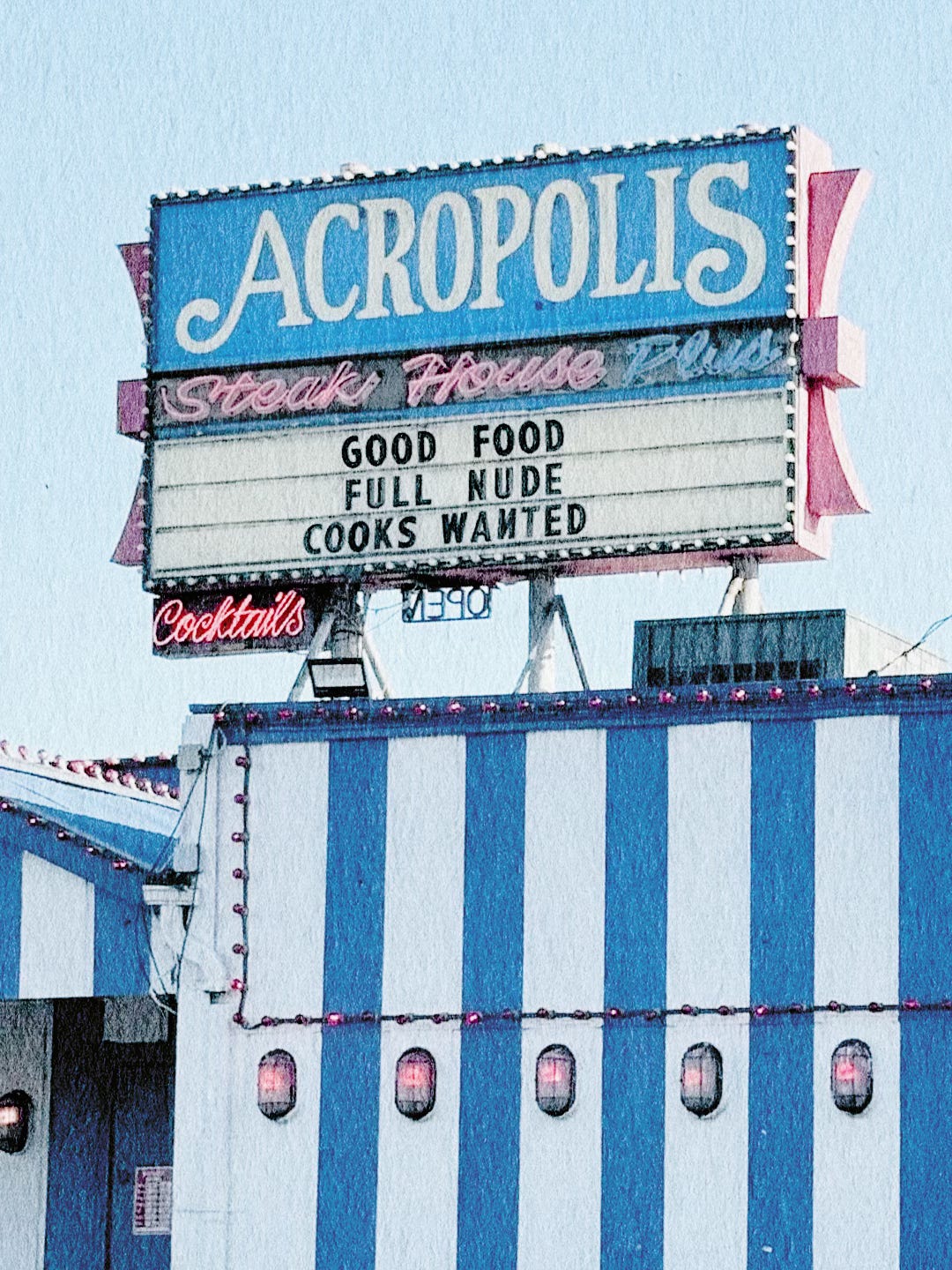
This week, we’ve been thinking about hospitality institutions that defy categorization, specifically, Acropolis, Portland’s legendary steakhouse strip club. In her essay Good Food, Full Nude, published in Steak Zine, founder of Language Arts and writer, Sophia June takes us inside, where an $11 sirloin and pole dancing have coexisted for the past fifty years.
The essay is part personal memoir, part history, and now, with Acropolis up for sale and possibly closing its doors this weekend, part elegy. But, at its heart, it’s a portrait of an institution that raised generations of dancers and became one of Portland’s most enduring restaurants.
Before it closes, June shares what makes this place worth remembering.
Essay by Sophia June
My favorite meal in Portland, Oregon, costs eleven dollars and comes with a pole dance: an 8-oz. sirloin served with two fat slices of Texas toast at Acropolis, the city’s only strip club steakhouse.
Acropolis Steakhouse is housed in a dilapidated white and blue striped structure—an homage, along with its name, to the Greek upbringing of its now-deceased founder Haralambos “Bobby” Polizos. “Acrop,” as it’s colloquially known, is the city’s only strip club steakhouse and is as famous for its home-grown beef as it is for flesh of another kind.
This year marks half a century of Acropolis, making it Portland’s longest running strip club still operating in the same building. It’s a feat for a city with the most strip clubs per capita in the United States, a fact that if you were raised in Portland like I was, you probably memorized before puberty.
Growing up in a pre-Portlandia Portland, it’s hard to overstate how irrelevant the city felt on the national stage, like Seattle’s diminutive little sister, a place where Kurt Cobain may have hung out but didn’t live. Strip clubs were Portland’s calling card, a signifier of the “Keep Portland Weird” clout that is the city’s most reliable, albeit eyeroll-inducing export. Since 2005, nude dancing has been a protected form of free speech in Oregon—one of only a handful of states that allow full nudity and alcohol at clubs. But what really enables strip clubs to thrive as cultural ground is the Oregon Liquor and Cannabis Commission’s law that bars serving liquor must also sell food—which is to say, a strip club in Portland can also be your favorite restaurant.
Outside of strip clubs, nightlife in Portland mostly consists of knocking back a couple of IPAs at a brewery and going to bed by midnight. But to foster a feeling of true escape, we went to the strip club. My holiday work party for Portland’s alt-weekly Willamette Week was held at Sassy’s, where I watched my boss pull a ripped one-dollar bill out of his wallet and gingerly place it inside a stripper’s G-string. I belted “Like A Prayer” at Devil’s Point “Stripparaoke” while trying to dodge a dancer’s Pleasers clicking like a nutcracker and the dollar bills fluttering onstage. There was Tiny Tuesday at Lucky Devil, where all the strippers were under five feet; and Comic Strip, a monthly comedy open mic hosted by a stripper, where both strippers and normies performed jokes while taking off their clothes. When a vegan strip club called Casa Diablo opened next door to Acropolis in 2017, the two clubs had a public feud that involved the vegan strippers protesting outside of Acropolis, chanting: “Vixens not veal, sizzle not steak!” The feud never quite resolved, though Acropolis erected a wall between it and Casa Diablo, which eventually closed the location.
“I call the Acropolis the Cheers of strip clubs,” says Jenna, who has worked as a dancer at the club since 2005. “People have been coming to the Acropolis for years and years. Something about it just feels comfortable, like home.”
The first time I went to a strip club, I was eighteen. My friends and I hotboxed my car and went to a spot called Jiggles right off Interstate 5, with a row of semi-trucks parked in front. Inside, the women were beautiful, but the men stared vacantly ahead. The scene was grim, druggy, subdued. I was disappointed.
Jiggles was also the first club that Joy, a dancer working at Acropolis since 2011, visited when she turned eighteen. Similarly, she wasn’t impressed: “I was like, ‘this is what it’s about?’” Walking into Acropolis to experience the “steak and legs” she’d grown up hearing about was entirely different. She got a lap dance from Jenna, who had electric blue eyes and blonde streaks in her long, dark hair, and who she would go on to work with. “I remember being so starstruck by the beautiful women,” Joy says. “I remember eating the food, which was wonderful. Initially, I didn’t have the courage to audition because I was intimidated by the women there. They’re just total baddies.” Joy taught herself to pole dance before the age of ubiquitous pole dancing classes and studios, at night when her baby was sleeping. After a few years, she finally worked up the courage to audition. To her surprise, she got the job. “It is and will always be my favorite place to dance,” she says.
I didn’t start going to Acrop until I moved back to Portland after college. My roommate and I lived about a mile from the club. Our periods were synced; we were desperate for iron and couldn’t afford to go out for a steak dinner anywhere else, so we’d bike the back roads to the club. It was one of few places in Portland without a place to lock our bikes, so one of us would wait while the other ran inside to the takeout window. We’d bring the warm plastic bags home, untie them as steam whirled into the air, and eat the bloody sirloin straight out of the container, pink juices staining the Styrofoam. I always ordered the Acrop Steak Special: 8 oz. of lean sirloin that didn’t exactly melt in my mouth, but that I enjoyed tearing into with my teeth. I made only $800 a paycheck working at the alt-weekly; for us, Acropolis was a place of abundance.
Whenever we wanted a big night out, we’d go to the club. We’d duck in from the rain and trade our cash for fat stacks of two-dollar bills, walk past the stages lit by neon beer signs, and head to the back near the kitchen and open-air salad bar. We’d pile lettuce, shredded carrots, and cucumber slices on our plates (heeding the handwritten warning sign: “Please use utensils, not your hands”) and scarf down buttery slabs of toast alongside our meat. Afterward, sitting by the stage, I’d sip PBR and watch a dancer undulate her breasts in my friend’s face, steam fogging his glasses. I’d toss a wad of bills at her and cheer as she did the same to me.
Jenna has worked at Acropolis since the era she describes as the height of its success in the mid-2000s, when they opened at 7 a.m. for a loyal breakfast crowd who’d order ten-egg omelets and steak. “Back then, the place was just fucking slammed. Didn’t matter what day you worked, what shift you worked,” she says. “You’d come into the club and there’d be a line of people outside the door.”
Jenna had been working as a novice “baby stripper” an hour south in the state capital when a friend moved to Portland to work at Acropolis. When she reported she’d made $2,000 in a night, Jenna canceled on her club, drove up, auditioned, and walked away with $1,500 on her first shift. “Once I started working there, I was like, ‘I’m home,’” she says. She became the Acropolis cover girl for years, representing the club on the cover of erotic magazines and in advertisements. Around 2010, one of the dancers painted a portrait on wood of Jenna kicking up her heels with star-shaped pasties on her breasts. The owners added the portrait to the original sign, but removed it recently when it started to rot. Joy offered to buy it. She had it professionally framed, and hung it in her dining room.
Acropolis is anomalous in that it employs a small group of dancers and has an unusually high retention rate. Management is decent and family ownership keeps everything personal. Most of the girls who work there currently are full-time dancers who have been there for at least three years, which is uncommon in the industry. Back when Jenna started dancing at Acrop, it was a rougher scene. Girls would pee in each other’s bags as retribution for dancing with another girl’s regular, or throw their suitcases into the nearby Johnson Creek. Now, there’s easy camaraderie. “We’re all pretty much a huge family,” Jenna says. “If you don’t fit into that family, if you’re kind of bitchy, or you’re talking shit, you probably won’t stay very long.”
Notably, Acropolis is not a hustle club, where dancers roam the bar coaxing patrons into private rooms. Instead, dancers perform twenty-minute sets, which as Joy puts it, are, “an ass kicker,” but more fun than the pressure of having to sell private dances. After the set, dancers have a twenty-minute break to collect their cash and perform any lap dances customers request before they go back onstage.
As platforms like OnlyFans continue to grow in popularity and strip clubs have become more high tech—allowing payment with crypto or credit cards—Acrop keeps things old school. “It’s kind of a dive bar now. I think the quality of good dancers and good food in a comfortable setting is what people want,” Jenna says, mentioning that it’s not uncommon for an old episode of Little House on the Prairie to be playing on the bar TV.
Still, while Acropolis is a beloved respite for its old-school feel, it hasn’t been sheltered entirely from the vicissitudes of the economy. Acropolis recovered after getting hit with the recession in 2008, but things haven’t been the same since the pandemic. “It’s kind of feeling like we’re all going down with the Titanic,” says Jenna.
People don’t go out as much, she tells me. They’re more reluctant to spend money. When Bobby was alive, he would be there at 7 a.m., stay all day, go home, and come back to close. You can still find his son and nephew making sweet, tangy secret sauce from scratch in the kitchen—each making it slightly differently—and hand-cutting their own gyro meat, but they don’t spend as much time there. There was a series of deaths in the family that, combined with the pandemic, made the club downsize. The family no longer sources all the meat from their own ranch. “People bring up the salad bar all the time,” says Joy. “I’m like, yeah, there’s no more salad bar. Sorry.” On Christmas Day, Jenna learned Acropolis was for sale. She was hosting a party when her friends started asking what she was going to do when the club closed. She was shocked.
Jim Polizos, Bobby’s eldest son, is refusing to talk to reporters who have been showing up at the club. He also hasn’t said anything to the staff, who have started looking for other jobs. Jenna is making plans to go to nursing school, which she’ll attend while working as a cosmetic tattoo artist. “Hopefully that pans out well, because I don’t see myself dancing anywhere else,” she says.
But over text, Jim confirmed with me that Acropolis is indeed for sale, that they never really recovered from the pandemic and want to explore new ventures. He hopes the new owner keeps the club open. The 7,778-square-foot property is listed for $1.95 million, which Jenna described as an “exorbitant amount,” considering the 1947 building’s condition. Water leaks through the ceiling; the men’s bathroom is basically nonfunctioning, she says.
Still, she’s hopeful it remains open throughout the summer. Already, people have been flocking back. “People have been coming in and all I hear over and over and over again is, ‘I’m here because I heard it was selling.’ A lot of people are really sad.”
“It isn’t like it used to be, but we still hold onto it,” Jenna told me before the announcement. “I’d feel like a cheating wife if I went somewhere else. Me and several of the other girls are all on the same page. We’re just going to be here until the wheels fall off.”
Sophia June is a writer and the co-founder of Language Arts. She is obsessed with the scene in Moonstruck where Cher feeds Nicholas Cage steak and spaghetti.
Read: Vittles #3, The Influencers Issue, is coming in late July, exploring the people, platforms, and ideas that shape how we eat today. Pre-order here.
Eat: Brëwr, the NYC-based coffee-cocktail bar is hosting a Desi Bakes pastry pop-up in collaboration with food writer Mehr Singh this Sunday, July 5th. Pastries will be available 11 a.m. until sellout.
Attend: This Sunday, July 5th in New Orleans, Southern Foodways is screening At Her Table, a series of short films that highlight the creativity and work of Black women chefs in Louisiana. The event is free to attend, RSVP here.
Submit & Eat: Yu & Me Books in Chinatown is accepting pitches for its second issue, Theme: Unexpected. Pitches must be submitted in stores (details can be found on Instagram). Plus, for the entire month of July, when you purchase a book, get a free 7th Street Burger.
No posts
Comments
Nothing yet. Say the first thing.
Sign in to join the conversation.