
Cake friends,
What comes to mind when you think of Australia? Is it kangaroos bouncing across the outback? The twang of Crocodile Dundee? How about a Bloomin’ Onion? For many, Australia’s global image is a caricature of the wild.
In “When You’re Here, You’re Australian,” published in Steak Zine, Ruby Robina Saha learns that hard truth, visiting Outback Steakhouse as an Australian immigrant, and discovering a shrine built not around Australia itself—for fear of encouraging “too much authenticity”—but around America’s gritty fantasy of life Down Under.
With a Sydney Olympics cap, a “Paul Hogan fit,” and a craving for the Australia that she misses, Ruby finds a restaurant where stereotypes and fantasy stand in for a country that is far more complicated than its rugged global mythology. Read the full piece below.
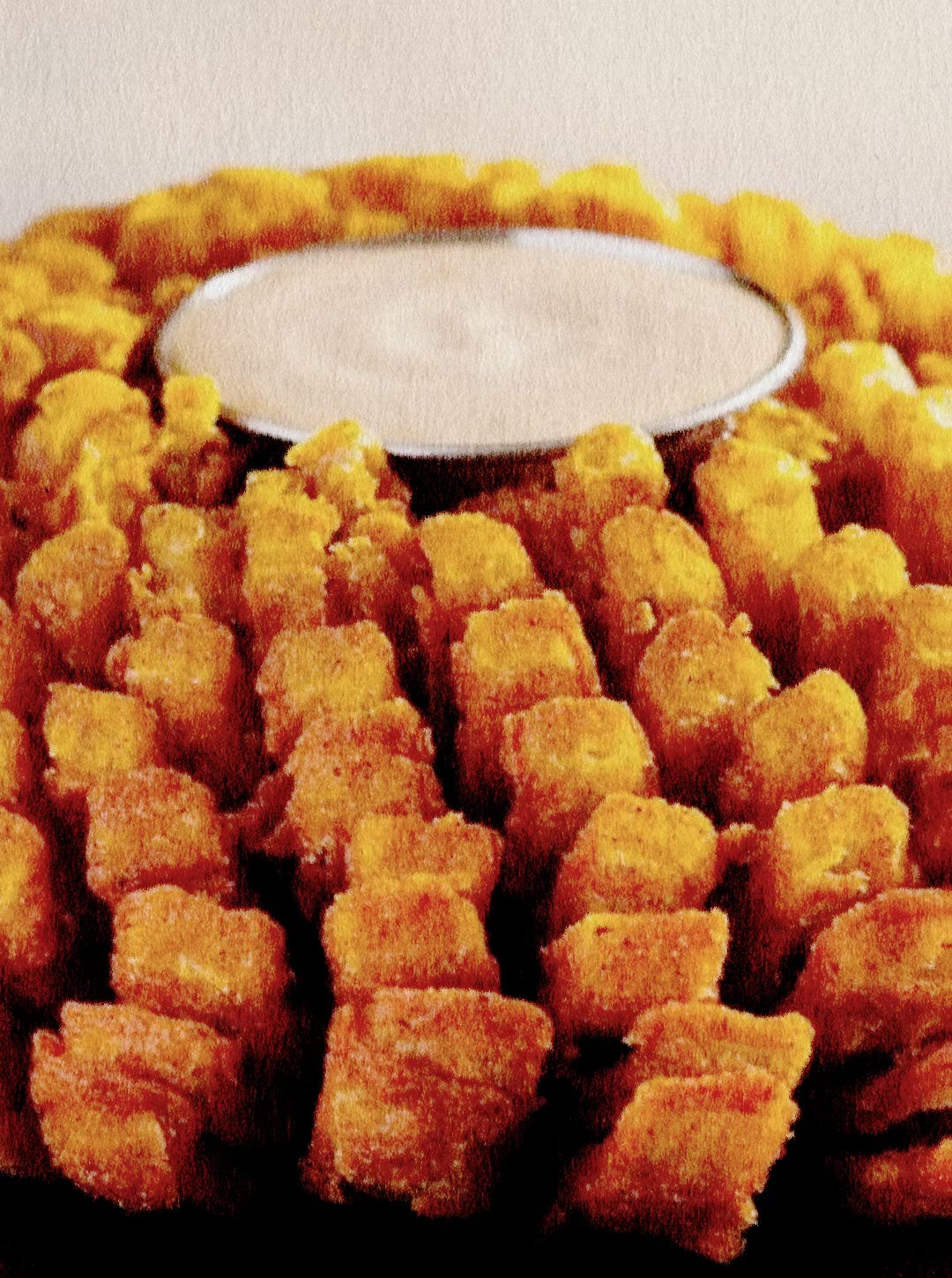
Essay by Ruby Robina Saha
Two Americans and an immigrant walk into an Outback Steakhouse in the suburbs of Chicago. I, the immigrant, am wearing khakis, a western belt, and a Sydney Olympics cap that no longer fits my head.
My family moved from Indonesia to Australia in late 1999, just in time for the millennium fireworks over the Harbour Bridge. Life in Sydney was always threaded with water, from our house on the bay to the Opera House sails folded against the sky at Darling Harbour, where I first learned to slurp oysters. But to the rest of the world, Australia was best summarized by Crocodile Dundee, the 1986 film that became the country’s highest-grossing movie. Its surprise success cemented the land down under as a frontier of sun-scorched simplicity where bushmen solved problems with big grins and bigger knives. Watching it together for the first time last month, my roommate and I braced ourselves for dusty cliches but ended up charmed, wondering if our lives might be better off with more crocodiles around.
At Outback, the hostess greets us with Midwestern friendliness, but not a single “G’day.” So much for my fantasies of belligerent Australian kitsch. I’d come ready for kangaroos and didgeridoos, eager to bask in the absurdity. Instead, the wood interiors and bland pastoral paintings could have belonged in any chain restaurant if not for the Australian flag over the bar and menu items like the Platypus Punch: a mix of vodka, mango, and lemonade that comes with a plastic figurine and changes color but is neither venomous nor biofluorescent like its namesake. I take this personally. In my hipster Paul Hogan fit, I realize with horror that I’m the most Australian thing in this restaurant.
In 1988, three American entrepreneurs who had never set foot in Australia opened Outback Steakhouse in Tampa, Florida. It was an instant hit. Five years later, in an interview with Fortune Magazine, founder Chris T. Sullivan admitted concerns that visiting Australia risked introducing “too much authenticity” to the experience and might encourage them to “bring back authentic Australian food, which Americans don’t generally like.”
As I scan the laminated menu, I wonder what Sullivan imagines to be authentically Australian. As the founders put it, Outback sells “American food and Australian fun.” But what does that even mean? Both countries’ notions of a singular cuisine are complicated by their settler colonial histories, Indigenous erasure, and diasporic populations.
Outback’s founders understood that in Reagan’s America, authenticity was a boomerang best left hanging on the wall. The 1980s had ushered in a new era of curated worldliness for the suburban middle class, and Crocodile Dundee’s cultural impact landed at the perfect moment. In contrast to no-frills chains like IHOP and Denny’s, new entrants like Olive Garden, P.F. Chang’s, and Outback democratized cosmopolitan dining through what sociologist Joanne Finkelstein calls “parodic theming”—fantasy environments built from recognizable but explicitly fake cultural symbols. They offered mythical, entertaining experiences that were welcoming to Americans across race and class. “When you’re here, you’re family.” Or rather: When you’re here, you’re Australian.
Today, Outback operates about a thousand locations worldwide, a far cry from its late-‘90s reign as the leader of America’s casual dining scene. The chain peaked in the early 2000s before the Great Recession hollowed out its core customer base. But Outback persists abroad with surprising popularity in Brazil and even seven locations in Australia, all clustered along the tourist-heavy eastern coastline.
In preparation for my pilgrimage, I asked around for tips. American friends raised on trips there after Sunday mass praised the surprising value and quality of the steaks, and of course, the Bloomin’ Onion, as if a deep-fried allium could ever be bad. Even my doctor weighed in, recommending the Croc-Tail, a slime-green mix of vodka, Midori, and tropical juices topped with a crocodile keepsake. I failed to ask if this was medically sound advice.
As we study the menu for any trace of Australia, I’m reminded of the foods I miss most: briny oysters, buttery barramundi, coconut-flossed lamingtons, and meat pies from the tuck shop. None of these made it to the menu, which does include: Kookaburra Wings (Buffalo wings with an Australian accent), Shrimp on the Barbie, and a sprawling steak selection including American steakhouse classics like prime rib and New York strip amidst more faux-Straya branding like Victoria’s Filet Mignon. We order the ribeye. They’re out of bone-in, so we settle for boneless. Everything is aggressively decent—except the steak, which comes out medium-rare but chews like gray leather.
For a steakhouse, it’s a baffling failure. And yet, it’s fitting: Outback has always been more interested in mythology than meat, and in this, it’s perfectly authentic. American steakhouses began as working-class banquet halls in the mid-nineteenth century, before postwar prosperity elevated them into temples of masculine luxury through the alchemy of storytelling—transforming butcher’s meat into premium cuts, dinner into ritual. With its “No Rules, Just Right” motto, Outback applies the same logic to geography, selling lawless frontier mythology dressed in suburban comfort. Its success hinges on a nostalgia Americans already understand: the white lone ranger surviving in perilous terrain. Australia’s own masculine mythology grows from the same roots of settler colonialism, cattle ranching, and frontier survival; Outback just swaps the tumbleweeds for kangaroos.
*
It’s startling just how much of Australia is the outback. The desert interior makes up more than 70 percent of Australia’s landmass and houses less than 5 percent of its population. More than 40 percent—a landmass the size of India—is considered uninhabitable. It’s a wilderness most Australians never witness, yet it defines Australia’s global reputation.
Frontiers, by design, are empty, uncultivated, open for the taking. For both Australians and Americans, the frontier represents the “real” nation surviving constant antagonism. Both mythologies gloss over indigeneity as marginal or decorative, unable to exist in a stolen present. Both promise an experience that requires no knowledge and makes no demands, that floats freely in time and space: a theater of Manifest Destiny that could be deployed anywhere, anytime.
When I mention that I grew up in Australia, most Americans immediately try to pronounce all the vowels in the word “no” or attempt a bad Steve Irwin impression. One friend mentioned the opening scene of the 1994 film Dumb and Dumber, where Jim Carrey tries to seduce an Austrian woman with “shrimp on the barbie,” confusing countries but nailing Outback’s imprint. Younger generations picture a continent populated by variations on Margot Robbie and Troye Sivan: blonde, sporty, bubbly. Americans know Australia has deadly animals and a fraught racial history, but mostly they think it’s weird and fun. The Outback founders got that part right.
Walking into Outback as an immigrant, I’m struck by how it makes the exotic feel familiar. In striking contrast to a white tablecloth steakhouse in Chicago, where the clientele skews wealthy and homogenous, Outback might be the most diversely populated restaurant I’ve seen in over ten years of living in the Midwest—an Indian couple and their adult kids, big Black and white families, a group my friend clocks as post-church regulars.
The Bloomin’ Onion may be a fundamentally American monument to excess. But the outback, both real and imagined, is pure Australia, packaged for easy consumption. In the end, authenticity is beside the point. The restaurant, Crocodile Dundee, and for most Australians even the outback itself are all fantasy—refracted through a desire for rugged simplicity, available at a strip mall near you.
Ruby Robina Saha is a writer whose party tricks include impersonating Australians, a skill acquired after two years of covert fieldwork (ages seven to nine).
Read: An interview with Aliza, our co-founder, about the production and creation of Cake Zine with Shopify. Tanya, our other co-founder, was also interviewed by Arden Yum for the series Cheat Sheet—where she shared her favorite chocolate mousse recipe and her restaurant playlist hack.
Pitch: Enclaves mag is accepting pitches for its inaugural issue, Roots, exploring the many connections people have to Queens, New York. Submissions are due Aug. 23, find more details here.
Eat: Celebrate all things fermented at a community potluck in Troy, New York hosted by Yesfolk and friends this Saturday, Aug. 1.
Play: The Funday Press is a new publication filled with games and puzzles. Subscribe and find more information here.
Bake: Looking to make the most out of summer corn? Try this chewy, glutinous corn cake by Shilpa for Bon Appetit’s bake club.
Missing Love Island?: Forbidden Fruit contributor Sithara Ranasinghe published a zine about the religious and secular language used in modern dating shows like Love Island. Find it here.
No posts
Comments
Nothing yet. Say the first thing.
Sign in to join the conversation.