
Cake friends,
When we first set the theme for our new special issue, Steak Zine, we expected to receive pitches about old school waiters and plant-based meat. But it wouldn’t be a Cake Zine publication if it didn’t venture into unexpected territory—and when writer Rachel Ossip heard about the theme, she was inspired to dig deep into her family history, to chase down the identity of the woman posing in this iconic pin-up poster: the Cattle Queen.
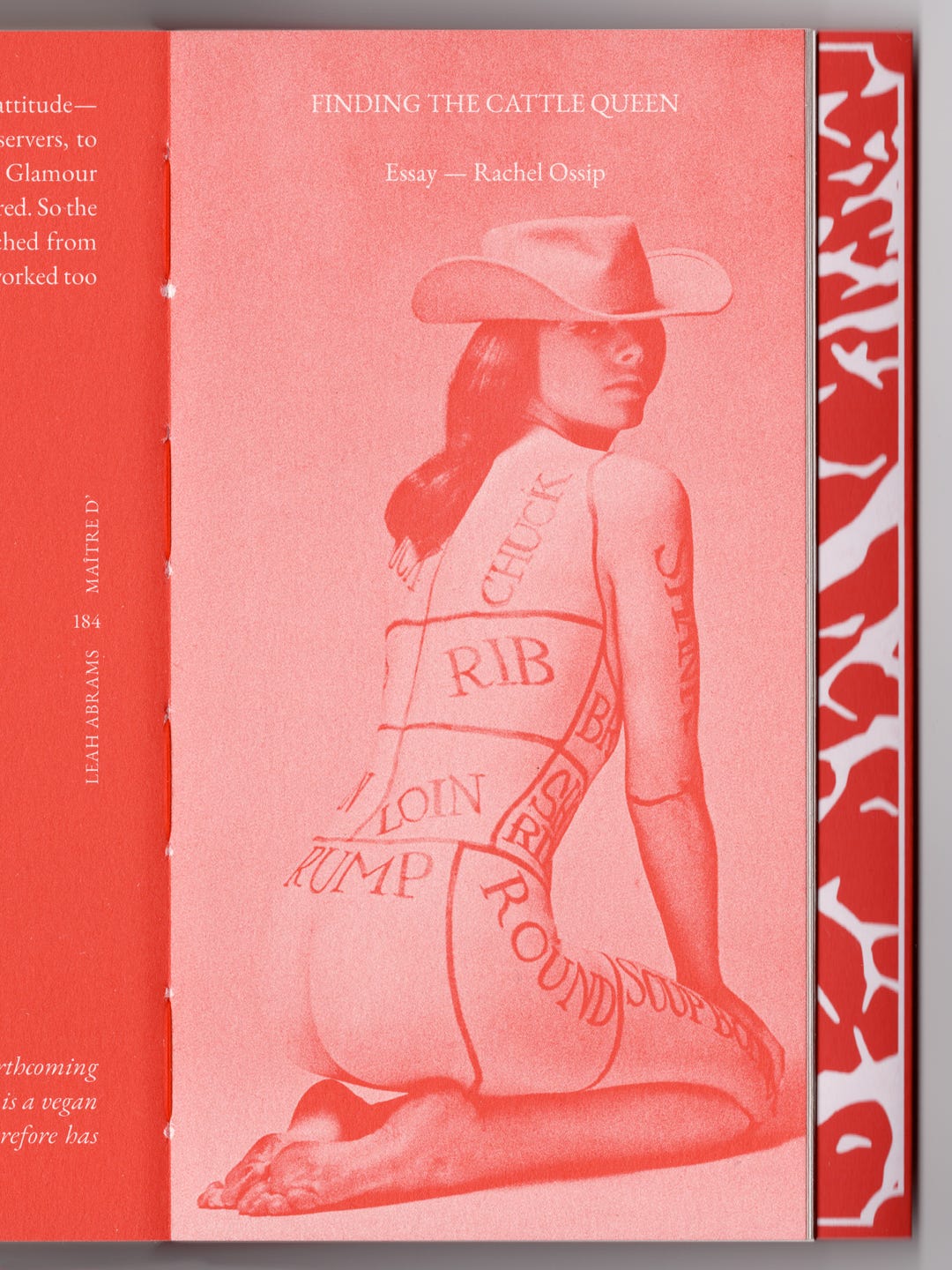
Before it was a feminist protest poster in the ‘60s, a Florida souvenir postcard in the ‘70s, or a controversial Urban Outfitters baby tee in the early 2000s, this proto-viral image was a newspaper advertisement for The Cattle Baron, an upscale steakhouse in the heart of Manhattan’s theater district opened by Jerry Ossip—Rachel’s grandfather.
The image is ubiquitous, but the Cattle Queen herself is anonymous—or was, until now. Read about her unexpected, heady, and ultimately triumphant search in Steak Zine, shared in brief below and excepted in full today in N+1.
Essay by Rachel Ossip
In 1967, in the heart of Manhattan’s theater district, my grandfather Jerry opened a steakhouse. The Cattle Baron took the energy of a theme restaurant and gave it an adult polish. Red and white tablecloths, quilted wall panels, dark wood accents, and uplight chandeliers accented the red brick walls, while waitstaff appeared in “Western attire.” The following year, advertisements in Playbill and the New York Post implored eaters to “Break the Dull Steak House Habit” by patronizing Jerry Ossip’s Cattle Baron. “We looked around at the steak house scene. And we found it dreary,” the ad proclaimed. “We opened up the Cattle Barron for you men (and your women) who hunger for the best steak in town—and something else, besides.”
The real draw sat just above these words: a black-and-white image of a woman kneeling naked in a Stetson, glancing seductively over her shoulder. Her body is portioned out with painted lines, each segment labeled as a cut: chuck, rib, loin, rump, soup bone, and so on. The something else on offer, one must guess, is her—or whatever kind of louche access she implies. The sexual revolution was underway, and this combination of text and image urged the viewer to imagine the extent of what could happen in low-lit banquettes as dark liquor flowed. By all accounts, the ads were a scandalous hit.
I never met Jerry—he died years before I was born—but the lore that surrounds him filled my childhood. He was a charming man who often hosted celebrities in his restaurants; the Cattle Baron sat on 46th between 7th and 8th, in “stage country” as its ads proclaimed. Jerry thus became a go-to source for gossip columnists and was frequently cited recounting who appeared with whom. He wasn’t opposed to a gimmick; a promotional postcard for the Cattle Baron suggests that you could not only “select your own prime steak” but then also “brand it” (with a hot iron, I presume) before it was broiled “exactly the way you want it.” After your steak, you could order the Pony Espresso—a punny name for your average shot of after-dinner caffeine—to accompany dessert.
My uncle Brad, who was 15 at the time, remembers my grandmother’s discontent with the ad’s nudity; while she would never have called herself a feminist, the fiery bottle redhead certainly had opinions. She chewed Jerry out, appalled by the salacious image. “Boy, he got an earful,” Brad laughed. The newspapers apparently agreed with her: Although the model was naked in the original ads, Jack O’Brian, a gossip writer, reported in his Voice of Broadway column that the New York papers “made her wear a bikini.” Thus, in some of the early advertisements, a faint silhouette of underwear and a bra curve around her hips and back, seemingly added to the pasteups as an afterthought—or, in this case, a correction. Nonetheless, her magnetism is undeniable, even in that version with the most alluring areas crudely covered.
By the fall, large-scale, pin-up style posters featured a color version, with western-inflected serifs boldly proclaiming Jerry’s slogan: “Break the Dull Steak Habit.” The poster spread widely, perhaps in part because this injunction could mean almost anything when divorced from the specific context of the steakhouse. It implores you to live a more-than-ordinary life, with the suggestion that you will then encounter a more-than-ordinary woman. The warm tones and details visible at a larger scale only increase the model’s allure: Her auburn hair shines in the light, her darkly lined eyes look heavy-lidded. The flushed skin of her ass and thighs seems to glow, its rosy freshness contrasted by a patina of dirt on the soles of her feet. She’s not quite sitting, and instead seems poised to stand, perhaps to turn to face you. It is hard to look away.
I first saw her, in the less polished black-and-white version, back in the summer of 2016. As a birthday present for my father, my stepmother had framed a small card with the image alongside other ephemera—a menu, a signed check to pay patrons back ten cents for the cost of their reservation phone call (a classic Jerry gimmick)—from the Cattle Baron. My father hung the collection on a wall in the kitchen, and every time I visit, I try not to stare. Looking at her, I ricochet between desire and revulsion, lured in by the simple draw of her body, cleverly emphasized by the painted forms, and yet repulsed by the clear misogyny it communicates.
Somehow, my well-loved grandfather provoked the creation of an undeniably compelling yet undeniably bigoted image. Even so, I don’t think Jerry—or anyone involved in the original ad’s creation—could have quite imagined the ultimate stir she would create.
No posts
Comments
Nothing yet. Say the first thing.
Sign in to join the conversation.