
The Mienne Sex Serum ($55) might be lube. In fact, I think the brand wants you to think it could be. But when my friend Michael gave it to me, it was with a regretful, “I’m pretty sure this is just for ladies.”
As the backstage manager of a fancy burlesque theatre in New York, Michael had just been gifted all these samples of Mienne products for the brand’s launch—but this serum, he was simply trying to get rid of. The instructions specifically said “not for internal use.”
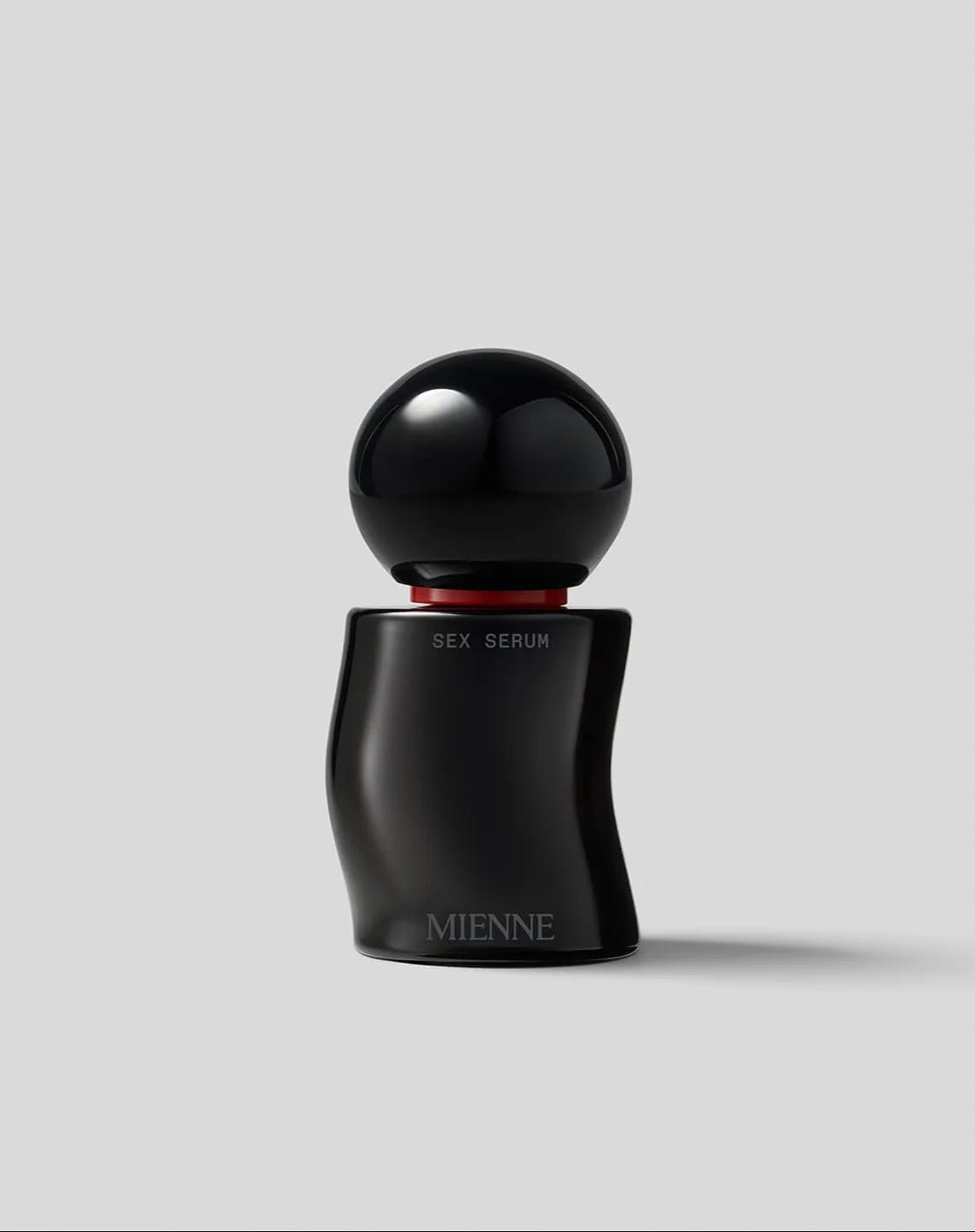
Instead, the product seems designed, mainly, to look good: it’s chic black, undulating glass. And it’s heavier than you’d expect; the rounded cap feels like an onyx marble. When you hold it, you’re brought back into the material world——reminded that you have a body and that body interacts with objects. Your body feels things. And some things feel good.
But again: the Sex Serum is not meant to go anywhere where friction or glide matter.
This, I think, is the premise of the entire Mienne brand (and the fatal flaw of American sexuality): we consistently conflate desire with pleasure, believing the two basically interchangeable.
But perhaps we conflate the two because sometimes desiring…hurts so good.
I’ve never felt more desirous than when I’ve lived in a different country from a lover; always imagining the next time we’d meet. Despite what I would have protested at the time, this hopped-up desire was never really about the other person. (Nor was it even really about the sex.) It was pure desire itself—unthreatened by proximity or the expectation of action. Desire could always be delayed and orchestrated; reality never had to intrude. It would never be satiated, because the other person was never really there.
Lacan thought this was the nature of desire itself: we’re all doomed to want only that which is out of reach. But in the words of Esther Perel, “Desire is an expression of our free will. Nobody can force us to want.” If both of these observations are true, what does this say about our selfhood? Does that mean we are what we reach for?
We all know the feeling of wanting something—how the stomach leaps and the nerves hum. We equate wanting with vitality; to be ambitious, aroused, desirous is to feel alive. We think, “this lights me up, therefore it’s truly mine.”
But, I hate to inform you that mistaking sensation for truth is nothing more than a marketing psy-op.
Share Philosophy For Party Girls
People much smarter than me have unpacked this at length. Lauren Berlant calls it cruel optimism; Eva Illouz says it’s emotional capitalism. Both theorists describe a world where feelings are not just private experiences but guides. If we’re sad, it’s time for a “self care” night. If we’re not horny, we should buy mushrooms or toys or...
Even feminism gets folded into this capitalist logic: to be visibly desiring is sold as liberation. Politics fade into self-expression.

This creates a terrible bind; to feel autonomous, you must exist in a state of absence. You become defined by what you lack rather than what you are. Personhood is always oriented toward a future, fantasy version of yourself that will exist once you finally have/become/achieve the thing.
In this wasteland of choice, desire still seems like our truest compass. To want strongly is to be certain of where you’re going. But beneath each urge lies a quiet dread: what if our desires don’t bring us what we actually want?
Those of us who have spent our lives following the compass of desire have learned that it never points to anything real. You look back after a few years and find that you’ve just been going in circles. You just keep spinning.
Emily Nagoski (author of the omnipresent Come As You Are and Come Together) offers another direction. In her books, she rallies against what she calls “the desire imperative”—the myth that we’re supposed to measure the value of sex by our desire for it. (Good sex is the sex you crave.) She insists this thinking isn’t just broken, it’s counterproductive; we shouldn’t be measuring sex by how much we want it, rather how much we enjoy it. And though Nagoski proposes this shift as a relational tool, I wonder its implications for our wallets.
This fundamental model shift—from “wanting” to “enjoyment”—is basically a practice in mindfulness and ego-checking. (It’s Lyotard’s “radical mutation of desire,” which I wrote about a few months ago.) It’s prioritizing your embodied experience over your ego ideals.
But this shift can cause panic. In a world where we confuse desire for direction (“If I know what I want, I know where I’m going”), you will lose the ability to claim desire as certainty. In a world where feeling autonomous is to feel yourself wanting, contentment can be easily confused for passivity. If you’ve stopped choosing, you’ve stopped being alive. Satisfaction becomes a kind of death of the self.
But this loss isn’t reason for despair.
Prioritizing pleasure over desire often has the consequence of often stimulating more pleasure and deeper engagement. (When my boyfriend and I instated some of Nagoski’s thinking, we were back to early relationship sex. Let me tell you: it was hot.)
Nagoski’s proposition is radical because it offers permission to exist without reaching. It reclaims sensation from the market.
Pleasure—by which I mean real, embodied, present pleasure—doesn’t require you to strive for anything.
You can feel good about what’s happening now without it becoming evidence of your personhood…or your trajectory…or your authenticity.
You can just sit still and enjoy it.

In the five months that the Sex Serum has sat on my nightstand, I have used perhaps four squirts. From what I can tell, my experience with the product is not unique. The company’s Instagram hasn’t been updated in five months. The massage candle says I can pre-order for when they restock; the restocking date was three months ago.
I look at the black, wavy bottle on my nightstand. Despite how little I use it, I can’t bring myself to throw it away. I think I’m waiting for the day the Sex Serum bottle is empty so I can fill it with something else—something I might actually use for sex.
And I catch myself in the big ironic trap: despite all I’ve learned of pleasure, I’m still wanting. My mind is still reaching.
Perhaps we can’t ever completely rid ourselves of desire, but we can pay attention to the direction of our wanting. We can start reaching for what will actually touch us back.
It really is a very sexy bottle.
Thanks for reading! Philosophy for Party Girls is entirely reader-supported. If you liked this post, please like and share it!
remember: every like matters :,)
No posts
Comments
Nothing yet. Say the first thing.
Sign in to join the conversation.