
The Moss Landing Energy Storage Facility is the world’s largest lithium battery energy storage system (BESS). It is also one of the most fire-prone. Since its opening in 2020, the facility has suffered multiple fires and thermal events, including the major fire on January 16, 2025 that closed a section of famed Route 1, forced the evacuation of as many as 1,500 residents, and brought the U.S. energy storage industry to a crossroads.
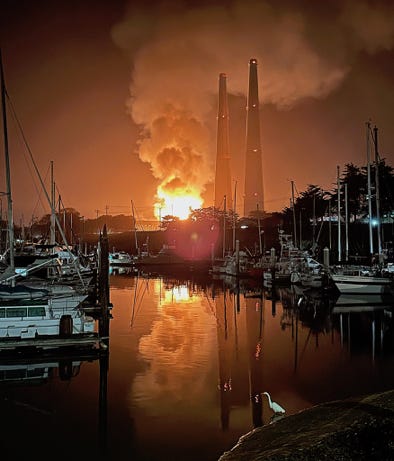
Two distinct energy storage facilities exist at Moss Landing. One of them, responsible for roughly two-thirds of the energy stored on the site, is owned by Texas-based Vistra Corporation. The smaller facility was co-designed by investor-owned utility PG&E and Tesla.
The 256 Tesla Megapack batteries are made of nickel-manganese-cobalt (NMC) lithium-ion cells, a high-energy-density chemistry known for its susceptibility to “thermal runaway,” the phenomenon that leads to most battery fires. The clear history of fires in these batteries is causing Santa Cruz County to question the wisdom of installing a similar proposed facility up the road in Watsonville—an area often called “the salad bowl of the world” because of the lush agricultural land found there.
For these reasons, the Green Party of Santa Cruz County (GPSCZ) is calling for a halt to the construction of any new lithium battery facilities in the county. However, there are other options.
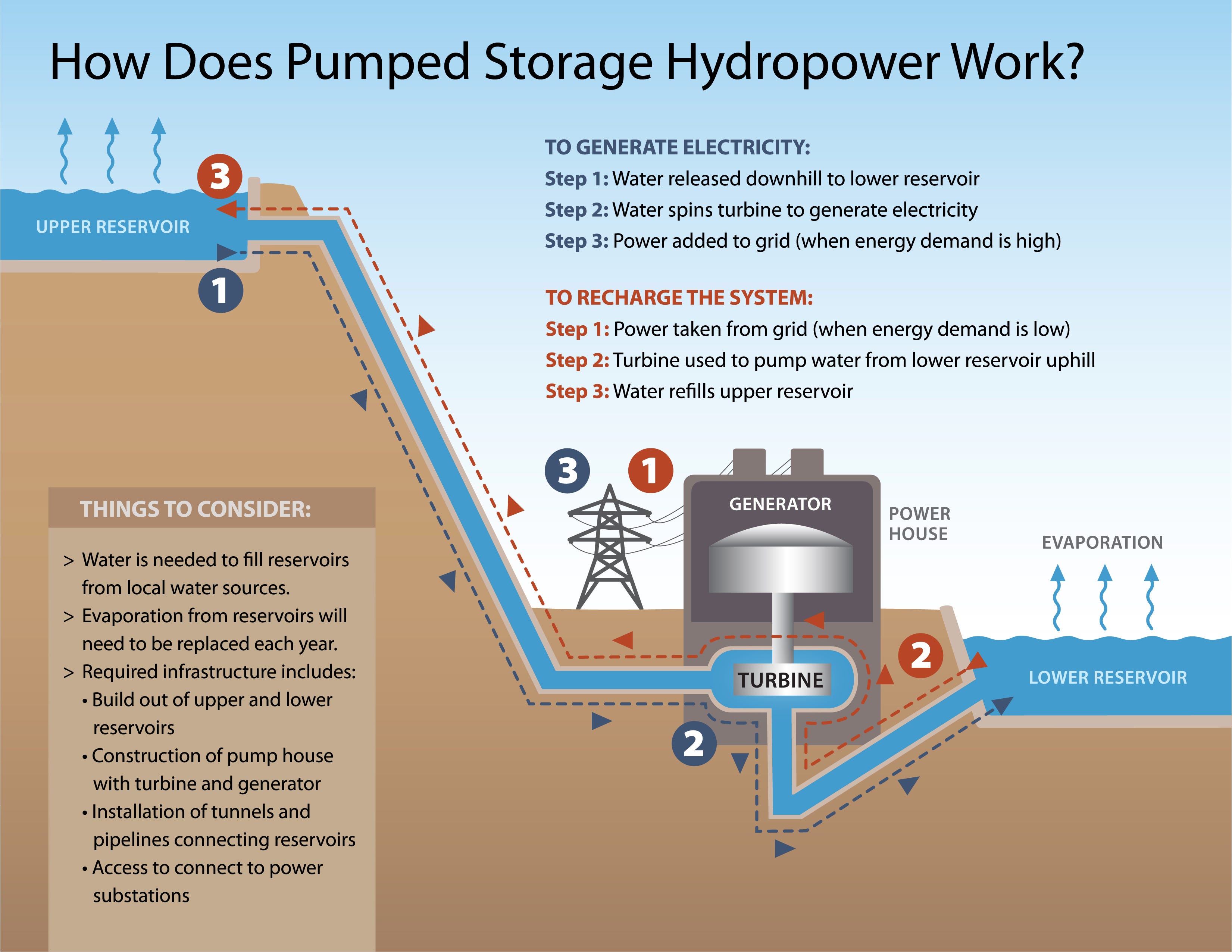
One possible alternative is “pumped hydroelectric storage” (PHS). PHS works by creating two water reservoirs at different elevations. When energy demand is low, some renewable energy is used to pump water to the higher reservoir. When energy demand is high, gravity sends the water rushing down to the lower reservoir where it goes through a turbine that converts it into electricity. PHS uses relatively simple technology that is roughly 80% efficient in the real world, and it has none of the dangers associated with battery storage.
Other possible energy storage options include Compressed air energy storage, Vanadium flow batteries and Iron-Air batteries.
Thanks for reading California Green Party News! This post is public so feel free to share it.
Digging deeper with Green leaders
To go deeper into the impact of the Moss Landing fire on residents in the area, we interviewed three politically active Green Party members who live near the Moss Landing facility.
Audra Walton, professional accountant and Reparations activist
Audra Walton is an active member of the Green Party of Monterey County who is also deeply involved in the movement for Reparations for Black American Freedmen Descendants. She spoke about her experiences on the day of the Moss Landing fire and afterward.
During the fire, Audra was driving from Marina to Gilroy, a route that put her roughly parallel to the Moss Landing site. When she got back home to Marina after work, she spent the night in her home, sleeping with the window open as usual. The next day her tongue was swollen. She tried to explain it away as allergies of some kind, even though that didn’t make any sense to her. But later she coughed up two blood clots, one of them in the presence of her primary care doctor.
“I do believe I have been affected, but I don’t know that that’s the case. I want to believe my symptoms are caused by something other than the fire. I’m not looking to get a huge settlement from a big company because they gave me a lifelong injury. What I want is not to be injured.”
The doctor gave her a chest x-ray which showed that she had bronchitis, an odd result for someone who hadn’t had any bronchitis symptoms. She would like to have more tests—a pulmonary function test and a CT scan—but she doesn’t know that she can afford to do it. She has health insurance through her employer, as well as coverage by Central Coast Alliance, which is a Medi-Cal program. Medi-Cal will cover the specialists she wants to see next, but her employer’s insurance will not.
“I do believe I have been affected, but I don’t know that that’s the case,” Audra says. “I want to believe my symptoms are caused by something other than the fire. I’m not looking to get a huge settlement from a big company because they gave me a lifelong injury. What I want is not to be injured.”
Audra says all this knowing that the long-term results of whatever she breathed in that day may not manifest themselves for twenty or more years.
Share California Green Party News
Gabriel Medina, independent filmmaker and School Board Trustee
Gabriel Medina is an independent filmmaker and Green Party member who recently beat the Trump-endorsed Republican to become the Pajaro Valley Unified District School Board Trustee for Area 3. He lives three or four miles northeast of Moss Landing in the town of Las Lomas and represents three schools in the northern part of Monterey County, along with a small sliver of Santa Cruz County. He is the only elected official in his unincorporated small town.
Gabriel told us that a small hill is all that separates the Pajaro Valley School District from the Moss Landing energy storage site. As the plume was forming on January 16, 2025, the smoke from the burning batteries was blowing right into his district. Being a brand-new School Board Trustee, Gabriel had to participate in the difficult decision to shut down the local schools or keep them open. In the end, the School Board decided to leave the schools open because many students live in areas that are even more exposed to Moss Landing than the schoolyards are.
“I had to get on the phone and demand that something be put up to cover these holes in our building, it adds to the neglect we feel in this area. We can’t get roads fixed promptly. We can’t get sidewalks installed.”
Because Gabriel’s community of Las Lomas is across the bridge from Santa Cruz County and far away from the large city of Salinas, it has always gotten the short end of environmental insults like major storms and fires. In 2020-2021, Las Lomas suffered floods because Monterey County refused to allocate funding to improve the levy, something residents had been demanding for years. When the levy was breached, people were displaced and students in the Pajaro Valley School District had to be bussed to another school for nearly a year.
Gabriel’s school was still under construction from the floods on the day of the Moss Landing fire, and many windows were simply not installed at that time. A month later, after a subsequent flare-up of the battery fire, many windows were still not installed, allowing contaminants to blow directly into the school again. “I had to get on the phone and demand that something be put up to cover these holes in our building,” Gabriel said. “It adds to the neglect we feel in this area. We can’t get roads fixed promptly. We can’t get sidewalks installed.”
Gabriel has not noticed any personal health issues from the Moss Landing fire, but a number of friends and constituents have symptoms ranging from bad headaches to asthma attacks. For these reasons, Gabriel finds it hard to believe reports claiming that the level of harmful chemicals in the environment from the Moss Landing fires is negligible.
Now, with a new energy storage facility proposed for Santa Cruz County, Gabriel’s district would be dead-center between two high-powered battery installations known to have the potential for fires and serious contamination. “That’s what makes my constituents extremely uncomfortable with these proposals,” Gabriel said.
He points out that lithium battery fires cannot be put out by spraying water or fire-fighting chemicals on them. You simply have to wait and let them burn themselves out. Obviously, this allows many dangerous chemicals and heavy metals to be released into the surrounding atmosphere and land, not to mention the waters of the Elkhorn Slough, a famous bird sanctuary and nature preserve located in Moss Landing.
“The long-term impacts are what worries me,” Gabriel said. “People who don’t notice immediate health harms are not necessarily ‘okay.’ The environmental insults from these facilities could have health effects that don’t surface for ten or twenty years after the event. My grandmother got sprayed with pesticides when she was young, but it was my mother who had to suffer with ADHD and autism.”
Bruce Delgado, Mayor of Marina, CA and a lifelong Green Party member
First elected Mayor of Marina in 2008, lifelong Green Party member Bruce Delgado has lived in Marina since 1996. Prior to becoming the veteran Mayor of a coastal town on the Monterey Bay, Bruce worked as a botanist for the Bureau of Land Management, where he did habitat restoration and protection at Fort Ord National Monument.
“First of all, I’m concerned,” Bruce said, “that if any serious harm is happening to the environment from this fire, we know about it.” Right now, he feels that the county and other officials have done a pretty good job of informing the public about what their data shows so far.
But he acknowledges that it’s harder than most people think to measure the air impacts, soil impacts and water impacts that might be dispersed after an event like the Moss Landing fire. “That may partly be because ‘dilution is the solution to pollution,’” he said, using an old—and sadly outdated—cliché about the forgiveness of Mother Earth.
“So I’m not acutely concerned,” he went on, “about this particular fire. But I am concerned about the things that we may never know, and how those things might affect our health and the health of other non-human lifeforms.”
“First of all, I’m concerned, that if any serious harm is happening to the environment from this fire, we know about it.”
He was as alarmed as everyone else when he heard the early testing results from non-government scientists that reported high levels of contamination. But later tests by government scientists contradicted those results. “I assume from those later tests that the long-term real-world effects are negligible. I hope we can trust the government’s information. Yes, I was placated by their findings, but I haven’t been actively involved in questioning their results.”
He stresses that the difficult job of getting meaningful data is a small part of the whole story. “It’s a two-step process. The first step is to finish gathering all the data and do our best to determine if any harm was done. That step is the easy one,” he said.
“Step two is the hard step. Where do we go from here? We’re trying to fight climate change and we have to use all the tools at our disposal. I have to assume that batteries will be part of that. But other techniques will also have a role. I’d be surprised if we as a community felt confident, at least in the short term, to say that this technique is good and this other one is bad.”
He concluded by pointing to the fact that the Moss Landing facility was originally built in 1950 as a gas power plant. “I have to hope that any new battery-powered energy storage facilities will have been built from scratch to serve that purpose.”
Thanks for reading California Green Party News! Subscribe for free to receive new posts and support my work.
Comments
Nothing yet. Say the first thing.
Sign in to join the conversation.