
My new book is coming out soon and I thought I’d share a short passage from the opening chapter.
This excerpt gets at the heart of what the book is about: denial, addiction, and the very human art of learning to not see the obvious.
I woke up on the bathroom floor, my cheek pressed against the cool tile. My head pounded. My stomach was in knots. There was blood on my shirt. Shame and remorse flooded me.
My girlfriend stood in the doorway and asked what happened.
“I slipped,” I said.
But even as the words came out of my mouth, I knew they weren’t true.
The truth was worse.
I honestly didn’t remember.
That realization—that I could no longer account for my own actions—should have terrified me.
It didn’t. Not right away.
Instead, I clung to the status quo, no matter how miserable it was. The human ego will choose familiar misery over unfamiliar hope almost every time. It doesn’t matter how destructive the old story is—if it feels familiar, we often prefer it to the uncertainty of change.
This is the lie that kills us: denial.
Not always physical death, but the kind Scripture often speaks of—separation from God, from one another, and from our own true selves.
I think of it as the human art of not seeing the elephant right in front of us.
I used to think this was mainly an addict’s problem. But the more I’ve learned in recovery, the more I’ve seen the same pattern everywhere—in myself, in families, in churches, and across society.
The strategies I used to hide my drinking and drug use weren’t unique to me. They are deeply human. We all have them. I still do. They come preloaded, like a default setting.
My years of blindness weren’t simply moral failure. They were also the frantic efforts of a nervous system trying to survive more truth than it knew how to handle.
My hiding practice started young.
I learned that peanut butter could mask the smell of alcohol. I knew which drawers worked best for stashing weed. I knew how to dodge questions, lie without blinking, and spin a story just believable enough to make people stop asking.
By twelve, I was already becoming an expert at hiding.
Hardly anyone asked where I had been anymore. No one asked why I came home smelling like smoke. If they did, I had a joke, a shrug, or a smart remark ready to deflect them. I became my own press secretary, keeping the elephant invisible while everyone else learned to step around it.
My family never talked about what was obvious to anyone paying attention.
Later I came to see that my father was shaped by trauma he never fully resolved. He worked obsessively. He had a lot of unresolved rage. I suspect there were other addictions as well. I don’t know everything he carried. But I know the silence around his struggles and behavior shaped the emotional climate of our home.
As a child, I could feel that something was off, but I had no language for it.
Denial had already woven itself into the fabric of our family life.
We learned not to notice.
Not to ask.
Not to trust what we felt.
The rules remained unspoken but unmistakable:
Don’t talk.
Don’t feel.
Keep the image intact.
And the explanations were always ready:
Bad luck.
Someone else’s fault.
Just stress.
Anything but the truth.
Denial isn’t passive. And it doesn’t belong only to the person with the most visible problem. It gets baked into the whole system around them.
Families teach denial like lullabies.
Mine did.
There is an elephant in your living room. It’s really there.
You’ve walked around it for years, maybe decades. You’ve arranged the furniture to make space for it. You’ve learned to speak softly so you don’t disturb it. Your family moves carefully around it. Visitors notice it immediately, but they quickly learn not to mention it.
That’s how denial works.
It doesn’t begin because we are bad. It begins because we are trying so hard to be good. We cannot bear the grief, the shame, or the terror that we might be powerless. So we create softer versions of reality. We build scaffolding around the lie and keep moving.
Until the scaffolding collapses.
My story isn’t unique because I’m an addict. It’s universal because I’m human.
We all have patterns, fears, and truths we’d rather not face. Mine involved alcohol and drugs. Yours might involve a relationship that’s quietly killing you, work that’s burning you out, spending you can’t control, eating your feelings, secrets you plan to carry to the grave, or a phone you can’t put down.
Different details.
Same defense mechanisms.
We tell ourselves stories to avoid truths that might crack us open—
and maybe even transform us.
“Then the Lord God called to the man and said to him, ‘Where are you?’”
—Genesis 3:9
It’s one of the most important questions in the Bible.
Not “What did you do?”
Not “Why did you do it?”
Just: Where are you?
The question is not accusation. It’s invitation.
What might be the elephant in the room in your life right now—the truth you’ve learned to step around?
What might change if you named it honestly?
God of truth and mercy,
you see us more clearly than we see ourselves.
When fear tempts us to hide,
give us the courage to be honest.
When shame tells us we must face life alone,
remind us that healing begins in connection.
Help us become people who can tell the truth,
communities where the truth can be spoken,
and companions who help one another step out of denial and into life.
Amen.
More soon. I’m grateful to finally be getting this book into the world.
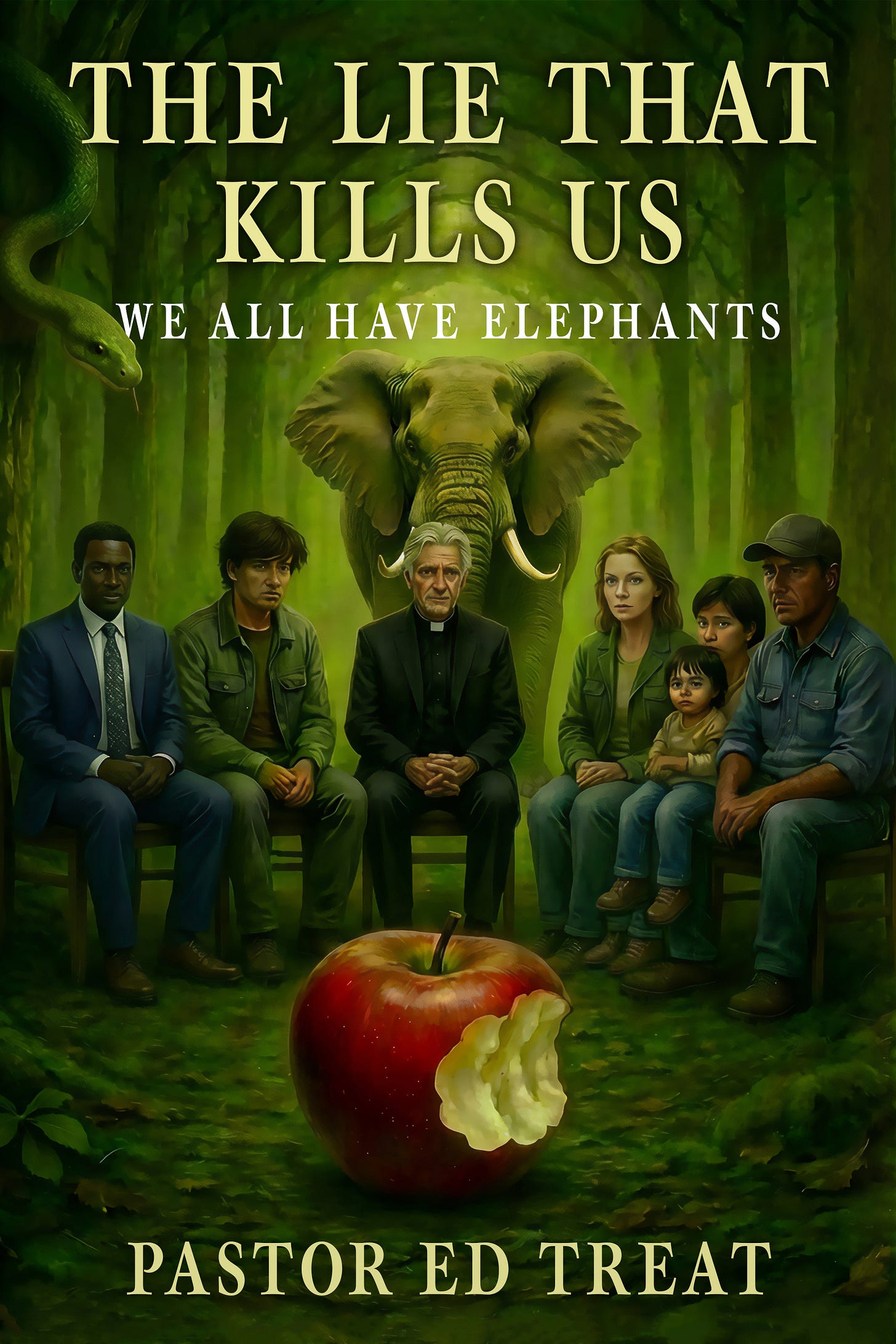
The Elephant Chronicles are meditations based on my upcoming book “The Lie that Kills Us: We All Have Elephants.” It explores the elephants we avoid: denial, addiction, trauma, death, and grace.
If you’d like me to let you know when it’s released later this spring, send a note to: Pastored@addictionandfaith.com
I’d be honored to keep you in the loop.
The book is now available here: Amazon
No posts
Comments
Nothing yet. Say the first thing.
Sign in to join the conversation.