
The pandemic lockdown seemed to have claimed another celebrity marriage dissolution: Bill Gates and Melinda Gates recently announced their divorce after a 27-year marriage. The Canadian government has officially reported that 5 million Canadians, 1 out of 8 Canadians, were involved in a divorce or breakup during the lockdown. Prior to the lockdown, there had been an apparent trend with high-profile wealthiest entrepreneurs to see their marriage dissolve at the peak of their success and popularity: Elon Musk and Jeff Bezos’ divorces were the first and second in the lead.
Divorces are often portrayed in the media as an event that only impacts the couple in question. In reality, the lives of many other parties are also deeply affected: first in line are the children and grand-parents, next, come other family members and close friends, then colleagues and business associates. There are multiple hidden emotional and financial costs that come with the territory: the children’s emotional distress, poverty (in 2007, divorce was the leading cause of poverty in the US), a messy child custody battle, the stress of single-parenthood, a divorce rate in the 60 percentile for second marriages, and 70 percentile for third marriages. Prior to COVID, there has been an ongoing silent global pandemic: loneliness as indicated by the number of single-occupant households in the USA has been steadily rising since 1970, and an increasing number of Americans who do not have a close friend to call upon in time of needs. Loneliness is globally affecting people’s emotional and physical health, medical experts compare its negative health impact to smoking 5 to 10 cigarettes a day, the toll on healthcare systems has reached such a critical point that the UK federal government has created a new Minister of Loneliness.
(This website has more detailed statistics https://www.wf-lawyers.com/divorce-statistics-and-facts)
I tend to think as family values erode in industrialized societies, marriage and long-term monogamy loose their ground as viable arrangements for romantic relationships. Looking at marriage from the family context, and if you can draw up your extended family tree that includes at least three generations then stand back to look at the entire genealogy. Observe that, with the exception of your spouse, all other kins were selected for you by “An Invisible Hand” without your consent. As the current statistics reports, close to one out of two marriages ends in divorce, not counting the ongoing unhappy marriages, it makes me wonder if the desire to choose one’s spouse, and the belief in one’s ability to make a sound choice are just pure self-delusion. Traditionally, parents were in charge of selecting spouses for their children, and this arrangements had apparently caused a great many dissatisfactions such that a rebellion took place in recent history in which most young people stepped up to take charge of this matter to choose who they will marry. This new arrangement does not seem to work too well either. Now, the question becomes, “who would be a better fit for this job?” If we referred back to the family tree, it seems to suggest to leave this task to “The Invisible Hand.” And this resonates with the age-old concept of “Soulmate,” which designates a spouse pre-selected by “The Invisible Hand.”
However, we are not out of the wood yet, as there is no tried-and-true method for recognizing one’s Soulmate in the crowd. Once again, if we refer back to the family tree, it does seem to suggest, perhaps, a Soulmate is someone who would fit well into this network of relationships since a person’s life is most likely to unfold within this ecosystem. This is food for thoughts. It does, however, open up the eventuality that there is room for improvement in the “finding” process. At the same time, it seems we have come full circle back to square one with a slightly different objective: instead of trying to make the right selection, we are now looking to “find the one.” I am not confident there is a real distinction beyond different wordings?
One more observation from the family tree is that people generally don’t divorce a family member other than their spouse. In the past, children could be abandoned or disowned by their parents, this practice has become unpopular in recent time. People also don’t have the practice of divorcing their parents, or siblings, or other extended family members, it makes me wonder why it is widely acceptable to divorce one’s spouse?
We have so far looked at the glass half-empty of marriages. On the half-full side, marriages that work well are a great source of happiness in life, and remain the lottery jackpot most people yearn to attain. In our time, these lotteries only favor a few lucky ones. The reward of great happiness is a strong motivation for my quest to make happy marriage a common reality of everyday life, as accessible to everyone as sunrise.
For many years Bill and Melinda Gates' marriage was my role model, their divorce has been a huge disappointment, especially after 27 year, and being one of the wealthiest and most successful couples. Their relationship has not been as strong as it had seemed. And among the 13 legal reasons for divorces:
Adultery
Bigamy
Desertion
Mental incapacity at time of marriage
Marriage between close relatives
Impotence at time of marriage
Force or fraud in obtaining the marriage
Criminal conviction and/or imprisonment
Mental or physical abuse
Drug or alcohol addiction
Mental illness
Irreconcilable differences
My guess for Bill and Melinda’s legal ground for divorce is either "Irreconcilable Differences" or "Adultery" based on the limited public information available on the case, and the gossips circulating on social media.
“Irreconcilable differences” seems to be over-used as an escape hatch when none of the other legal grounds applies. And dissolving a marriage is often taken for granted as the default course of action when a couple is disenchanted with their relationship. It is almost impossible to be fully aware of all the implications of a divorce before going through the whole process, and in the years to follow. Like many forks on the road of life, we sometime think back on the path not taken and wonder what would have happened if we had taken it instead:
What the future might be if I stay?
What are the vows would we make to one another if we get to renew our vows, or if we were to go back in time to redo our marriage again from the beginning?
Differences are a reality in every relationships, as ubiquitous as gravitation. In general, we tend to gravitate toward people who have common interests, or who are in agreement with our point of view–similarity is often used as a measure of compatibility.
I have three observations regarding this bonding process: first, having many things in common with your S.O. at the onset of a relationship could be seen as having similar past experiences before meeting one another. This is a promise that the relationship will thrive upon this initial common ground. However, just like the age-old warning in the financial investment world: “past performance does not guarantee future success,” the statistics have shown that many of couples eventually grow apart. Meanwhile, we have the mysterious cases of “opposites attract,” couples that seems to have more differences than things in common at the beginning of their relationship, and who defy common wisdom to go on to create happy thriving marriages. This is a new revelation: the ability to build a common ground over time is a more reliable contributor to the happiness of a couple than their initial compatibility.
Secondly, borrowing a page from the bio-diversity of nature, and the diversity of multi-ethnic, multi-cultural societies, differences in a couple deserve to be elevated from the status of “obstacles” to that of “treasures.” Couples entering a new relationship are encouraged to adopt a new mindset that embraces the rich diversity of their combined heritage, and to build their relationship upon this richness, instead of engaging in the usual destructive practice of trying “to resolve” their differences. The next question is how to make diversity work for both people in the relationship. This is a new line of thoughts that deserves to be explored in greater depth. Of the top of my head, I can think of these examples: (1) combine the individual bucket lists of both persons into one common bucket list that the couple will work together to realize each item on this list. (2) diversity implies each person is an expert on some subject that the other is not familiar with, as a result, each person takes turn to teach the other the subjects of their expertise, and the other person is willing to learn.
Thirdly, a new approach to look at marriage as a rite of passage of two single people who brings their individual life experience into the marriage. Upon entering into their marriage, the couple makes a conscious decision to let go of their prior lives as singles to begin afresh the process of building a brand new life together as a couple, making good use of their combined personal experiences. And in time, the common ground the couple will build together will be much larger than the sum of their initial personal differences. A visual diagram of this process is the capital letter “Y,” a relationship that falls apart is likely to begin from the common ground at the bottom of the Y and progresses toward the top where the couple grows apart. And in the case of opposites attracts, the relationship begins from the top of the Y where the couple starts out on separate paths, then progresses toward the bottom of the Y, working together to build a large common ground in their relationship. Over time, their individual identities disappears into this new common ground.
Furthermore, I would love to see the following two commitments be part of many new wedding vows:
we commit to never harbor resentments toward each another.
we commit to argue, to agree, to disagree, to love and to honor our differences.
… until divorce do us part.
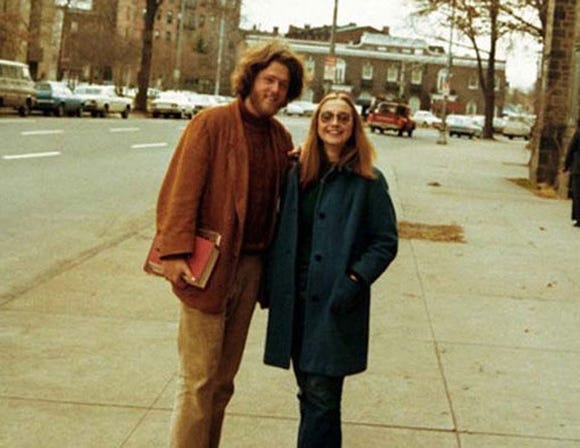
This young couple are still together after 40+ years, through many up’s and down’s of their careers and personal lives. In case you don’t not know, this is Bill and Hilary Clinton, a US former president and a former US presidential candidate.
While in office, Bill Clinton was involved in a sexual scandal with Monica Lewinsky. According to insider.com:
In Hilary’s 2003 memoir "Living History," she wrote, "I didn't know whether our marriage could — or should — survive such a stinging betrayal, but I knew I had to work through my feelings carefully, on my own timetable," calling the decision to stay with Clinton one of "the most difficult decisions I have made in my life."
After her loss in the 2016 presidential election, Hillary detailed the moments following her concession, writing in her third memoir "What Happened," that she laid in bed after she conceded to Trump and "stared at the ceiling," according to CNN. She wrote of her husband's consolation, saying, "Bill took my hand, and we just lay there."
Hillary released her third memoir, "What Happened," in September of 2017, which reflects on her election journey, career, and personal life in candor. She included a sentimental ode to Bill in her book, reflecting on the high points of their 40-plus years together, saying, "He has been my partner in life and my greatest champion since the moment we met." (Full article on Insider)
Contrasting Bill and Melinda with Bill and Hillary, both couples are highly accomplished, powerful, famous, and successful. The differences are in the fact that Bill & Hillary went through trials and tribulations in their careers: Bill Clinton's impeachment trial, and Hillary's 2008, 2016 presidential campaigns. These events put their relationship and their careers on trial. Meanwhile, Bill & Melinda have lived their life from a position of power and success virtually unchallenged, and uneventful. Ironically, it is hardship that makes love grow deeper, and relationships grow stronger–through trials and tribulations, a couple reveal to each other their true character, the depth of their love for one another, the strength of their commitment, and their trust in each other grows tremendously as they cross over the troubled waters side-by-side, leaning on each other to pull through to safe-ground. Like the old saying, "Love conquers all," Love leaves when there is nothing to conquer. (See my previous article: “A radical approach to marriage”)
One other major difference between Melinda and Hillary is that Melinda never had the opportunity to take a shot at realizing her career aspirations while Hillary got to run for president twice. I imagine this would be a sufficiently strong motivation for Melinda to decide to dissolve her marriage.
Hillary has proven that adultery is not by default, a cause to dismantle the life she had built with Bill. She was under tremendous social pressure to leave, and she had the courage to stay, and to rise up to tackle the new circumstances that had just presented themselves in her life. Adultery has also become an archaic custom in this day and age when there are a large repertoire of relationship choices such as open marriage, LBGTQ, polyamory, etc. Adultery is considered to be a sin largely for the purpose of transferring wealth from one generation to the next, and to keep the wealth within the family bloodline. In present time, the question of a legitimate heir can be quickly answered with a DNA test, meanwhile, the value of transferring wealth within the family bloodline has lost its appeal when wealthy people like Bill Gates and Warren Buffett have pledged most of their wealth to charity instead of their children.
As mentioned above the rate of divorce of third marriages is in the 70%, for second marriage is in the 60%, and 50% for first marriage. Marriage experts have suggested an explanation for this strange statics: most people unknowingly recreate the same drama in their subsequent marriages which lead to more dissatisfaction, and with prior experience, it is easier to leave the second and third time around.
The courage to change is “the courage to stay.”
Marriage is an ever-evolving institution that changes at the same accelerating pace as society evolves.
Marriage is a complex mixture of emotions, finance, moral values, traditions, religion, gender politics, civil laws, and more…. Most of these components are invisible until a divorce comes into the picture then issues from each of these areas all surface out of thin air.
Bill and Hilary, Bill and Melinda are wealthy, successful, and famous couples who do not live their lives according to the same rules as the population at large. Most people including myself do not have intimate knowledge of the lives of people in high society. The observations in this article are based on the publicly available information.
This article does not mean to pass judgements or to contribute to the gossips around sensational events of the day. The objective is to follow the advice of a wise person who, once said: “Only fools learn from their own mistakes.”
The movie “Lalaland” tells a bittersweet story of two young artists who were deeply in love, yet were unable to build a life together.
In contrast, the movie “Passengers” tells another bittersweet story of two strangers who were accidentally stranded by themselves on a spaceship that was on a one-way journey to a distant galaxy that takes longer than a human lifetime to arrive. The couple struggled and succeeded in building a beautiful life together for the rest of their lifetime aboard the ship.
A song by Sia: “The courage to change,” to inspire and motivate changes when facing with life’s challenges
― Rumi
No posts
Comments
Nothing yet. Say the first thing.
Sign in to join the conversation.