
by Caesar Osiris
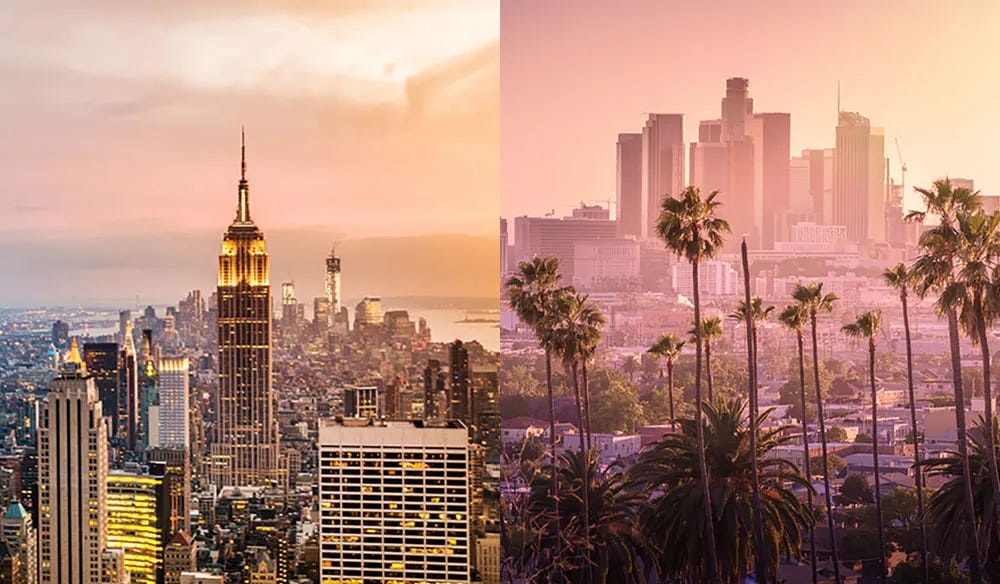
I’ve been reflecting on how social communities grow, sustain, and thrive. Especially in cities like Los Angeles and New York, two vibrant, creative places that offer radically different conditions for human connection.
Caesar’s Substack is a reader-supported publication. To receive new posts and support my work, consider becoming a free or paid subscriber.
One city moves like a river. The other rests like a lake.
The River: How New York Feeds Its People
New York City is a place where the city itself does much of the work of connecting people. You don’t have to make an appointment to encounter others, you just step outside. The density of life creates a natural current. People walk, ride, wait, eat, celebrate, and grieve together. Parks, stoops, subways, community centers, sidewalk conversations, they become accidental meeting grounds.
This infrastructure of interaction is what helps communities thrive: shared space, shared experience, and a bit of beautiful chaos that brings people into each other’s lives.
The Lake: How Los Angeles Asks You to Build
In Los Angeles, connection is less of a current and more of a choice. It’s a lake, with shimmering islands of community, scattered far apart. Each pocket of art, movement, or culture thrives, but you often have to swim (or drive) to reach it.
You need a map, a connection. Or a friend. Or a deep intention.
Thriving in LA means making the effort. Driving across town. Hosting the dinner. Creating a pop-up screening, hosting the party. Building the very spaces that other cities offer by default through their urban design. In a city built for private sanctuaries, thriving communities feel like handmade bridges. woven from trust, time, and repeated invitation.
So, What Makes a Community Thrive?
Across both rivers and lakes, the thriving ones share certain elements:
Consistency: Not just big events, but regular rhythms. A weekly gathering, a group chat, a monthly creative meeting. Community is a living organism, it needs water and sun, often.
Reciprocity: The best communities are not extractive. They give and take. They listen and contribute. They celebrate your wins and help carry your weight. Thriving isn’t about constant activity, it’s about mutual nourishment.
Shared Purpose: It might be art. It might be activism. It might be food, dancing, yoga, music, play, or healing. Thriving communities often have a center of gravity, a reason to come together, even as people bring different roles or energies to the mix.
Physical or Digital Space: Communities need places to land. That could be a front porch, a rehearsal space, a Discord server, or a borrowed back room in a café. The container matters. It signals: This is where we gather.
Emotional Safety: Without it, people perform. With it, people reveal. Thriving communities don’t just tolerate difference, they embrace vulnerability. They allow people to be messy, real, and in-progress.
Why It Matters Right Now
The world is fragmented. So many people feel isolated, even in crowds. But when a community truly thrives, it does more than support its members. It sends out a signal. It becomes proof that connection is still possible. It becomes a blueprint for how we care for one another in uncertain times.
Maybe thriving communities need both the current and the calm.
The accidental and the intentional.
The river and the lake.
Wherever you are—swim, wade, or float toward each other.
Don’t wait to be invited. Be the invitation.
Because on the other side of your effort,
There’s not just something waiting to grow,
There’s someone waiting to belong.
Caesar’s Substack is a reader-supported publication. To receive new posts and support my work, consider becoming a free or paid subscriber.
Comments
Nothing yet. Say the first thing.
Sign in to join the conversation.