
Yewon Park is a pastor and a social worker from South Korea.
A reflection from an attendee of the 2026 Our Stories Our Faith Conference in Indianapolis.
This piece is the second in a series of conference reflections intended to recount and ruminate on the insight and fellowship gained at the OSOF conference.
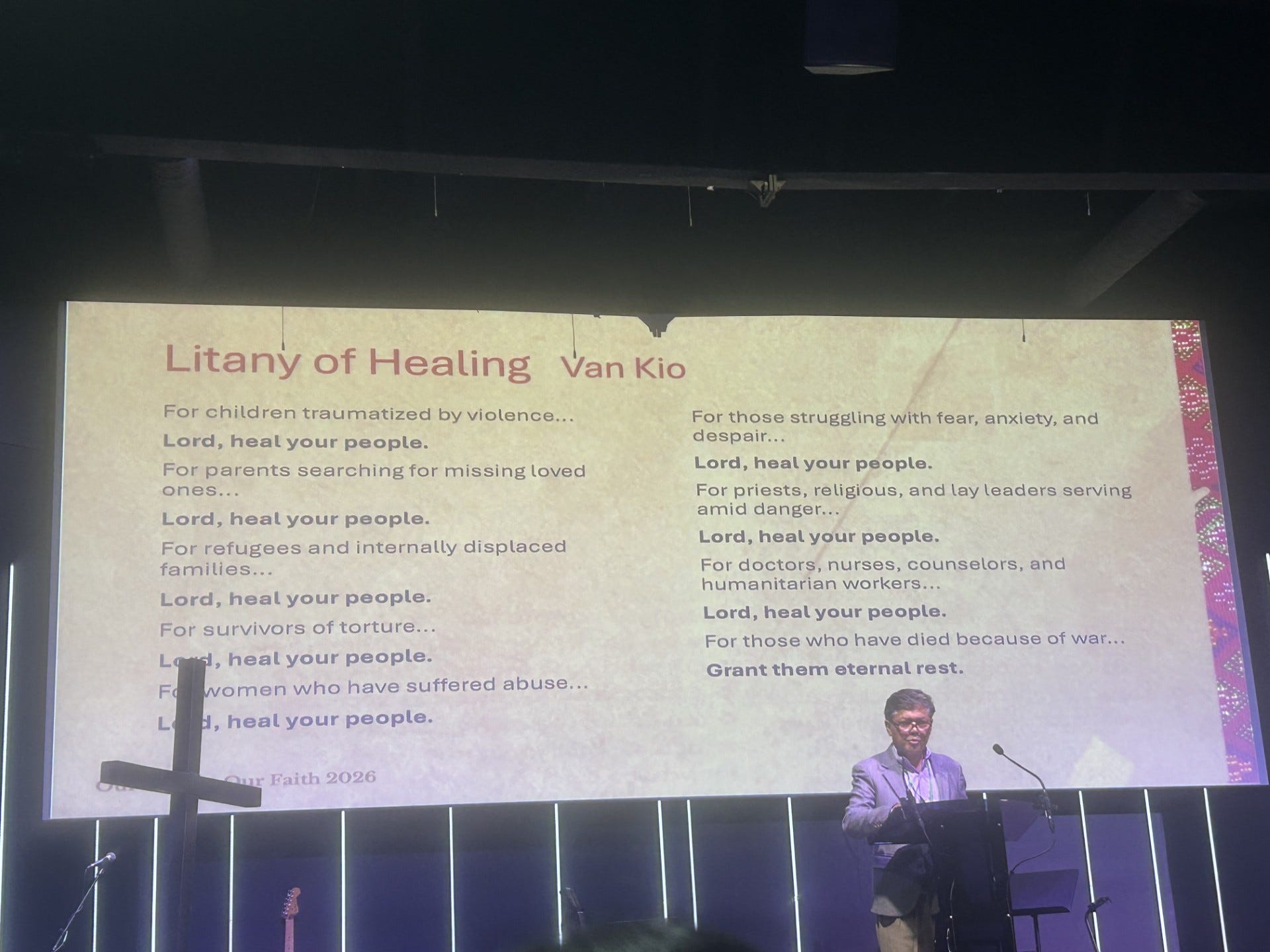
At the closing worship of the Our Stories, Our Faith Conference on the Burma Christian Diaspora in Indianapolis, we prayed a Prayer Before the Cross and a Litany of Healing together. After hearing stories of migration, war, displacement, resettlement, intergenerational conflict, and resilience among Burma Christian communities, I found myself wondering whom we were actually praying for. We were certainly praying for communities still living through violence and displacement. But perhaps some people in the room were also praying for an earlier version of themselves—for the person who had survived something so overwhelming that, at the time, they did not yet have the language to name what had happened.
That thought stayed with me because one theme I heard repeatedly throughout the conference was not simply the presence of trauma, but the difficulty of speaking about it. For many who survived war, evacuation, refugee camps, and resettlement, suffering was something to endure rather than something to discuss. Some had never experienced anything remotely comparable before and therefore lacked a framework for making sense of their distress. At the same time, the language of Western mental health does not always map neatly onto culturally grounded ways of understanding suffering, faith, family, and healing. Cultural stigma can add yet another layer of silence.
What surprised me most, however, was how familiar a story so different from my own could feel. The history of Burma Christian refugees should not be collapsed into the history of Korean immigration. Many members of these communities came to the United States after surviving political violence and persecution while living as both ethnic and religious minorities. Yet as I listened to the challenges they now face within their churches, I repeatedly thought of the Korean immigrant church.
The first generation carries memories that the next generation did not live through. Their faith, their gratitude toward the country that received them, and their commitment to the church cannot be separated from those memories. Meanwhile, younger generations often encounter the church from an entirely different social location. One generation may wonder why the young seem less committed to discipleship; the other may wonder why their parents seem unable or unwilling to understand them. Both may love one another deeply while lacking the language—or sometimes even the willingness—to explain what lies underneath their actions.
One story from the intergenerational panel especially stayed with me. A child of refugees remembered that their parents had never attended school events, even when the child was succeeding academically. For years, the child interpreted that absence as a lack of interest. Only after graduation did the parents explain that they did not understand American school culture and were afraid of being seated among white parents. A single conversation changed the meaning of years of misunderstanding.
As I heard that story, I wondered how many such conversations never happened within Korean immigrant churches. Perhaps we have already allowed one generation to pass without asking enough about what our parents feared, what they sacrificed, or why certain practices mattered so deeply to them. At the same time, perhaps the first generation did not always know how to explain those things to their children.
The conference also pushed me to think differently about mental health ministry. My first instinct is often to think in terms of resources: Where are the counselors? Which organizations provide culturally responsive care? How might churches build referral networks for addiction, trauma, legal assistance, or other needs? Those questions still matter. Yet the conference made me wonder whether the more fundamental question comes before referral: Have we created a community in which people can say that they are hurting?
During the session on addiction, I was struck by the emphasis on what churches can do through ordinary relationships—welcoming people without shame, speaking openly about addiction from the pulpit, reaching out relationally, and connecting people to appropriate support. It reminded me of something I have often observed while working with refugee communities: people who once received help frequently become some of the most committed people helping others who are walking through similar experiences.
…the conference made me wonder whether the more fundamental question comes before referral: Have we created a community in which people can say that they are hurting?
I kept thinking of the image of the wounded healer. Healing does not necessarily mean that a wound disappears. Sometimes the wound becomes the place from which a person recognizes the pain of another. What someone once received can then be offered outward—not because the experiences are identical, but because suffering has enlarged their capacity to notice and accompany another person.
There was something joyful to me in that possibility. The most hopeful thing I heard at the conference was not a promise that trauma could simply be left behind. Rather, I saw the possibility that what had once been a source of pain could become a source of compassion, solidarity, and service.
After returning from the conference, a conversation with the pastor helped me name one more lesson: the importance of presence. Asian American communities are often occupied with the needs of our own ethnic communities, and understandably so. Yet if we hope to build a broader Asian American Christian community, we also have to show up for one another. I went to learn about the Burma Christian diaspora, but in listening carefully to their stories, I found myself seeing the Korean immigrant church differently.
Perhaps presence precedes understanding.
This leaves me with a question for my own ministry: Can immigrant churches build trusted networks of counseling and mental health resources while also creating cultures in which seeking help becomes speakable? Resources matter, but so do testimony, prayer, pastoral care, intergenerational conversation, and relationships strong enough to hold difficult truths. The church does not need to replace professional mental healthcare. But perhaps it can help create the language and trust that allows someone to take the first step toward it.
…if we hope to build a broader Asian American Christian community, we also have to show up for one another. I went to learn about the Burma Christian diaspora, but in listening carefully to their stories, I found myself seeing the Korean immigrant church differently.
I keep returning to the Litany of Healing from our closing worship. Perhaps we were praying for others. Perhaps we were praying for our communities. But perhaps some were also praying for the selves they had once been—the selves who survived without words for what they had survived.
Maybe healing sometimes begins when the present self finally finds the words to pray for the past self. And perhaps one task of the church is to make sure that the next generation does not have to wait so long to find those words.

Yewon Park is a social worker and ministry leader serving at the Korean Church of Boston. Her interests center on immigrant and refugee communities, mental health, and the role of faith communities in fostering healing and belonging.
Thanks for reading Imagine Otherwise! This post is public so feel free to share it.
Comments
Nothing yet. Say the first thing.
Sign in to join the conversation.