
By Daniella Jacob, Editor at the CAAC and incoming PhD student at the University of Virginia.
I have been a part of the team at the CAAC for approximately two years now. This has meant that I’ve experienced two cycles of annual conferences. Out of all the conferences and events the CAAC hosts, Our Stories Our Faith (OSOF) is my favorite. It was actually one of the factors that convinced me to apply for this job. I had heard all about the one in California centered on Japanese immigrants. It was my first time hearing about a conference being in a particular city so that attendees could intellectually learn and then tangibly see what they had just learned.
This year’s conference certainly did not fall short of the OSOF legacy. However, compared to previous years’ OSOF Conferences, this one felt more intimate and maybe even intrusive at times (in a good way). The community we got to peer into this past weekend seemed, to me, to be at a crossroads. One defined by a generation overwhelmed with gratitude towards America and tenacity to keep the Burmese culture as they know it. And, a crossroads in which this tenacity has worn out the succeeding generation. Dreams of the refugees and their children seem to be colliding at this time of intergenerational handoff.
This year, we got the privilege of being invited in to see Indianapolis through the lens of the Burmese Christian diaspora.
Naw Eh Phaw, the conference’s opening speaker, has done a great job of introducing the Burmese diaspora and the significance of Indianapolis as a place. As was expressed in her opening speech, and underscored by several other speakers, the resilience of the Burmese Christian Diaspora is something that’s difficult to put into words. Although a lot of the history of the Burmese diaspora was deliberately left unspoken during this conference, I was able to grasp that their experiences were not defined by suffering, but rather God’s preeminent faithfulness through it.
As Dr. Hrang Hlei mentioned in his lecture, the Burmese refugees initially migrated from place to place, looking for a home that would accept them. Many migrated to neighboring Asian countries such as Malaysia, Thailand, and India and often sustained even more suffering in those places based on their religion, ethnicity, or refugee status. America–Indianapolis specifically–feels like the place that finally delivered a relief to their suffering and an end to their nomadic sentence.
Speaker after speaker on day one noted this profound and almost insatiable gratefulness the Burmese diaspora owes to America and to the Baptist missionaries who first brought Christianity to Burma. In Phaw’s opening speech, she makes a notable recognition of Adoniram Judson, an American baptist missionary who first brought the gospel to Burma. Dr. Pum Za Mang noted how America has been so gracious to accept Burmese refugees. Dr. Hlei, when addressing the question of why Burmese people chose Indiana, noted the kindness and welcomingness of the Hoosiers (Indiana residents). These were just a few instances out of several in which the speakers recognized why gratitude is warranted towards America.
A picture was painted, with broad strokes, that the Burmese diaspora had been welcomed as a stakeholder to the American dream. And, now they owe something back to the collective American good, whether that is to (a) seize the opportunities at hand (b) spread the gospel to their fellow Americans or (c) contribute to the collective good through jobs and/or community organizing.
A majority of the questions that followed these presentations could be organized into one big bucket: “what does the next generation think of ___?” More specifically, audience members noted and asked:
Pastor Hlei, you mentioned that it is important for the diaspora community to not lose institutional ties with the local Christian denominations that supported them initially. Is this sentiment common and still held among the younger generations?
Do you know of churches that practice mutual learning and appreciation across generations? Are there examples of this today?
What can we do to help the younger generation also love our dialects, language, church, culture, and identity like we (the first generation) do?
Does cultural continuity and individual freedom exist for the younger generation?
The younger generation has the weight of carrying this American dream and seizing the opportunities at hand. But, this has led to stereotypes such as the tiger mom and pressure on the second generation. What should we make of this?
Could you say more about the idea of being ‘indebted forever’? Do you see gratitude as creating an ongoing obligation to the United States -- not just newcomers?
Again, these were just a fraction of the Q&A inquiries that address the broader concern of the pressures that are falling on the second-generation of Burmese immigrants.
As a non-Burmese audience member, noticing this pattern of questions was revealing. These questions felt like ones that Burmese Christian people were sitting on for a while now. I sensed that, in the older generation, many have been thinking: why does my passion feel disproportionate to that of the younger generation? Why are they so passive when they have all this opportunity at their fingertips? How did the younger generation already forget all we’ve been through?
I also sensed that the younger generation of Burmese Christians have been considering: Is my fate to simply inherit the American dream my parents have already planned out for me? Can I choose to blend American culture or Burmese culture or will that mean I’m not Burmese enough? Why do I have to seize every opportunity that I don’t quite want?
OSOF made a space for these questions to move past introspective thinking. These precious questions now broke to the surface and were verbalized in an intergenerational environment. Although the speakers were humble enough to recognize that they don’t have all the answers to these brutally difficult questions, they were finally acknowledged as “good” and “important” questions.
I consider myself lucky to have been invited into this space. I find the crossroad that the Burmese diaspora is facing to be illuminating to the questions I’ve been struggling with for a decade as a second-generation Indian American. I found it comforting that each immigrant community goes through this difficult, intergenerational handoff. And, I found it exhilarating that none of us have the answer and that we may just have to ride the wave and see what this rising generation does with what they’ve been given.
Dr. Hlei ended his presentation answering a huge question: “What is the future of these immigrants?” He offered three potential scenarios that the Burmese Christian diaspora could choose in the near future.
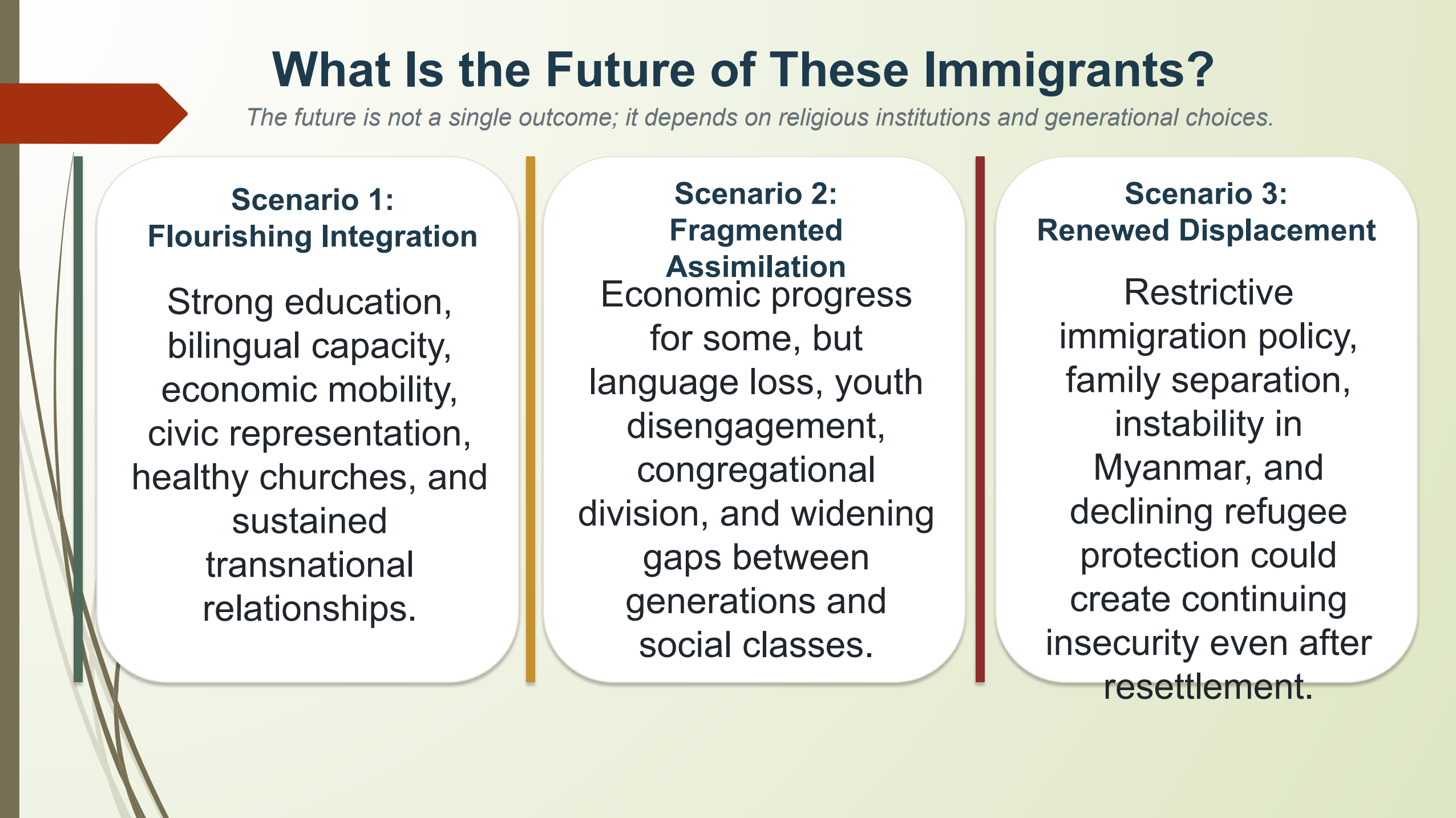
I think I know my prediction. What’s yours?

Daniella (Dani) Jacob is the child of Indian immigrants from Kerala. She completed her BA in Religious Studies at Bryn Mawr College in May 2026. She is currently a Fulbright Grantee to Bulgaria. After her time in Bulgaria, she will begin her PhD in Religious Studies at the University of Virginia. Daniella has recently savored her post-grad summer road-tripping and watching cooking videos.
Comments
Nothing yet. Say the first thing.
Sign in to join the conversation.