
There’s a system that’s been running in China for over two thousand years. It’s called BaZi (八字), literally “Eight Characters.” It maps five elements (Wood, Fire, Earth, Metal, and Water) onto the moment of your birth, then reads their interactions like source code for a life.
I spent weeks studying it, testing it against many people I know. Friends, family, public figures. I expected to debunk it. Instead, I found a framework that answers a question no personality test has touched: why some people find their path effortlessly, while others, often the most capable, spend decades searching.
Five elements. Each produces one, controls one, and is controlled by one. Wood feeds Fire. Fire produces Earth. Earth generates Metal. Metal creates Water. Water nourishes Wood. And in reverse: Wood breaks Earth, Earth dams Water, Water kills Fire, Fire melts Metal, Metal cuts Wood.
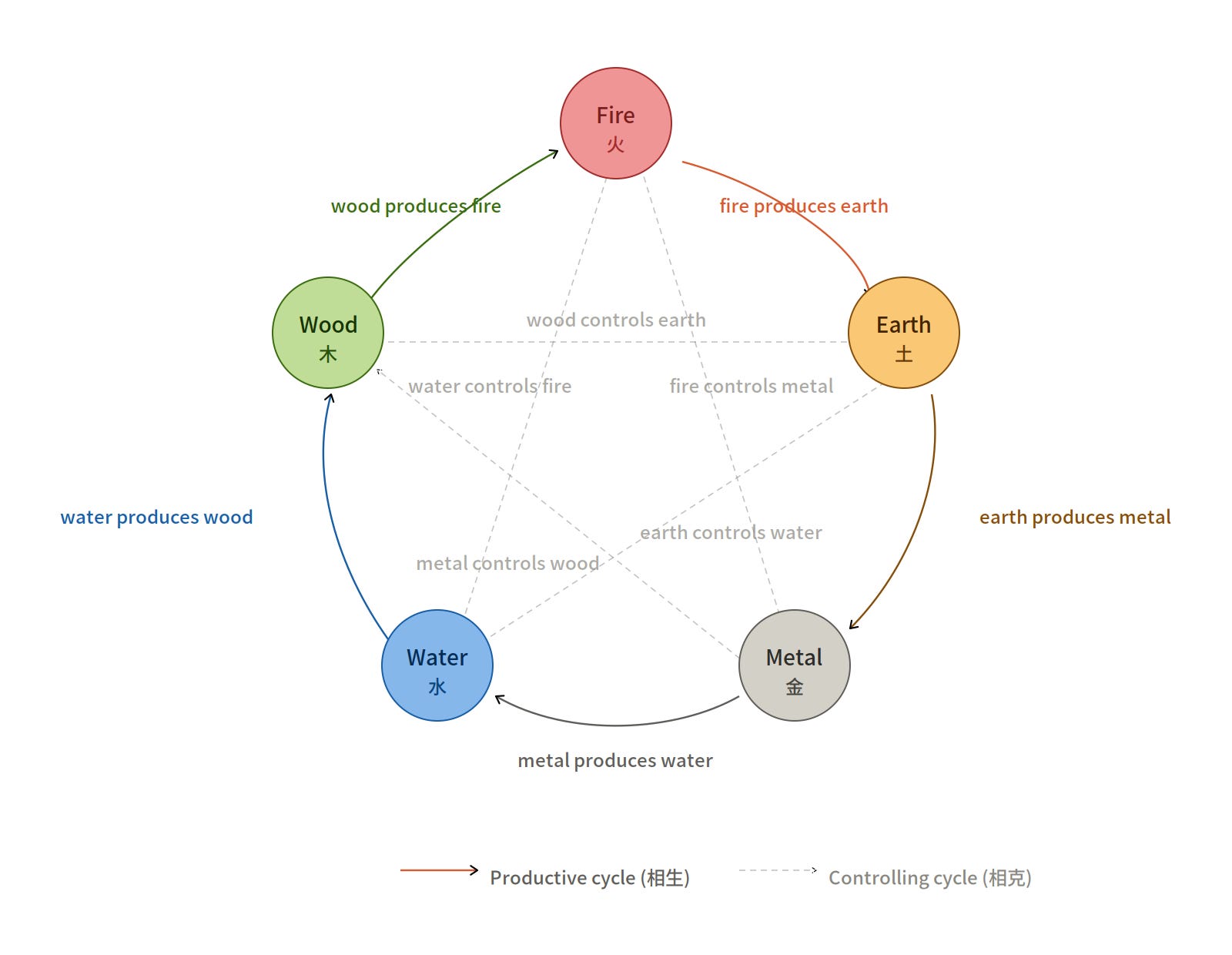
Your Day Master, the element of the day you were born, is you. Everything else in the chart is defined by its relationship to you. This is where BaZi parts ways with Western astrology. In Western systems, Mars means Mars for everyone. In BaZi, the same element plays a completely different role depending on whose chart it’s in. Metal in a Wood person’s chart is the force that controls them: pressure, authority. Metal in an Earth person’s chart is what they produce: talent, creative output. Same element. Opposite function.
There are no universally good or bad elements. Only relationships, and whether those relationships are functioning.
Each element splits into Yang (outward, forceful) and Yin (inward, subtle). Yang Wood is the tree that would rather snap than bend. Yin Wood is the vine that wraps around obstacles. Yang Fire is the sun, generous to all. Yin Fire is the candle, intimate and selective. Yang Metal is the axe. Yin Metal is the jewel.
The useful distinction is this: Yang elements develop through challenge. A tree untested by wind has shallow roots. An axe that never strikes is just a piece of metal. Without resistance, Yang elements don’t strengthen. They bloat.
Yin elements develop through support. A candle in a storm doesn’t grow stronger. It dies. A jewel in dirt doesn’t toughen. It dulls. What makes a Yang element thrive is precisely what kills a Yin element.
This has implications for how we think about pressure, resilience, and growth. The advice to “lean into discomfort” assumes a Yang constitution. For a Yin constitution, the correct move is often the opposite: find protection first, then grow from safety. Neither approach is wrong. They’re prescriptions for different patients.
BaZi assigns every element in your chart a functional role based on its relationship to your Day Master. These are called the Ten Gods (十神). They’re not personality types but dynamics. The same person has all ten operating at different volumes.
The Seal (印) produces you. It represents dignified reputation, institutional credibility, and protection. Not fame in the viral sense, but the kind of recognition that comes with a professorship or a trusted name. When strong, you’re endorsed and shielded. When excessive, you’re insulated from the discomfort that drives originality.
Authority (官杀) controls you. Pressure, discipline, direction. The Yang version (七杀) is dangerous pressure that forges or breaks. The Yin version (正官) is legitimate structure you respect. A chart with no Authority at all produces someone comfortable but adrift, with no external force asking anything of them.
Output (食伤) is what you produce. Talent, expression, creative work. The Yin version (食神) builds through craft. The Yang version (伤官) builds by first tearing down what exists. One makes gardens, the other clears forests.
Wealth (财) is what you control. Money and resources. But Wealth in a chart whose Day Master is too weak to hold it is like handing a heavy suitcase to a child. The opportunity is real, but the capacity isn’t there.
Companions (比劫) are your own element reflected back. Peers, equals, competitors. They strengthen you and they divide your resources. The only relationship where the other element is essentially you.
Individual Gods matter less than the relationships between them. Much of real-world behavior can be explained by a handful of recurring dynamics.
The Seal suppresses Output.
Protection reduces creative urgency. The more institutional support, credentials, or external validation a person receives, the less pressure they often feel to produce original work. This isn’t necessarily about laziness. It’s structural. Every layer of endorsement creates a layer of insulation from the productive discomfort of having something to prove.
Output generates Wealth.
Creative and productive work are the traditional bridges to income. When Output is weak, blocked, or absent in a chart, that bridge becomes difficult to cross. This helps explain why some people are clearly talented yet struggle to turn their abilities into financial success. The problem isn’t always effort or strategy. Sometimes the connection between creation and monetization is simply missing.
Wealth undermines the Seal.
Money and reputation often exist in tension. Aggressive monetization can erode credibility, while strong credibility can make people hesitant to commercialize their work. This isn’t a moral judgment but a structural trade-off. The creator economy has spent the last decade rediscovering a tension that BaZi identified centuries ago.
Authority produces the Seal.
Pressure creates credibility. The most respected people are often those who have endured the greatest challenges. Sustained responsibility, accountability, and adversity create the conditions for expertise, trust, and institutional recognition.
The Hurting Officer clashes with the Direct Officer.
The rebellious star of expression naturally conflicts with established authority. This dynamic often appears in people who are highly capable within institutions but repeatedly find themselves in conflict with them. The academic who alienates committees. The employee who questions every directive. The entrepreneur who struggles under hierarchy. It’s not necessarily a character flaw, but a structural friction between two forces within the same person that are pulling in opposite directions.
A strong Day Master has energy to spare. A weak one is perpetually running low. The practical significance is that the same element arriving in two different charts produces opposite experiences.
Authority on a strong Day Master registers as ambition: “I have something to prove.” Authority on a weak Day Master registers as weight: “I can’t afford to make a mistake.” Wealth on a strong Day Master is an opportunity seized, while wealth on a weak Day Master is an opportunity that exhausts.
This reframes the question of whether pressure, competition, or adversity is “good for people.” The BaZi answer is that it depends entirely on the constitution receiving it. Pressure on a strong foundation is a forge. Pressure on a weak foundation is a burial. The prescription has to match the patient.
The Seal represents dignified reputation. Wealth represents money. And in the elemental cycle, Wealth controls the element that produces the Seal, meaning money structurally undermines the conditions for credibility.
This creates a genuine dilemma. People with strong Seal elements tend to be respected but not rich. People with strong Wealth elements tend to earn well but struggle with lasting credibility. The acclaimed artist who can’t pay rent and the wealthy influencer who can’t earn respect are both experiencing the same structural tension from opposite sides.
The resolution, when it exists, runs through Output. Recognition strengthens the Day Master, the Day Master produces Output, and Output generates Wealth. The chain is: be endorsed, become stronger, create something, get paid. Each link must be present. When people try to skip from reputation directly to money, or from money directly to respect, the system resists.
Output Generates Wealth (食伤生财). The earned-wealth path. You create, the market pays. This requires a functioning Output element in the chart. It’s the most respected path because you’re selling product, not selling yourself.
Strong Body Takes Wealth (身旺克财). The Day Master overwhelms Wealth directly. No creative bridge needed. This produces people who seem effortlessly lucky, but with no craft behind the money there’s no accumulation. What comes easily leaves easily.
The System Provides (官印相生). Authority and Seal reinforce each other. Wealth comes from belonging to an institution. Stable and protected, but with a ceiling.
Most charts structurally favor one road. A significant source of frustration is attempting the wrong one: the institution-suited person trying to freelance, the natural creator trapped in a corporate track, the effortlessly lucky person wondering why their ventures have no staying power. The roads aren’t interchangeable. The chart suggests which one has the least friction.
Some charts are overwhelmed by a single element. These tend to produce specialists who find their lane early and never question it. When one elemental voice drowns out all others, there’s no internal debate. The path is obvious because there’s only one path available.
Balanced charts, where every element is present but none dominates, are traditionally considered auspicious. And in some ways they are: adaptable, resilient, capable of navigating any terrain.
But the lived experience of a balanced chart is often one of chronic searching. You have the tools for business, art, academia, leadership, and craft, but none so dominant that it announces itself as your calling. You’re legible to every world and native to none. The business people find you too philosophical. The philosophers find you too commercial. The artists find you too strategic. The strategists find you too intuitive.
Dominant charts are deep wells. Balanced charts are river systems with multiple tributaries that need years to find their way to the same body of water. For most of those years, the process looks indistinguishable from wandering.
The specialist’s task is to go deeper. The balanced chart’s task is different: to build an architecture that holds everything together. Not a single career but a portfolio of activities that collectively engage every element. This takes longer. It looks less legible from the outside. And it produces something that no specialist can replicate: the ability to connect worlds that don’t normally speak to each other.
BaZi isn’t really about predicting events. It’s more about revealing the underlying patterns of a life—what naturally draws you in, what drains you, where your energy flows easily, and where it tends to get stuck.
What I find most interesting is that it gives names to patterns that are otherwise hard to see. Why you keep ending up in the same type of relationship. Why certain jobs energize you while others leave you exhausted. Why some periods of life seem to unfold effortlessly while others feel like you’re pushing against a wall.
I’ve tested it against more than fifteen people so far, and I haven’t come across a chart that didn’t resonate with the person’s actual experience. That’s not scientific proof, of course. But when something keeps showing up consistently, it starts to earn your attention.
The biggest value of BaZi, at least for me, isn’t prediction. It’s perspective.
It offers an alternative explanation for things we often blame ourselves for. Maybe the person with weak Output isn’t lazy. Maybe they’re struggling to express something that’s difficult for them to access. Maybe the person whose Wealth and Seal are constantly at odds isn’t bad with money. Maybe they’re navigating two forces that naturally pull in different directions. Maybe the person who can’t settle into a single career isn’t unfocused at all. Maybe they’re built for variety in a world that rewards specialization.
Knowing your structure doesn’t magically change it. But it does change the way you relate to it. Instead of constantly fighting yourself, you can start working with the grain of who you are.
And sometimes that shift alone changes everything.
No posts
Comments
Nothing yet. Say the first thing.
Sign in to join the conversation.