
It has been a year since I quit my first startup. There was no announcement post, no dramatic pivot, no public lesson packaged into a thread. I just had enough distance to notice what actually changed. I used to think quitting would mean losing momentum, falling behind, or starting over, like stepping off a moving walkway while everyone else kept moving forward. That is not what happened. What changed was not how much I worked, but what I was optimizing for.
Before, I was trying to win. Winning meant growth, traction, and momentum, things that were easy to point to and uncomfortable to live without. Scale felt like the goal, but looking back, it was also a shortcut, a way to stay in motion without fully knowing why. I can trace the start of that tension back to a moment I did not fully understand at the time.
I still remember sitting alone in an office pod at 1871 in Chicago, on a call with my startup mentor. At some point, he asked me a simple question: you have to know what you actually want. I froze, not because I did not care, but because my mind was pulling in too many directions at once. Ideas, expectations, possibilities, fears. Underneath all of it was a quieter instinct to avoid a kind of discomfort I did not want to face yet. At the time, I thought that discomfort was something to push through. In hindsight, it was information.
A few months later, in June 2024, I traveled to New York for the Fancy Food Show. Between meetings and walking the floor, I met up with a few old friends I had not seen in years. I found myself saying, almost casually, that I was starting a business. Even as I said it, I was surprised by how confident it sounded, as if naming the identity made it real, as if stepping into the role could come before understanding what it would actually demand. They were supportive and excited for me. I did not talk about the parts I was already unsure about.
After I quit, I expected something obvious to happen, relief, panic, clarity. Instead, things just got quieter. Over time, I noticed I no longer wanted to introduce myself as a founder or even as a former co founder. It was something I had done, not something I needed to keep naming. That surprised me. As a minority, I used to feel pressure to claim space quickly, to name myself before someone else did, to make sure my voice was visible and taken seriously. Now, I feel more compassion toward people who are just starting out as founders. I recognize the urgency, the need to move fast, to be seen, to prove something before you have had time to understand what you are building.
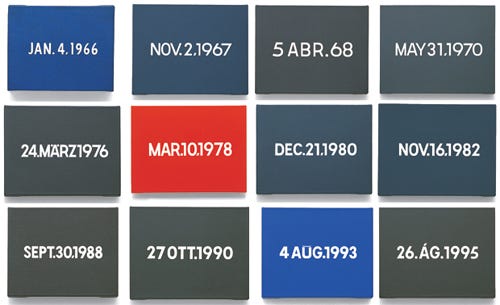
On Kawara, one of the “Today” or Date Paintings from his long-running series in which each work consists only of the date it was executed. These pieces highlight daily presence and the quiet accumulation of time.
That shift made me more cautious about moving ideas forward. Not hesitant, but more deliberate. I spend more time sitting with ideas before pushing them into the world. If I think of last year as a time when I was trying to accelerate my life, this year feels different. I am moving at a more natural pace and paying attention to what happens when I stop forcing momentum.
Around the same time, something else clicked for me. Babba Rivera said on the Social Currency podcast with Sami Cohen that you are only as good at work as you are personally, because it is still you. That line stayed with me because it explained why acceleration stopped working. You cannot outrun the parts of yourself you have not worked through. They show up in your decisions, your pacing, and what you choose to avoid.
That is when compounding started to mean something different to me. I no longer think about compounding in terms of big outcomes. I think about small, consistent acts that train how I handle difficulty. I am trying to work through things instead of holding my breath, pushing through a burst of intensity, and calling that progress. That pattern always felt exhausting and short lived. I care more about balance now, about not avoiding small, everyday discomforts, and about spending more of my time on what I am actually good at, rather than forcing myself into work that only looks impressive from the outside.
Over time, I also stopped chasing visible wins. What replaced it was an interest in compounding quieter things. Writing without worrying about performance, improving design judgment through repetition, building tool fluency by exploring instead of committing, and forming relationships without trying to extract value. None of these felt like wins, and that was the point.
I also lost my urgency to scale. Scaling is a multiplier. It magnifies what is already there. If the thing underneath is not clear, scale just makes the noise louder. Precision does something else. Precision takes time. It means making fewer things intentionally and letting ideas stay unfinished long enough to understand what they are. Looking back, I rushed past that stage more than once, not because I did not value it, but because everything around me rewarded speed.
Quitting gave me room to slow down without having to justify it. Over the past year, I have built smaller things, shipped without attachment, paid more attention to signal than metrics, and tried to make choices that future me will not have to undo. This changed how I think about leverage. Leverage used to mean scale. Now it feels closer to alignment, doing things that stack instead of pulling in different directions.
I do not feel less ambitious because of this. If anything, the ambition feels steadier. I am no longer trying to win. I am trying to compound.
Comments
Nothing yet. Say the first thing.
Sign in to join the conversation.