
“At the Table” is a series of interviews and spotlight conversations with people I admire from within and outside of the wedding industry. These conversations focus on topics related to building an intentional, relationship-first business alongside a present, connected, values-driven personal life.
I don’t remember when I first encountered Megan’s work. It was years and years ago, back when she had a wedding paper company and I *think* before either of us had children. I fell in love with her work when she started working with brands and talking more on IG about color theory. I was drawn to how she saw the world, with her love for color, and for the beautiful blend of intentionality and playfulness that came across in everything she touched. So when it came time to start the rebrand process for my photography business, I reached out to her to see if that was work she would consider taking on. The timing was perfect, and so was our partnership. I found in Megan a perfect “meeting of minds,” someone who wanted to know and understand the “why” behind every single choice we made throughout the design process. But even more than that, I found a kindred spirit and a friend. I’m thrilled she said yes to an interview!
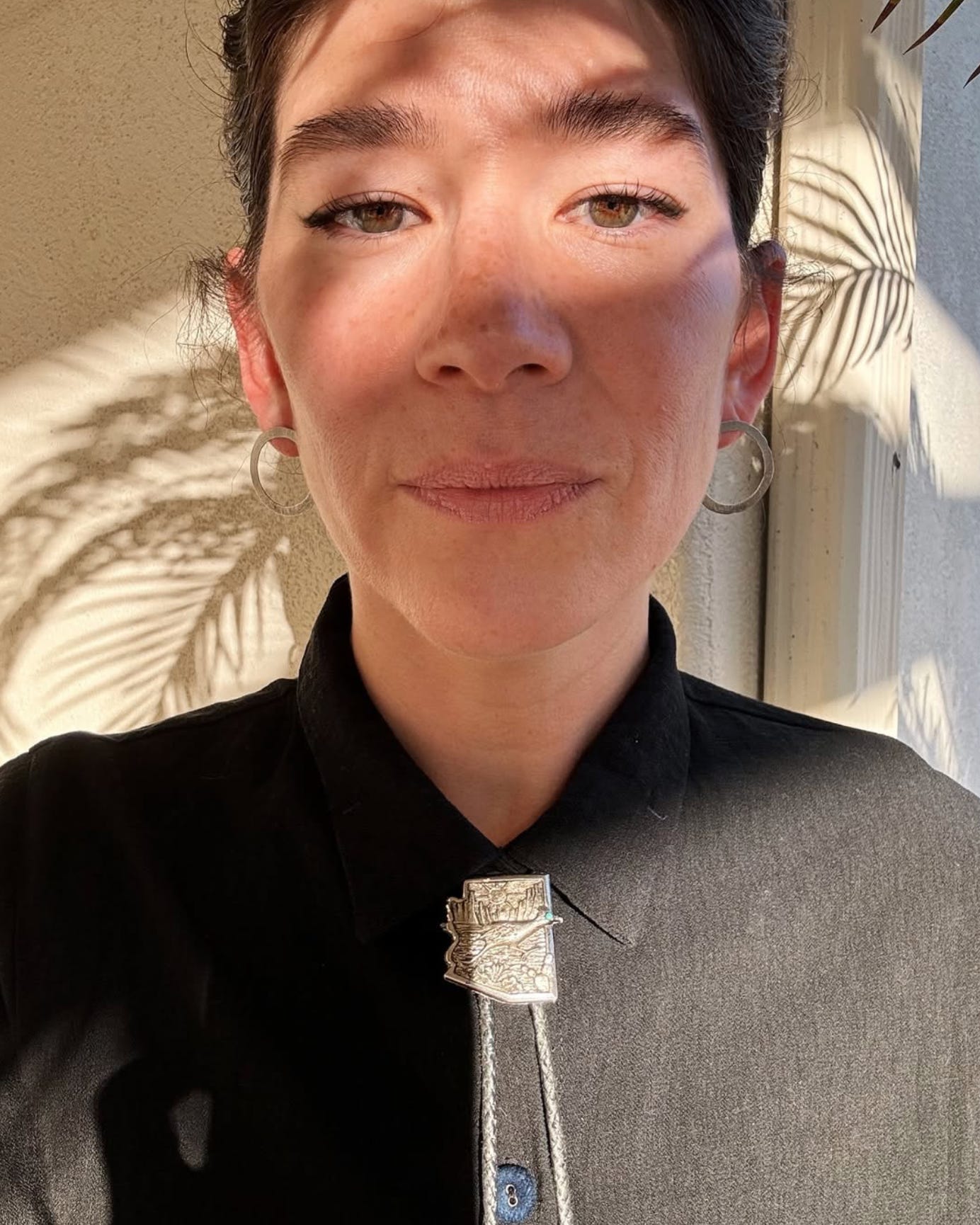
Follow Megan’s work via her website and IG.
→ First of all, tell me in your own words what you do for work, and why you do it?
I create brand worlds for creative women, and I do that because I love creating and I love working alongside women who are empathetic, thoughtful, and ambitious.
→ What does a typical day look like for you?
I usually start my day by going to a Pilates gym in the morning, then I come home and make breakfast. I read books and eat breakfast with my boys, and then Jason takes them to school.
After that, I start work. I like the beginning of my workday to be when I make and create, and I’ve started working with noise-canceling headphones on. I usually save client meetings for around 1pm, and I meet with clients on video calls because I really like being able to see reactions and feel like we’re together—it’s energizing and fun.
Then I go pick up Griffin, who’s in kindergarten, and we spend the afternoon together. Later we pick up little brother Rafa (or Jason does) and we all go to the park. We had an unseasonably warm winter this past year, so they’ve basically been in shorts forever now. They’re four and five, and honestly the amount of energy they have is astronomical. Griffin will come out of his room in the morning just shrieking—it’s the first thing he does. So I’ve really had to think about my energy budget. It’s not that I don’t have time, it’s that I don’t have energy.
At the end of the day, Jason and I hang out together—chit chat, do chores, let the dishes sit in the sink, and watch The Office before going to bed.
→ In her book Dare to Lead, Brené Brown says that every person has just two core values that shape everything else that they do or believe. Do you agree with that idea? If you could boil your values down to just two, what would they be? How do those influence how you do your work & live your life?
I think boiling things down to two is so hard for me. That’s not really how my brain works. But the two that come up most for me are creativity and empathy.
There was a time a few years ago when I was doing a lot of strategic work for a client, and there wasn’t much physical creation involved. And I remember wondering, “Am I even creative anymore?” But then I realized I am. It just shows up everywhere. It shows up in how I doodle on grocery lists, how I wrap gifts for my boys’ friends’ birthdays. I realized creativity doesn’t go away for me. Whether it’s visible or strategic, it’s always there. It’s what makes me feel like myself.
And then empathy. That one feels like both a gift and something that can trip me up. I feel things really deeply, and sometimes that can pull me past my own boundaries because I’m so tuned into other people. I’m in a season of learning how to use it in a way that helps others without it costing me too much in the process.
→ The British author Alain de Botton has this famous quote: “There is no such thing as work-life balance. Everything worth fighting for unbalances your life.” I tend to agree with this idea, that work-life balance is an unhelpful goal, and we should instead think about aligned values and healthy rhythms in all spheres of life. What do you think about the phrase “work-life balance?” How do keep healthy rhythms & momentum going in both work and personal spheres?
I think a lot about this idea of an “energy budget.” It feels like there’s a total in the bank, but that total is always changing, depending on my health, my cycle, what’s going on with my family, what other people need from me. I used to really live by black-and-white rules: we wake up at this time, we do this by this time, I meet clients on these days, this is what gets done.
But I’m realizing that energy is never fixed. It’s more like a constant reevaluation of what I actually have to give, and what’s being asked of me. That part has been really hard, because it’s not just about balancing. It’s about continually adjusting, and figuring out what I can say yes to in a way that’s more thoughtful, not automatic. And honestly, that takes energy too.
I think I’m becoming more comfortable with things being messy. I’d rather have joy than be perfectly balanced or look completely buttoned up. So sometimes that means it’s okay if things are simpler, like throwing an Uncrustable in a lunch box instead of cutting a bunch of vegetables, if it means we get more ease and joy in the day.
And I’m also learning to think about life more in terms of longer blocks of time, like a year. Having Griffin in kindergarten this past year has helped with that, because I can see the natural rhythm—Christmas break to spring break—and I’m building my work availability around those blocks. I needed that boundary. It’s hard for me to create that on my own because I get very excited about what could be created with somebody.
But then on the flip side, there are these tiny micro moments that feel so meaningful right now. For example, the kids just want to cuddle on my lap. Or we’ll sit on the floor and play with stuffies and it doesn’t matter what we look like or what time it is. We are just being in it.
And I’m realizing those moments can actually matter more to them in this season than me saying, “I’m done with work at 3 and I’m available,” but then being mentally elsewhere. They don’t want the schedule as much as they want the connection.
→ Some people argue that a focus on people and a focus on profit are competing priorities, but I love talking about the ways that running a relationship-first business aids in building more profitable, sustainable businesses. What do you think about this idea? Are they competing ideas? Why or why not?
I think if you have good boundaries, they actually help each other. People and profit aren’t in opposition in that case.
For me, I love creating, but this is my one precious life, and if I’m not creating alongside people where there’s a real give and take, where we’re in collaborative conversation and encouraging each other, I don’t want to do it. And conversely, when you show up to serve somebody well and you lead with relationship as the priority, there’s a kind of faithfulness that comes from that. People come back to each other over time.
Something I’m realizing though, in a people-first business, is that people-first also means I have to remember I’m a person too. And people mess up. Some of my most creative seasons in the past came with relationships that ultimately ended pretty dramatically. Looking back helped me see patterns, like how I used to be overly accommodating, and how that wasn’t actually healthy either.
Now I’m learning that a people-first business doesn’t mean avoiding discomfort. It actually means being willing to have hard conversations so relationships can last. It’s not about being perfect. It’s about being honest enough that things can actually hold up over time.
→ What are some ways that running a people-first business has benefited you? How has it benefited others?
At a recent shoot, there were some pretty harsh words exchanged between two people. It was uncomfortable for everyone in the room. The next day, one of them came up to me and apologized, explained their side, and was clearly feeling really devastated about how it came out. Then someone else kind of walked in and said, “Let’s just leave that in yesterday.” And I remember saying, “No—I want to hear her out. We’re humans here, and we’re going to mess up. And if we’re going to be in a relationship together, it’s okay to admit that and move on.”
That felt really different for me. In the past, I think I would’ve just walked on eggshells around something like that. But I think it was a benefit to the team to be able to stay in it, be honest, and acknowledge what happened instead of pretending it didn’t.
We’re all passionate about what we do, and sometimes that comes out in harsh ways. People have strong opinions, long histories, and a lot of experience, so the way things are said can land wrong. But I think the shift is realizing we can apologize, we can own it, and we don’t have to be perfect.
And that, to me, is one of the biggest benefits of a people-first business—there’s space for repair, and that makes the relationships stronger.
→ Our culture and our industry is fast—trends come and go in the blink of an eye, and there’s just so much noise, especially on social media. It can be tempting to believe that the only way to stand out is to add to the noise, to follow trends, to make a bigger flash than our competitors. But what if you’re a quiet brand? I have written about the difference between Fireworks and Fireplace brands here. Would you say that your business is more of a fireworks display or a fireplace? How does that influence how you market?
I think I’ve gone through different seasons. I care deeply about being authentic, and sometimes that feels like fireworks, and sometimes it feels like a fireplace. And there are moments where I know I need to show up in a certain way for my brand to attract and market in a way that works. I sometimes struggle with the gap between how I feel as Megan and how I need to show up as MaeMae & Co, because they can be different.
I think I’m a fireworks person. There’s a natural enthusiasm and energy in me, but that doesn’t always have to show up in my brand in the same way. Sometimes it can, especially when it needs my voice, but my personal voice and my brand voice can also be different depending on the context.
Becoming a parent really shifted something for me too. I used to see kids as something that would slow life down in a frustrating way. I’m someone who naturally moves fast, and I assumed I’d want to keep pushing forward in the same way. But when I had Griffin, I realized I had been wrong about that. That slowness is actually beautiful.
It feels more like tending a garden than moving quickly through a field. In work, things can grow and change quickly, but in motherhood (and now in life more broadly) I’m learning that some of the most meaningful things take time, care, and patience. That has really shaped how I approach my work too, giving me more permission to slow down and not rush every decision.
I also notice how my marketing doesn’t always match what I recommend to clients. I tend to go very quiet when I’m not actively sharing, partly because I want to respond to everyone when I do show up, and I don’t always have the capacity for that. So I’ll sometimes just go completely quiet, even though I know that’s not the “ideal” strategy.
I put a lot of creative energy into everything I make, and that can make consistency hard. I either want something to be really thoughtful and custom, or I just step away from it entirely. It’s something I’m still figuring out.
→ How do you stay authentic when it often feels that “fake it ‘til you make it” energy is rewarded?
Being authentic right now looks like just being honest. I’m not the resource for everything on brand and marketing. I don’t know everything. And saying that actually makes me feel more like myself.
And at the same time, I’m still willing to try new things.
→ What is bringing you joy in your work right now?
It’s the relationships. The ones where we can be fully honest, even when it’s uncomfortable, and actually come out feeling closer on the other side. I’ve had situations where something didn’t go perfectly and instead of it ending there, we talked it through. There’s accountability, there’s honesty, and then there’s this sense of, “Okay, we’re still here together.” That kind of authenticity really energizes me.
→ If we were to meet here a year from now, what do you hope we would be celebrating?
I’d want to be celebrating a healthier cadence in how I bring new clients on, where it feels more sustainable and intentional instead of reactive. And honestly, I’d love to be celebrating something as simple as consistently getting eight hours of sleep every night. That would feel like a real marker that things are more balanced and steady.
→ Final question: what is the number one book you recommend to every creative entrepreneur?
The Creative Habit by Twyla Tharp. She’s a choreographer, and I remember reading it in college and it really stuck with me. She talks about things like waking up early and moving your body to help your mind get going, which I honestly didn’t fully appreciate back then. Now, I get it. I’m in a season where I need that physical reset to access creativity.
What I love about the book is that it’s not about being rigid or overly structured. It’s about having a process that actually supports creativity, instead of just waiting for inspiration to show up. It gives you practical steps for creating consistently, not just occasionally when the idea hits.
Thanks for reading! This post is public so feel free to share it.
Comments
Nothing yet. Say the first thing.
Sign in to join the conversation.