

“At the Table” is a series of interviews and spotlight conversations with people I admire from within and outside of the wedding industry. These conversations focus on topics related to building an intentional, relationship-first business alongside a present, connected, values-driven personal life.
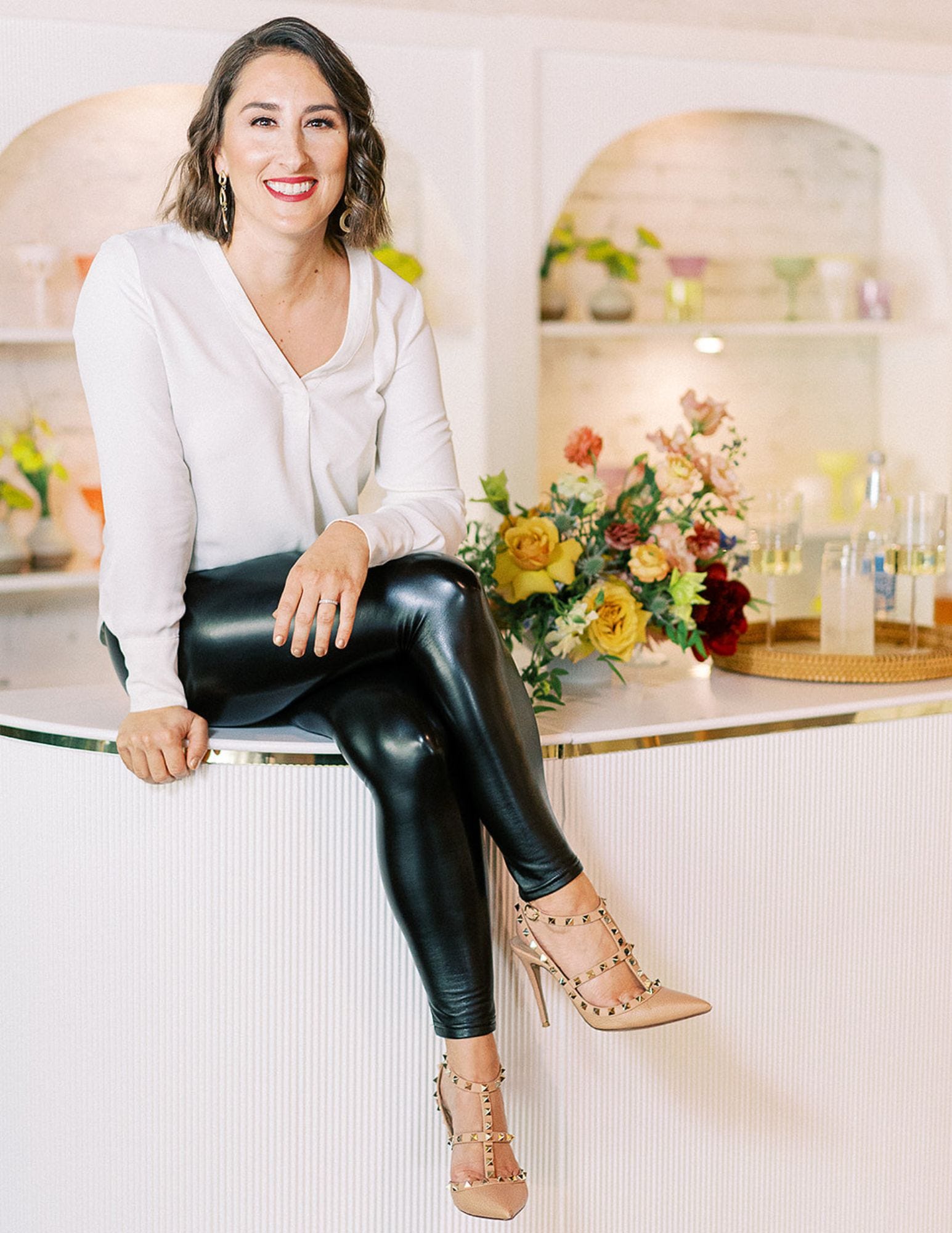
I was introduced to Vivant Rentals when I photographed a wedding that sourced rentals from them. I went down a rabbit hole, and quickly realized that Lindsay shared many of the same values and priorities that I hold. I’m thrilled she said yes to an interview—it’s one of my favorite to date!
Follow Vivant Rentals via their website and IG.
→ First of all, tell me in your own words what you do for work, and why you do it?
We provide beautiful, residential interior design-quality rentals for weddings and events of all kinds. And the reason I got into this niche of the industry? I mean, I feel most people would say that they love events, right? Most people feel like it’s super glamorous. And having worked for a catering company and doing venue management and then rentals, I really felt like interior design for events ticked all my boxes. It was all of the things that brought me joy about spatial design and custom builds and making a space feel truly unique to that client. You can provide something that makes an event feel authentically true to a client and their vision. I feel like events bring so much joy to people. What a beautiful thing to be able to celebrate with your loved ones. Whether it’s a wedding or a birthday or even a celebration of life, I feel like we don’t normally celebrate things enough.
→ What does a typical day look like for you?
My typical day has changed a lot over the last few years because with three kids, I’ve had to take a step back from some of the workaholic parts of my life. I’ve spent a lot of time in therapy over the last few years trying to nail down what it look like to have work life balance. Every day is very different, but an average day right now is get up, get the kids moving, do school drop-off. And then I go into the warehouse and touch base with the guys, see where we’re rocking and rolling, and get some admin work done. And then I try to budget time for myself built into my workday. And that’s hard some days, but I try to try to do that each day and I think that’s been really helpful for my mental space.
→ In her book Dare to Lead, Brené Brown says that every person has just two core values that shape everything else that they do or believe. Do you agree with that idea? If you could boil your values down to just two, what would they be? How do those influence how you do your work & live your life?
When my husband and I got together, we decided that our mantra was going to be to “live a life of intention and live a life of no regrets.” That has become our core value system and how we make decisions. We both try to really put compassion at the center, which has played out with how we’ve done this business and the team that we’ve grown this business for. We’re very communicative about our intentions. And then we’re also trying to create a framework that feels like your humanity matters, your work life balance matters, your family outside of this job matters. And some of those things came from our travels around the world. Being dropped into all these different perspectives and contexts, and then you bring all that back and you realize that the US is all about over consumption, all about “me”.
Anyway, I don’t have just two, but the things in the back of my mind all the time are intentionality and leading with compassion.
→ The British author Alain de Botton has this famous quote: “There is no such thing as work-life balance. Everything worth fighting for unbalances your life.” I tend to agree with this idea, that work-life balance is an unhelpful goal, and we should instead think about aligned values and healthy rhythms in all spheres of life. What do you think about the phrase “work-life balance?” How do keep healthy rhythms & momentum going in both work and personal spheres?
I think that kind of resonates with “live a life of intention”, right? Is there such thing as a balance? Probably not. But what’s your intention? If I want to have a relationship with my children as they age and be a safe space for them, then I have to intentionally show up and be present for them. That’s not going to happen just because I want it to. And the same thing with finding a work-life balance. It’s not fun to feel like you don’t have the space to be intentional. We all go through stressful times, but how do you come back to that center?
Do I think that it’s possible to find a work-life balance? Yes, but I think it comes down to intentionality. Some people just really, really, really like to work. I really like to work. I am driven by ideas, and seeing those ideas come to life, and meeting needs in a market, and building relationships. All those things really are wonderful to me, but not at the expense of other things.
I’m a big believer in therapy. I totally dislike my therapist, by the way. I think that if you like your therapist, you’re with the wrong therapist. You need to not like your therapist. They need to be challenging you and helping you work through stuff. One of those things I’ve worked through is being able to come home and shut my work off. My therapist challenged me make certain decisions that seem really simple in hindsight, but in the moment it felt very scary—I started putting up an away message at 3:30pm every single day that said “I am in Mom Mode for the rest of the evening. I will look forward to responding to your email tomorrow when I’m back at the warehouse.” And you would not believe the number of people who replied to my away message with all kinds of responses, all positive. “I need to do this. This is amazing. How is this working for you? Like, I want to talk about this.” I had one person who said, “I wish my mom had done this when I was growing up.”
That small thing felt so hard for me to do because I thought, “I’m just checking out,” but I decided to do it, because they’re getting a response that is authentic and intentional, and it gave other people permission to do that, too. I have to manually turn it on and off every day, which is a good trigger for me. It’s like, “Okay, I’m ready to go. I’m going to sit down, going to focus.” It’s been helpful, because I have a hard time turning off. I feel that entrepreneurial guilt, like I must be accessible all the time. But I will happily give someone else permission to shut it down!
So is there a work life balance? No. But can you find intention with your time? Yes.
→ Some people argue that a focus on people and a focus on profit are competing priorities, but I love talking about the ways that running a relationship-first business aids in building more profitable, sustainable businesses. What do you think about this idea? Are they competing ideas? Why or why not?
I have spent a lot of time on relationships first, and I will say that I wish I hadn’t. And I mean that from this perspective:
When Vivant was growing, growing, growing, I was in the throes of babies, and the money’s coming in, and we were just throwing money at the problem and throwing money at the growth and throwing the money at this and that.
I worked with a business coach, and I was telling him, we have got to find the profit stability. Because we’re making so much money, but it’s not sticking. So I read a book called Profit First by Mike Michalowicz. I wish I would have read that earlier, because if I had started with profit first, it would have allowed me to build relationships with a stable footing.
To me, profit and people are not separate. To me they are fully combined. And I just wish that seven or eight years ago I had that perspective, because it probably would have been a much better thing that I’m learning now. Now I’m going through the profit first process, and we hit a reset button, and I allocated accounts where they needed to be. It is a huge mindset shift, and I realized from going through that that some of my relationships were hurting our bottom line.
We had become a crutch. Our guys were doing other people’s jobs, so we were paying overtime, our guys weren’t getting any downtime, they were disgruntled, and it was because we were trying to serve well within some of our relationships. We’d have planners who couldn’t make up their mind, never had a floorplan or an organized timeline, or would make last minute changes, like “Oh, I forgot we need 150 chairs, not 100, guys can you just go back to the warehouse?” And our guys would do it because we just wanted to serve.
And it really became a problem. It’s very hard to say no to people that you have built a relationship with and have been so supportive of you and that you love dearly and that you appreciate being part of their event… but they are really hurting our profit.
But a people-first business doesn’t just mean client-first, it’s also the people within our own organization. We’re not just focusing on making planners happy or the couple happy. We also need to make sure that internally we’re run people-first. That’s sustainability. We want a business that can continually sustain what we put out there. If we don’t keep our people happy, we can’t serve in the future. I’d rather be a $3M business operating at a high profit with a team that feels cared about, clients that feel cared about, and less stress, more focus, more intentionality, than a $10M business where everybody’s beat, everybody’s ragged, and we’re always screwing something up and we’re making $20k in profit.
That was something that a business coach helped me work through. He asked me, “where do you want to go?” And being the driven mind that I am, I was like, “5 million, 10 million, 25 million, lets go, go, go.” And he said, “Okay, but why?” And I never thought about it. It’s easy to get caught up in the revenue as the number to focus on. I hate all the influencer garbage and the noise on social media about how to have a 7-figure business. And I don’t give a shit if you’re a 7-figure business. I want to know if you have a 7-figure profit.
→ What are some ways that running a people-first business has benefited you? How has it benefited others?
Our goal is to always offer premium customer service. We have a couple of things that we focus on within our team. The first thing is that you express appreciation and you express need for improvement with a statement that includes a feeling, not an accusation. And we do that at the beginning of each of our production meetings. Everybody goes around and they have to make a statement of appreciation. I think that has allowed us to say we really care about each other. And the core group of leadership that we have, they all understand that we are trying to say yes as much as possible. And if we have to say no, then we need to do it with other solutions. We would never go to a planner and say, “We forgot this many chairs. Too bad.” Instead we would say, “Hey, we’re three chairs short, and here are my three options. And do you have a fourth option?”
And that has really allowed us to play into our next thing, which is when Vivant arrives on site, it should provide peace of mind. Doesn’t always work. We’re in events, sometimes we crap the bed. But the ultimate goal is how prepared can we be before we arrive on site? How well can we try to take care of a product? We’re striving for perfection, which is very hard. But I think that has built the relationship where people know even if we do mess up, we’re going to try to fix it. And you can trust that. You can trust the communication is going to be there. You can trust that things are going to at least have some sort of good solution. And also that we will accept feedback. I’m going to say this kind of tongue in cheek, but I think that a lot of times, planners are really quick to criticize their vendors, but not many of them listen to feedback in the same way. I’m like, “It would be really nice if you could have a floor plan for the guys, and then maybe they wouldn’t put things in the wrong place that you didn’t like them. Like, that would be great.”
→ Our culture and our industry is fast—trends come and go in the blink of an eye, and there’s just so much noise, especially on social media. It can be tempting to believe that the only way to stand out is to add to the noise, to follow trends, to make a bigger flash than our competitors. But what if you’re a quiet brand? I have written about the difference between Fireworks and Fireplace brands here. Would you say that your business is more of a fireworks display or a fireplace? How does that influence how you market?
I think Vivant is definitely a fireplace brand. I have a really close group of event girlfriends, and we were talking about how it’s hard as a business owner, especially in our industry where everything is new and different and everybody’s constantly trying to up the game. It’s not a bad thing. Right? How do you constantly evolve? But are we evolving in the right direction? And it’s hard not to get caught up in that. A lot of people come into the industry, and some of them are just going to be fireworks. They come in, they kind of make a splash, and then they’re out.
And it goes back to building relationships. Are you building something that’s consistent? Are you building a cohesive collection? This is very controversial, but I’m just going to say it, I do not like black with natural caning anything. I think it is so trendy. And everybody’s asking, can you bring this in? And I asked, “How many times are you going to use that?” And they’re like, one client. They’re going to pitch that to one client, and then they’re going to move on. And I said, that’s just not Vivant to me.
I’m not a trendy person by nature. And so for me, I feel like I’m a fireplace kind of of gal. And I feel like that’s how Vivant is as a business. You can come to us and you can get a classic dining chair, maybe a little funk, but not much. And some classic pieces, and they’re going to go with a lot of different styles and a lot of different color palettes. I always crack up when I say this, but I’m like, vanilla pays the bills. I love watching all of the people who are so creative and so bold and obsessed with color. And I love their collections that are so loud and vibrant. And I just know that it’s not me. It would not feel authentic to do that. And any client who came to me wishing for that, it just wouldn’t be a fit.
When people ask “How do I break into working with this planner or this designer?” I say, you have to be their event soulmate. If you’re meant to be, you will find them. You will work together, and you will be collaborative, and you will feel like your cup is full. We don’t get a ton of inquiries, but we get the right inquiries because our brand is on point. There is room for everyone in the market. But that’s why it drives me crazy when people spend all of this time curating a collection that is just the same as everyone else’s. I cannot fathom just bringing in whatever because it looked like somebody else was renting it a lot. I don’t want to be the Wal-Mart of rentals, and I don’t want to be in a race to the bottom for rental price.
→ How do you stay authentic when it often feels that “fake it ‘til you make it” energy is rewarded?
Have a really great group of girlfriends who talk you off the ledge. Truly. You need people to pump you up and tell you, “No, you don’t need to go left, you don’t need to go right, you just need to stay the course.” And that’s hard. People ask you for a lot of things that you just know aren’t necessarily authentically you. Imposter syndrome is real. When you look around and you see what other people are doing, you can start to question. You’re like, how are these people even affording this?
So when it comes to things like fake it till you make it, I only feel like people fake it till they make it if they are trying to be someone else. If you’re authentically who you are, and you know who you are, and you know what you want to offer ,and you know the brand that you want to curate and how you want to treat people, I don’t think that it feels like you’re faking it till you make it. I’ve never felt like I’m faking it. It’s always been, “This is what I want to do. This is who I am. This is the brand that I want to curate, and people are either going to pick it up or not.”
→ What is bringing you joy in your work right now?
For the first time in a while, I feel I have a very clear vision of where I want Vivant to go. I think that part of it is being overwhelmed with a young family, a growing business, and I feel like for the first time in several years I have really clear direction. I know it’s going to be a little bit rocky to get there, but I think it’s going to be worth it. A year from now we are going to be in such a different place, running in a much more efficient way and working with the right clients more and kind of letting go of some things. Letting go of fear of hearing now. That is bringing me joy.
→ If we were to meet here a year from now, what do you hope we would be celebrating?
I would like to have a very, very high-functioning team. That would be what I would want to celebrate. And having niched down even more into the clients that we want to serve and be serving them at a much deeper level. Because that’s where I want to go. That’s what is bringing me joy, that focus. I know that we can get there, but it’s going to take some hard decisions along the way, which is never fun. But it will be worth it.
→ Final question: what is the number one book you recommend to every creative entrepreneur?
The top three books that I would recommend to any entrepreneur would be Profit First by Mike Michalowicz. Start there, then go to Buy Back Your Time by Dan Martel, and then Unreasonable Hospitality by Will Guidara. If you do those three, in that order, it’s game over. Your business will be successful. Just between those three, you really get everything right. Time management, sacrifice, business responsibility, leadership.
Thanks for reading! This post is public so feel free to share it.
Comments
Nothing yet. Say the first thing.
Sign in to join the conversation.